
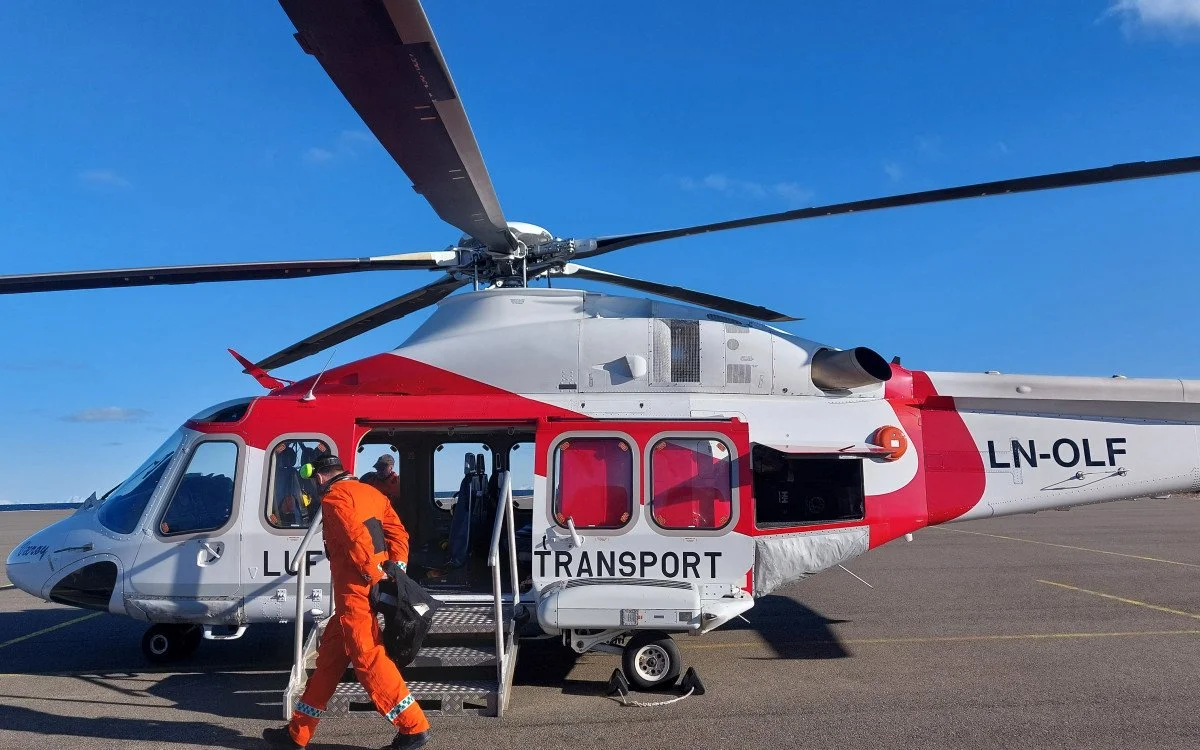
Lufttransport AS operates the helicopter route between Bodø and Værøy with a vessel that can accommodate up to 15 passengers. Photo: Julien Lebel
The island community needs a more varied and stable transport option. When the speedboat is not running, a helicopter could be the solution, a new research report shows.
A helicopter route to and from Træna would improve accessibility so significantly that it is conceivable that the benefits would outweigh the costs. This is one of the conclusions of the research report "Mobility challenges and improvement potential for transport to and from Træna - Analysis of the transport system on the Helgeland coast, benefits of improved transport services and a possible helicopter route".
The report was prepared by senior researchers Julien Lebel, Jens Ørding Hansen and Maiken Bjørkan at Nordland Research Institute , as a contribution to the EU project EmpowerUs. The project has aimed to co-create solutions to challenges in European coastal communities, and in Norway, Træna has been a partner and guinea pig.
Both the project and the report firmly state that reliable transport systems are essential for people to stay or settle in Træna and all other coastal communities. Along the Nordland coast, transport challenges are many and the potential for improvement is great.
Great potential for improvement
Traveling to or from Træna can be a complex affair. The first challenge is getting to the mainland. You need to have the weather on your side and a speedboat without technical problems. If you then rely on getting on by bus, train or plane, you will have to prepare for a significant wait, perhaps including accommodation.
“Today, the transport system is not sufficiently coordinated. The boat does not necessarily correspond to the bus, which in turn does not necessarily correspond to the train or plane,” says Julien Lebel.
– The lack of a transfer guarantee also means that you have to plan extra transfer time to be sure of catching the next departure. This applies especially to departures by train and plane, and may mean that you have to leave Træna the day before.
Lebel has good news, though.
– The potential for coordination is good and completely achievable. In other places in the world, such as Switzerland, the transport system works seamlessly, so it should also be possible in Nordland.
Helicopter route not impossible
Nordland still has its own peculiarities. The coast is long and the sea is rough. The weather can be capricious and challenging. For the express boat to Træna, cancellations have been recorded for over 70 days each year for the last three years.
At Træna, they want a more reliable alternative, not as a replacement for the boat routes, but as a supplement.
“Speedboat, ferry and helicopter are different offerings with different technical aspects and ways of operating. Although a helicopter route will also be affected by the weather, it will contribute to a more stable and diversified transport system,” says Lebel.
– The potential for a helicopter route between Træna and the mainland is certainly present, and the route operated by Lufttransport between Bodø and Værøy is a relevant example.
Flying a helicopter is expensive. A simple solution is for a helicopter route involving Træna to be integrated into the Ministry of Transport's list of so-called FOT routes. FOT stands for public service obligations, is subsidized by the government and sets requirements for, among other things, maximum ticket prices. The helicopter route between Bodø and Værøy is included in the FOT scheme.
– In addition, it is relevant for Træna Municipality to consider cooperation with neighboring municipalities, especially Lurøy and Rødøy, to establish a helicopter route that can serve more islands and provide more passengers. Such cooperation also provides greater leverage to get such a route in place, says Lebel.
Difficult with lasting offer
Despite warnings from both Researchers and business, Nordland County Council has decided to weaken the express boat service along the Nordland coast, which will hit Træna hard.
In the report, the researchers have examined an alternative called "community-driven transport services."
“To address the lack of transport services, several small communities in Europe have run initiatives based on local efforts. Transport services are run by enthusiasts in the local community, without the aim of financial gain,” explains Lebel.
In Træna, for example, one could imagine that people who travel by their own boat would inform about the trip so that other residents could join them.
“But there are regulatory and economic aspects that create challenges for establishing such services. In addition, they must not be used as an excuse for even less support for public transport services financed by the authorities,” says Lebel.
– The social engagement of the residents is also crucial, especially in order to put in place a lasting and stable offer, which can be a clear challenge in small communities with limited resources, such as Træna.
Must retain its uniqueness
A reliable transport system is important for Træna, both for the local population, businesses and the growing tourist traffic. The report shows that the number of travelers to Træna is increasing.
– The municipality's goal is increased settlement, but at the same time Træna should still be Træna, a place far away from the mainland, a place for those with special interests, says Lebel.
– The point of a stable and diversified transportation system is not that Træna should become like places closer to the coast, but that the island community should retain its uniqueness, while making it easier for people who live there to travel to and from, which increases the desire to live and stay.
