
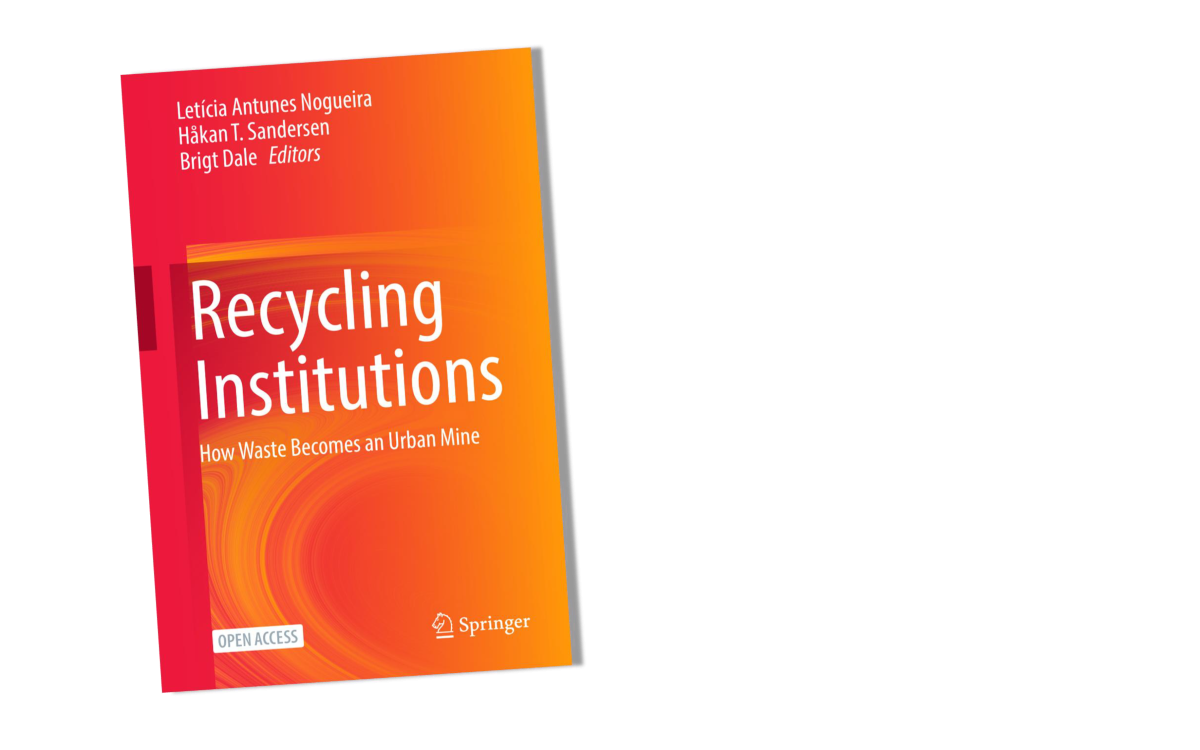
The book "Recycling Institutions: How Waste Becomes an Urban Mine" is now out in the world, with contributions from a number of Nordland Research's wise minds.
– The book examines how waste can become a resource through institutional changes, and how urban mining, i.e. the extraction of valuable materials from man-made reserves, can contribute to a more circular economy, with Norway as the main case, says Brigt Dale, research leader at Nordland Research Institute and editor of "Recycling Institutions", together with Håkan T. Sandersen from Nord University and Leticia Antunes Nogueira, Nordland Research Institute .
– We illuminate the concept of urban mining from a number of perspectives and show that infrastructure and institutions are crucial for changing people's environmental behavior, and that practice often shapes attitudes - not the other way around; households' work with sorting and recycling is central to this process, says Dale.
The book is a result of the research project "UrbanMine: Institutionalisation processes in times of circular green transitions", which was led by professor at Nord University, Berit Skorstad.
– Skorstad was an outstanding environmental sociologist who led the project with great commitment until her death in 2023, and this book is dedicated to her memory and professional legacy, says Dale.
– She combined academic depth with warmth and humor, and her research on norms, environmental behavior and shame as a driving force has had great significance for Norwegian environmental sociology.
Below you can read how the authors from Nordland Research Institute summarizes his contributions to the book.
Chapter 3: Urban Mining as Institutional Collective Action
Author: Arild Gjertsen
What is the theme of the chapter?
The chapter examines how urban mining is understood and managed in Norwegian municipalities through inter-municipal cooperation. The study shows that the term urban mining is often confused with more general concepts such as circular economy, and lacks both political anchoring and institutional clarity. There are few cultural and normative frameworks that support the development of urban mining as a separate policy.
What significance does this topic have for recycling valuable natural resources?
This is important for the recycling of natural resources, because a lack of understanding and regulation prevents the efficient use of waste as a resource. Regulations are often perceived as restrictive, and the market develops faster than legislation. Municipal purchasing power is highlighted as an important tool for promoting sustainability, but requires expertise and a willingness to prioritize environmental concerns.
What challenges have you highlighted that we face on the path towards a more circular society?
The chapter highlights several challenges on the path towards a more circular society: weak information flow between municipalities and intermunicipal companies, asymmetry between large and small municipalities, and lack of political debate and ownership. At the same time, it points to opportunities for experimentation and development of new policy initiatives, provided that some actors take the lead and that national authorities contribute to strengthening the institutional framework.
Chapter 7: Urban Mining Down to Business - Exploring the Organization and Competition in Take-Back Systems for Electric and Electronic Waste
Authors: Letícia Antunes Nogueira, Stian Bragtvedt and Louise Brøns Kringelum
What is the theme of the chapter?
This chapter analyses how the introduction of extended producer responsibility (EPR) for electrical and electronic waste (e-waste) in Norway has created a complex and competitive market. It focuses on how different actors – such as producer responsibility organisations (PROs), municipal waste companies and private actors – organise material flows and compete for access to waste and members. Our chapter shows how regulation has led to the establishment of business ecosystems with different understandings of value and objectives.
What significance does this topic have for recycling valuable natural resources?
The topic highlights how e-waste, which contains valuable and often scarce materials, can become a resource through urban mining. The EPR system facilitates collection and treatment, but competition between actors can both promote and inhibit efficient resource utilization. To realize urban mining on a large scale, institutions must be further developed so that they support material recycling and value creation, not just waste management.
What challenges have you highlighted that we face on the path towards a more circular society?
The chapter points to several challenges: fragmented responsibilities between actors, lack of incentives for optimal resource utilization, and competition that can lead to inefficiency or "cherry-picking" of valuable waste. There is also a risk that peripheral areas will be less well served. To support a circular economy, institutional change must occur that includes new norms, incentive structures, and a more holistic management of the value chain.
Chapter 8: Urban Mining in the Built Environment: The Role of Local Supporting Institutions
Authors: Jens Ørding Hansen and Bjarne Lindeløv
What is the theme of the chapter?
While the term urban mining is usually associated with electronic waste, our chapter focuses on the reuse and recycling of larger construction materials such as concrete. A key point of the chapter is that since such materials have a lower market value and are heavier and more expensive to transport than electronic waste, local recycling solutions are crucial for this type of urban mining. We draw on experiences from the EU project CityLoops, where cities in Norway, Denmark, Finland and the Netherlands tested different initiatives to increase reuse and recycling in connection with construction and demolition projects. The main theme is how local institutions, regulations, norms and cooperation can support the transition to a more circular use of construction materials.
What significance does this topic have for recycling valuable natural resources?
Concrete, soil and other materials used in construction are very resource- and energy-intensive to extract. Local reuse significantly reduces both greenhouse gas emissions and pressure on ecosystems. Our chapter shows that when local institutions facilitate cooperation, quality assurance and infrastructure development, local recycling of construction materials can become both economically viable and practically feasible. Urban mining of such materials thus contributes to extending the life cycle of the materials, reducing waste volumes and ensuring continued access to resources that would otherwise have to be obtained directly from nature.
What challenges have you highlighted that we face on the path towards a more circular society?
The construction sector is a conservative industry, and private contractors often perceive the reuse and recycling of construction and demolition waste as more costly and risky than the use of new materials. Experience from the CityLoops project shows that quality assurance and collaborative contract forms that reduce the contractors' risk are crucial to promoting reuse and recycling. Furthermore, this type of urban mining requires local storage capacity for the extracted materials, but land scarcity and competing land uses make this complicated, as an example from Bodø illustrates. In this chapter, we emphasize the importance of institutionalizing circular practices in municipalities to ensure lasting impact.
Chapter 10: Extractivism (Dis)Continued? Urban Mining as a Transformative Practice
Author: Brigt Dale
What is the theme of your chapter?
The starting point is the tension between the need for green solutions in the face of climate and natural crises, and at the same time a continued global dependence on resource extraction to maintain economic growth. I examine whether 'urban mining' can represent a real alternative to extractivism (that is, an extraction logic or resource extraction ideology), i.e. a break with the traditional growth logic, or whether it in reality only continues an old mindset in a new form, a mindset where growth is based on us consuming beyond the planet's carrying capacity. The chapter also discusses the relationship between green energy transition, the need for critical raw materials (such as cobalt, lithium and rare earths), and the ideological and social dimensions that lie in our way of thinking about natural resources.
What significance does this topic have for recycling valuable natural resources?
The topic is directly relevant to recycling and reuse, because urban mining offers a way to reduce pressure on natural resources by utilizing already existing “hibernating stocks” – materials that lie unused in buildings, infrastructure or waste. At the same time, the chapter points out that while urban mining may be part of the solution, it is not sufficient on its own. Recycling must be combined with a more fundamental downscaling of resource consumption if we are to stay within the planet’s carrying capacity.
What challenges have you highlighted that we face on the path towards a more circular society?
Even though the materials come from cities and waste, we risk perpetuating an ideology of unlimited growth and consumption. 'Urban mining' can thus become “just another type of mining” if it is not combined with reduced resource use. For the amount of materials that can be extracted from anthropogenic sources is itself finite, just like natural resources. 'Urban mining' can delay depletion, but cannot replace the need for a fundamental restructuring. We also see that the need for different minerals changes with new technology (e.g. transition from lithium to sodium-based batteries), which makes future needs for certain types of minerals unpredictable. This also poses a challenge when investing in recycling specific materials that are needed today, but which may be outcompeted in the future. 'Urban mining' can also create new “victim zones” in urban areas, where vulnerable groups are affected by the pressure on land and materials, in the same way that traditional mining affects local communities on the periphery.
