
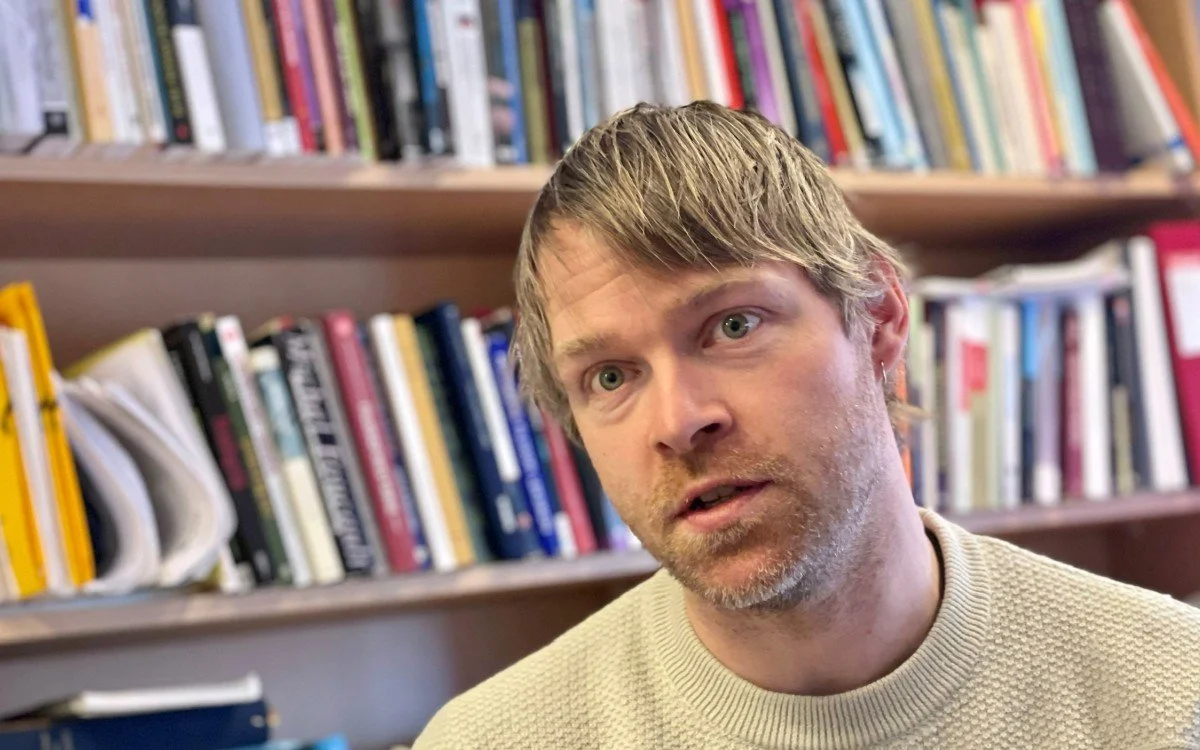
Senior researcher at Nordland Research Institute , Esben Olesen, is one of the editors of the book "Towards better cooperation? - Observations from studies of Norwegian welfare services". Photo: Thoralf Fagertun
Collaboration is often promoted as the path to good health and welfare services, but blind faith in collaboration can overshadow the problem that should be solved.
Collaboration, as well as related concepts such as interaction, coordination and co-creation, have become a trend in Norwegian welfare policy. Over the past 25 years, six reports to the Storting and five NOUs have been produced within the health and welfare field with these concepts as their main focus. They are also found in the Research Council's calls for proposals and steering documents, as well as in education policy.
This is revealed in the book Towards better cooperation? - Observations from studies of Norwegian welfare services , which was published by Universitetsforlaget last year. The authors are critical of whether cooperation is always the right medicine.
– I would say that you should only collaborate when it is absolutely necessary, says Esben Olesen, senior researcher at Nordland Research Institute and one of four editors for the book.

Together with Christian Lo, who is both an associate professor at Nord University and a senior researcher at Nordland Research Institute , he has written the chapter "When collaboration becomes both a solution and a problem."
Collaborating to collaborate
Olesen and Lo take as their starting point the concept of "wicked problems" and the tendency to use collaboration to solve such complex problems.
The idea is that intractable problems do not have right or wrong solutions, they are burdened with values and how one understands the problems colors whether one considers different solutions to be good or bad. The term was originally used to refer to, for example, the location of a highway, adjusting tax levels, combating poverty and designing education.
Over time, the concept of intractable problems has found its way into areas other than its original ones, including the Nordic welfare state. Providing services that cover all health and welfare needs of the population, in an equal and fair manner, is considered to be such an intractable problem.
But the ideal has not been realized.
Even after decades of lack of effect, the authorities still insist that collaboration is “the measure that will bridge the gaps that cut through the service landscape,” as Olesen and Lo put it.
“If it doesn't work, it's because we're not cooperating well. In the end, we're just cooperating to cooperate, not to solve the problems,” says Olesen.
– We argue that it is the way in which the service offering is organized that makes the ideal of a comprehensive service offering unattainable, not the lack or quality of cooperation between the various services.
Different understanding of the same patient
So how are services organized? By specific issues, such as diagnosis-specific, work-specific, age-specific, culture-specific, and social-specific. This leads to a rather fragmented and specialized landscape, where services must collaborate with each other to meet the needs of patients with more than one single challenge.
– Unfortunately, collaboration between different services does not automatically create comprehensive and coherent service offerings, says Olesen.
– Users with complex service needs risk having the focus placed on collaboration, not on the users' actual problems or needs.
Olesen explains that it is far from certain that an obese, terminally ill, depressed 92-year-old person will need help from the cancer department at a hospital, a psychologist, and a nutritionist.
– It may be that Olga needs to talk to a psychologist about her imminent death, rather than having to deal with all sorts of specialists, each with their own understanding of her situation, says the senior researcher.
– Collaboration is very expensive and requires a lot of coordination to be carried out well. You should really think before collaborating.
