
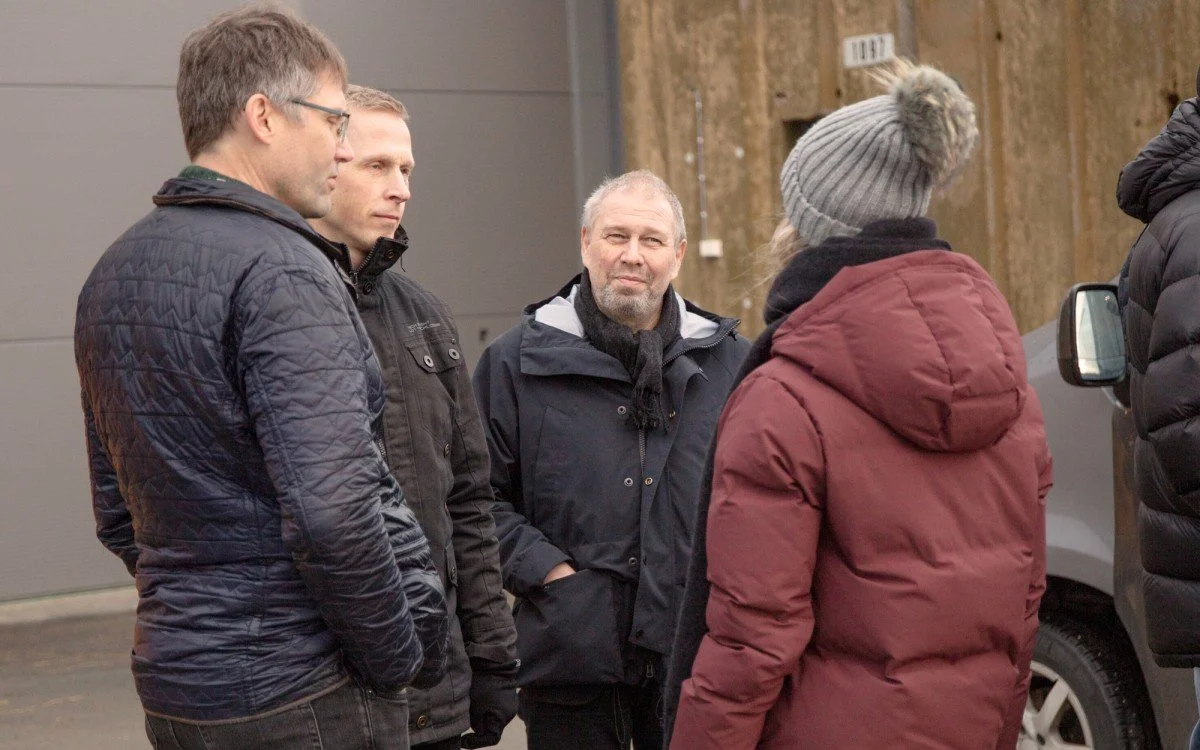
Nordlandsforskning's Bjarne Lindeløv (center) with colleagues in the HYBES project. Photo: Marta Anna Løvberg
Through the research project HYBES, Nordland Research Institute and Bodø Municipality to find out how buildings can produce as much energy as they use.
Text: Thoralf Fagertun ( Nordland Research Institute ) and Sigrid Rask Sørensen (Bodø Municipality)
Nordland Research Institute is leading the work on the European research project "Hybrid energy solutions for buildings, and infrastructure" and has Bodø Municipality on the team. The project will develop new methods to make buildings more energy efficient and environmentally friendly.
– In HYBES, we will develop energy solutions that help buildings produce as much energy as they consume. This is to enable cities to reach their climate and energy goals, says project manager Bjarne Lindeløv, and continues:
– These will show how the use of flexible and renewable energy systems can enable us to achieve the goal of establishing zero-emission neighborhoods. The energy systems are tested in combination with energy storage, with a focus on challenges in Arctic areas.
New systems for stable electricity
HYBES builds on the Elighthouse project, which ended in 2019. This time the partnership consists of institutions from Norway, Sweden, the Faroe Islands, Iceland and Ireland. While the Icelanders naturally focus on the opportunities inherent in geothermal energy, other partners are concerned with energy-efficient buildings or transportation in the form of electric vehicles.
– The project investigates how to build an infrastructure of renewable energy sources that provides a stable system, says Lindeløv.
So the power must not disappear because too many people decide to charge their cars at the same time.
“The infrastructure we have now will not withstand the energy needs of the future. Therefore, we need flexible solutions that are organized in such a way that the system does not collapse,” says Lindeløv.
Knowledge is created and spread
One of the most important learning points from Elighthouse was that good solutions are of little use if society does not adopt them. HYBES is therefore dedicating an entire work package to raising awareness among citizens, municipalities, energy producers and businesses - in fact, society as a whole.
– The transition must be anchored in those who will go through it, so raising awareness is a very important part of the project, emphasizes Lindeløv.
HYBES also has a clear ambition to spread the knowledge from the project beyond the partnership.
– For Norway, this applies to the whole of Nordland, all 41 municipalities. The same ambition applies to the partners in the other countries. We call it a capitalization plan because society will benefit from the knowledge the project develops, says Lindeløv.
– In addition, we are committed to raising awareness among future generations and will develop educational modules for high school.
Testing solutions on municipal Bodø buildings
Bodø Municipality will test energy solutions in municipal buildings. Initially, Mørkvedbukta School and Stadiontunet Nursing Home will be used as cases in the research project.
– The municipally owned buildings have already adopted modern energy solutions. The project will explore how Mørkvedbukta School's solar energy can be combined with energy wells, and how Stadiontunet Nursing Home can adopt solar panels. This can help the buildings produce as much energy as they use, says Julie Hinderaker Hagevik, project manager for research and development at Ny By Ny Flyplass.
Advanced technology
Bodø Municipality has a digital twin of the city. This will be actively used in the project. Tor Gausemel Kristensen works on several EU projects in Bodø Municipality, and actively uses the tool to visualize data.
- A digital twin of Bodø is a kind of visual copy of the city. We will use the technology to measure and visualize the energy consumption of the buildings involved in the project.
- This way we can know how much electricity the buildings use, and how much they have to produce themselves. This can help us understand which solutions can be implemented to achieve the goal of zero-emission neighborhoods.
