
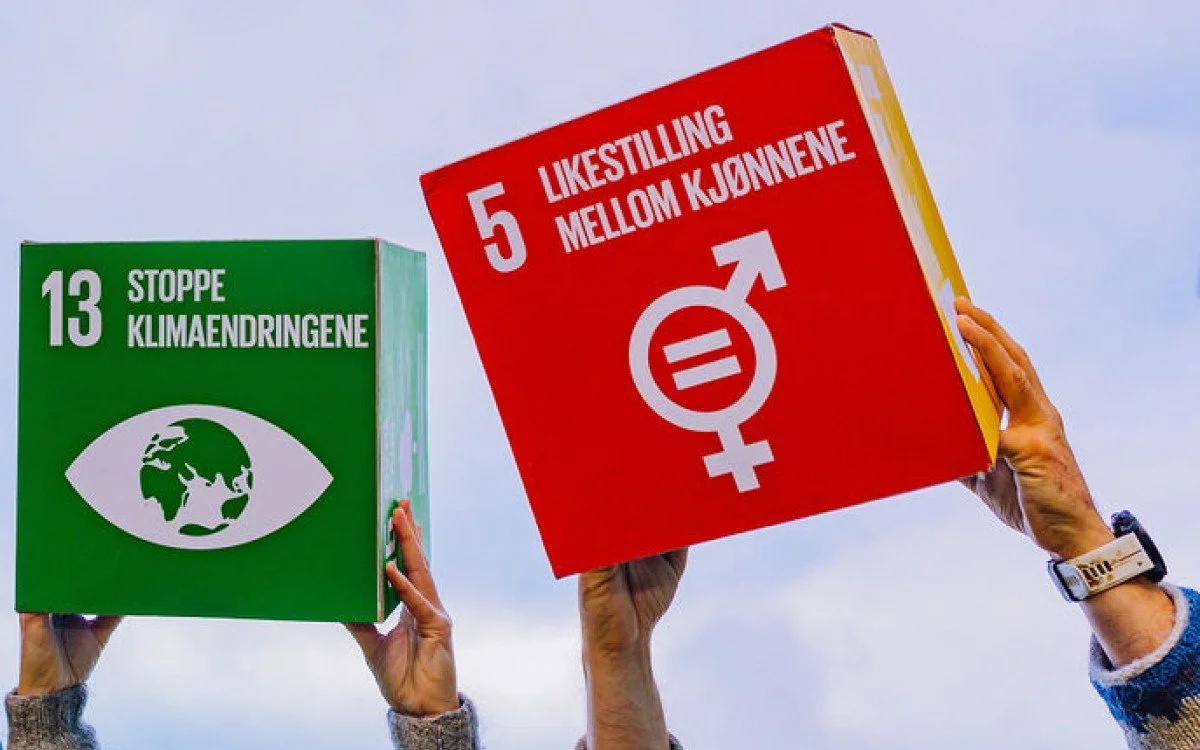
The research project SEQUAL connects Sustainable Development Goal 13 with Sustainable Development Goal 5. Photo: Karoline OA Pettersen
While men have higher greenhouse gas emissions than women, women are more willing to support political measures that reduce emissions. However, this is not reflected in the authorities' climate action, where gender perspectives are virtually absent, shows the research project SEQUAL.
SEQUAL looks at how climate policy can be more effective if it includes gender perspectives. However, such perspectives are lacking in Norwegian policy documents.
In a review of reports to the Storting, NOUs, state budgets and reports on the follow-up of the UN's Sustainable Development Goals in Norway, researchers Aase Kristine Lundberg, Helga Eggebø and Mari Teigen have looked for links between climate, gender and equality.
But such links are virtually absent in Norwegian climate policy.
– And why is this a problem? Because women and men affect the climate to different degrees, says Lundberg, who is a senior researcher at Nordland Research Institute and internal project manager for SEQUAL.
– With men's higher average income comes higher consumption and emissions of greenhouse gases. There are also gender differences between women and men's attitudes towards climate change, climate risk and their willingness to support political measures that cut emissions. Excluding this perspective from climate policy may lead to less effective climate measures.
Not lifted forward
The Norwegian Environment Agency, the Norwegian Public Roads Administration, the Norwegian Coastal Administration, the Norwegian Directorate of Agriculture, the Norwegian Water Resources and Energy Directorate and Enova have investigated various measures and instruments that can help Norway meet its emissions targets for 2030. The findings are presented in the 1,196-page report "Climate Cure 2030". The report forms the basis for the Climate Report adopted by the Storting in 2021.
– In one of the appendices we find traces of a gender perspective, says Lundberg.
– This is one of the very few places in Norwegian policy documents that gender perspectives can be found. Otherwise, it is largely silent.
"Climate Cure 2030" presents a number of measures for reducing emissions, including in agriculture. The point is to find the measures that are most cost-effective, that is, to identify the cheapest ways to cut emissions.
– The proposals are largely about technology and quotas, and there is strikingly little focus on people. One of the few places where gender becomes relevant is related to people's eating habits and diet, says Lundberg.
– Men eat far more red meat than women. Women are also more open to changing their eating habits, switching to a more vegetarian diet and increasing the proportion of fish in their diet.
Changing your diet is one of the simplest and most socio-economic ways to cut emissions.
– Gender differences are obviously present, but are not highlighted, they are not considered important, says Lundberg.
Rare research
Gender perspectives in climate policy are not a new invention, but have largely focused on the Global South.
– There is a lot of research that documents that women in the Global South face particular challenges in dealing with climate change. In the Global North, gender perspectives have not been as prominent, but here we see a change. Both Researchers and bureaucrats have become more concerned with it, but politics is lagging behind, says Lundberg.
The research project SEQUAL and the article "Gaps and Silences: Gender and Climate Policies in the Global North", which Lundberg, Eggebø and Teigen have written based on knowledge from the project, are therefore a step in the right direction.
The background for SEQUAL is a call from the EU's gender equality program GENDER-NET Plus, where the UN's Sustainable Development Goal 5 on gender equality was to be linked with either Goal 3 "Good health and quality of life", Goal 9 "Industry, innovation and infrastructure" or Goal 13 "Stop climate change".
– Our project was the only project that linked gender equality with climate and received support, says Lundberg.
– We wanted to see what happens when you include the gender perspective in climate policy in the Global North, in societies that are traditionally far ahead when it comes to gender equality.
Empty politics
After examining thousands of pages of climate documents, Lundberg and co have made some interesting observations. One is that a gender perspective is largely not included anywhere.
– We also see that much of climate policy is not about people. The spotlight is on the emissions trading market, atmospheric processes, technology and market mechanisms. But people are rarely mentioned when talking about climate change, says Lundberg.
The researcher points out that a gender perspective on climate policy opens up the possibility of looking at how climate measures affect different parts of the population differently.
– For climate policy to be both effective and fair, it is necessary to include perspectives on social inequality, such as gender, age, place of residence and ethnicity, says Lundberg.
– Emissions-reducing measures must be legitimate, and then people must also be included in the analyses of the measures.
