
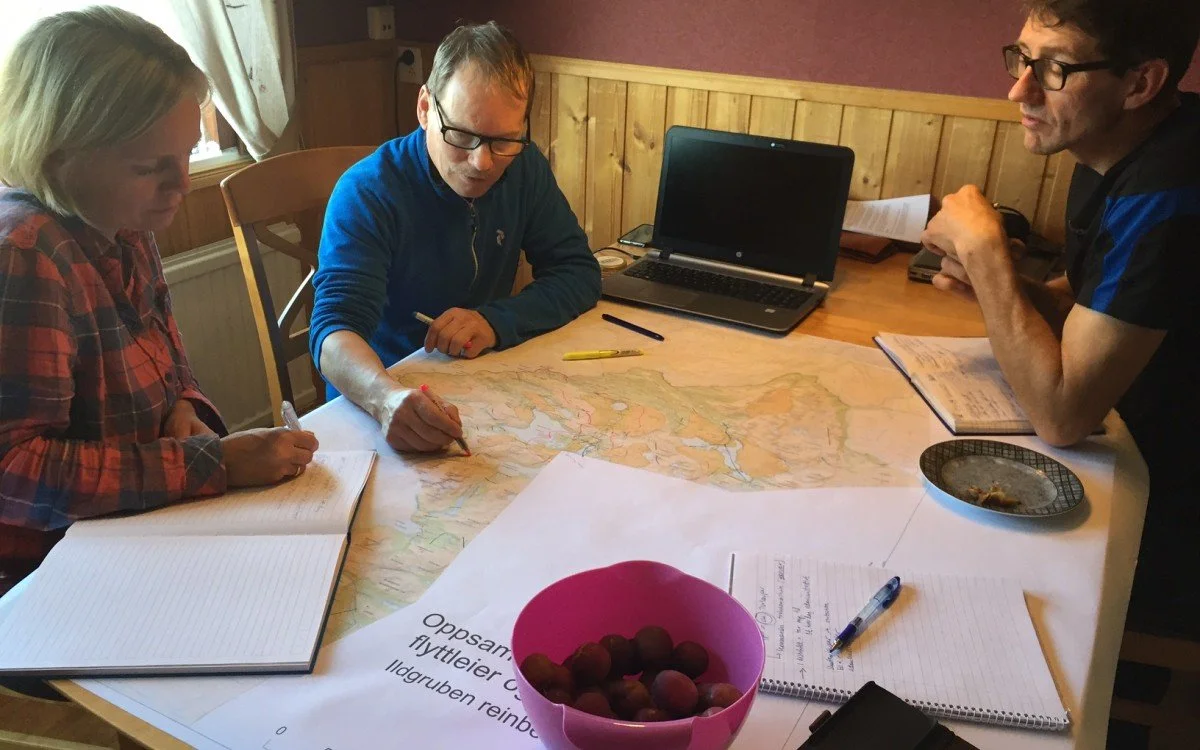
Camilla Risvoll ( Nordland Research Institute ), Tom Lifjell (Ildgruben Reindeer Herding District) and Svein Morten Eilertsen (NIBIO) are working together to include traditional knowledge in reindeer herding maps. Photo: Aase Kristine Lundberg
When developers, impact assessors and planners interpret reindeer herding land use maps, they may misunderstand the needs of reindeer herding. Maps that include traditional and experience-based knowledge help to solve challenges before they arise.
Loss of area and fragmented pastures is one of the biggest threats to Sami reindeer herding.
– Reindeer herding is experiencing that developers, impact assessors and planners do not capture the complexity that exists in reindeer use of the landscape and thus risk interpreting reindeer herding maps incorrectly, says Camilla Risvoll, senior researcher at Nordland Research Institute .
Risvoll co-wrote the article "Maps and stories in the creation of richer accounts of change in pastoral landscapes in Nordland, northern Norway" (2022) and the report "Traditional and experience-based knowledge in reindeer herding land use maps" (2022).
– Both reindeer herding practitioners and the administration have pointed out the need for more detailed reindeer herding maps that better capture the diversity in the use of reindeer grazing areas and the changes that affect the grazing, says Risvoll.
Together with stakeholders from reindeer herding and research colleagues, they have worked to find ways to integrate reindeer herding knowledge into the maps.
Easy to misunderstand
But why are better maps so important? Part of the answer to this question can be found in the challenges faced by the reindeer herding industry in recent decades.
“Loss of area and fragmented pastures are one of the biggest threats to reindeer herding,” says Risvoll.
– Available pastures are constantly being reduced due to encroachment and disturbance from human activity. Reindeer herders are increasingly having to spend large resources on keeping reindeer away from dangers such as railways, roads, various developments and a high level of predator pressure. This is in addition to an increase in very challenging snow and ice conditions in recent years, she says.
All of this leads to changes in the reindeer's access to natural pastures and their ability to follow their natural migration patterns, which is very difficult to illustrate on a map without having first-hand knowledge available. This knowledge is available to reindeer herders.
“Today's map does not show how the overall effects of changes in the landscape affect reindeer,” says Risvoll, citing flaky necks as an example.
A number of different interventions can create a bottleneck along a migration and migration route. Bottlenecks can be natural narrow passages or man-made bottlenecks that reindeer have difficulty passing due to disturbances or technical interventions.
Such bottlenecks can, for example, prevent reindeer from moving between seasonal pastures, but are invisible on today's maps. Developers or planners may therefore believe that areas that are actually important for reindeer are free for new activity, says Risvoll.
Should not replace dialogue and consultation
The experience and knowledge that reindeer herders possess through living in and using the landscape is invaluable for the development and interpretation of land use maps. The current standardized system of land use maps does not capture the changing use of the land by reindeer and reindeer herding throughout the reindeer herding year.
– There will always be major limitations in how the complexity and dynamics that unfold in the landscape, such as seasonal variations, topographical conditions, human activity and environmental and climate change, can be expressed in today's land use maps, says Risvoll.
– A map material where the experience-based knowledge of reindeer herding is better integrated will create a better basis for making decisions, while at the same time reducing the consultation burden for reindeer owners.
Risvoll emphasizes that this work does not aim to be completely complementary and replace consultation.
– Rather, it should be an aid, so that reindeer herding does not have to explain the most basic principles surrounding land use in the reindeer grazing district throughout the reindeer herding year every time someone plans an intervention within the district's borders, says Risvoll.
