
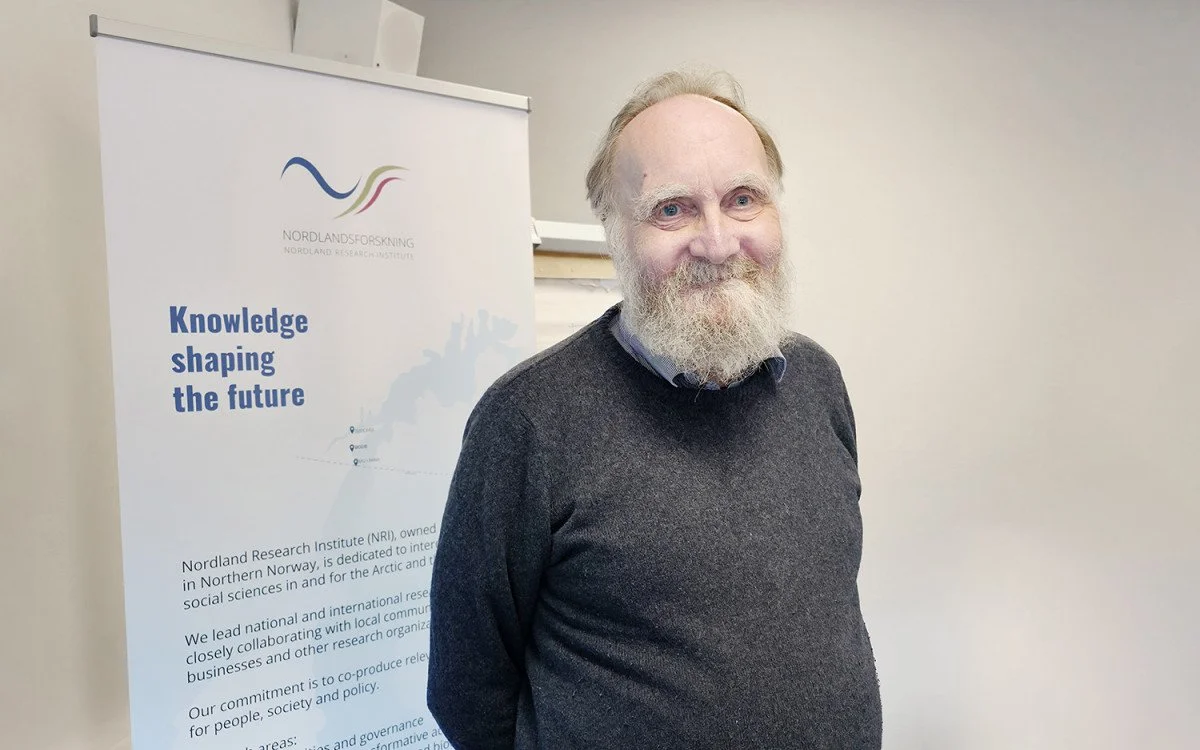
Åge Mariussen. Photo: Marta Anna Løvberg
Behind significant national innovations, such as the oil terminal in Hammerfest and the establishment of the Research Council of Norway, lie analyses made by wise minds. One of these minds belongs to Åge Mariussen (75), who is now stepping down Nordland Research Institute .
Politicians smile on the front pages, but the decisions they make require thorough impact analyses and visionary thinking. Throughout his long career, Åge Mariussen has paved the way for innovative solutions in society.
– I have worked continuously with regional development and innovation throughout my professional life, says Mariussen.
And he will continue to do that in his own company, but the time in Nordland Research Institute is over, after two memorable periods at the institute. It is time to settle the estate.
The Food Sociologist
You'd have to have a pretty sharp ear to tell that Åge Mariussen is from Nesna. But that's where it all started.
– When we moved to Rakkestad and no one at primary school understood what I said, it became an Eastern Norwegian dialect, he explains.
His schooling went well, however, and when the time came, Åge began studying sociology at the University of Oslo.
“The 1960s were a fun period, with large student influxes. Sociology was suddenly a popular subject, even though there wasn't a single sociologist in the workforce,” he says.
– So none of us knew what we were going to be, but we realized that we had to work at university.
But in a sea of sociologists, Åge managed to stand out.
– I combined sociology with mathematics and mathematical statistics. It was very unusual.
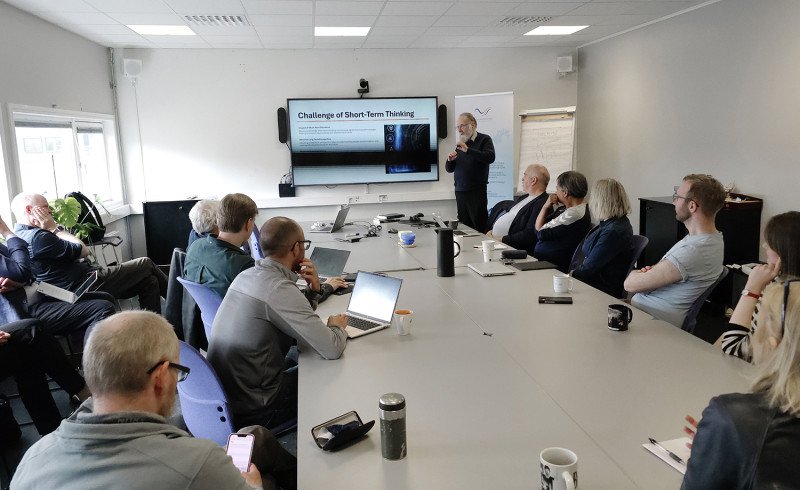
Åge Mariussen did not leave Nordland Research Institute without any well-chosen words, through the lecture "Analyzing multi-level structural change: Designing experimental strategies". Photo: Marta Anna Løvberg
The combination of social science and mathematics would prove to be very useful in the work on regional development that lay just ahead of him.
Join the oil adventure
A few years later, Åge had swapped Oslo for Tromsø. He was the first social scientist in a research institute that focused on research into salmon and salmon disease. However, oil soon took over the main role.
– I worked on regional economics and the societal effects of oil, on behalf of the oil sector and the Ministry of Petroleum and Energy, says Åge.
The Nesnaværing was allowed to play a role in the Norwegian oil adventure, in the phases prior to the establishment, where discussions raged and politicians demanded sharp impact analyses. And they got it.
– I was involved in the process that led to the oil terminal being built in Hammerfest. I sat on a committee, made the proposal and it was followed, even though many alternatives were up for discussion, says Åge.
– In retrospect, it has turned out that my analyses were correct. I was able to predict how many jobs the establishment would bring to Hammerfest.
A good idea
Åge also had a hand in the establishment of the Research Council of Norway. In the 1980s, he worked on developing a knowledge base for the aquaculture industry.
“At that time, each ministry had its own research council. Every time a fish farm was to be launched, it had to have approval from all possible ministries, each of which had its own views on what knowledge was important to produce,” says Åge.
– It was a major decision-making problem. I wrote a report in which I recommended one common research council, not six different ones.
That idea appealed to the then Minister of Church Affairs, Education and Research, Gudmund Hernes, who established the Research Council of Norway in 1993.
– I take some of the credit for that, says Åge. – People have listened to me.
A critical round trip
At this time, Åge had for the first time found his way to Nordland Research Institute , where he worked as a research director. The institute had recently been established and soon received plenty of assignments.
– We ran several large projects with a profit and had good contact with both the Ministry of Local Government and the Research Council. Those were good times, both financially and professionally, says Åge.
After a few lucrative years, he was tempted to try new adventures and went to Nordregio in Stockholm. He was involved in some projects in the city of Bodø, and for a period had three jobs at the same time in three different countries.
– The topics were overlapping. It was about regional development strategies and I gained large networks in different countries, says Åge.
Among other things, he took on a number of assignments for the European Commission in Seville, which eventually led to a curious extra job.
– I traveled around Europe and evaluated regional development strategies together with the European Commission, says Åge.
– My job was to say unpleasant things. Since I wasn't employed by the commission, I could be really critical.
New country, same Åge
After traveling enough, Åge returned to Nordland Research Institute The last 30 years or so have largely been about regional development in Nordland, but the distinguished researcher has also been central to the start of the institute's EU adventure .
At the relatively mature age of 75, he can look back on a number of book publications and articles in international journals, as well as a myriad of reports and analyses.
And even though the office at Nordland Research Institute Now that the room is cleaned up (he even found a missing bicycle under a huge pile of papers), Åge is not putting his research hat on the shelf.
– I have moved to Finland and run my own company there. I offer analyses of regional development.
