
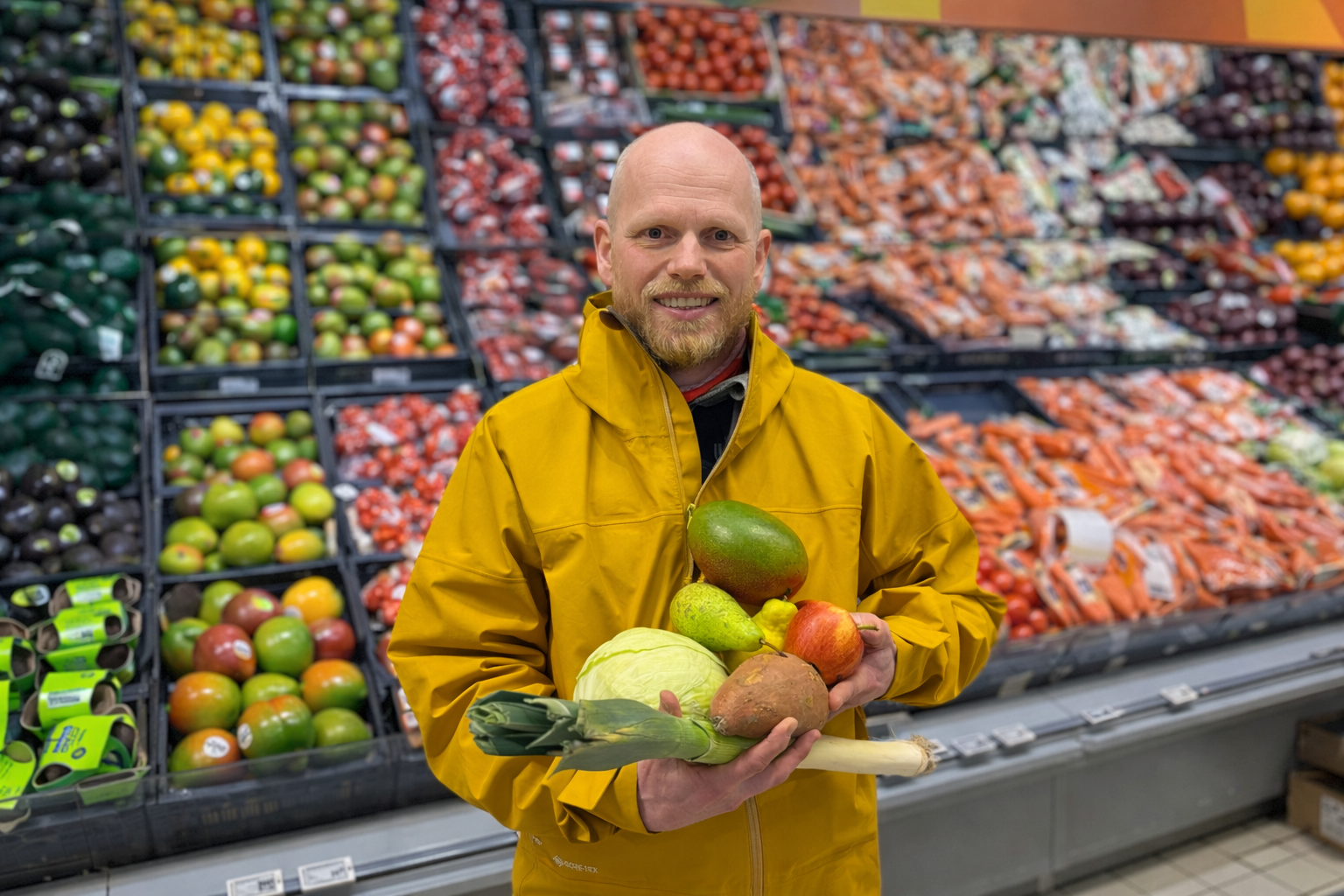
Busy with food production. Project manager Bjørn Vidar Vangelsten has worked with the use of local resources, local food and sustainability in food systems. Now he leads and Nordland Research Institute its first international project on the topic, which is part of the concept of agroecology. Photo: Tarjei Abelsen
This week, the partners in AgroPolis are gathering for a digital kick-off. The project, led by Nordland Research Institute , will develop new solutions for more sustainable food systems in Europe.
Text: Tarjei Abelsen
AgroPolis is the first major international food project to Nordland Research Institute coordinates.
– This is a milestone for us. We have worked a lot with sustainable food systems, local food and the use of local resources, but this is the first time we are working explicitly with agroecology as a concept and research field, says project manager Bjørn Vidar Vangelsten.
The project brings together partners from Norway, Sweden, Germany, Slovenia, Italy and Spain.
Shall strengthen local food systems
Agroecology is about more than how food is produced.
“It's about diversity, using local resources and creating good social and economic environments in agriculture. In a time when self-sufficiency and food security have become more important, agroecology can be a way to strengthen local food systems,” says Vangelsten.
He points out that much of the research on agroecology has focused most of its attention on food production itself.
– AgroPolis is special because we look at the entire value chain, from primary production to processing, storage, transport, market and consumer.
Facts about AgroPolis
AgroPolis stands for "Promoting AGROecology through co-creating value chain innovations and improved multi-level POLIcieS in a beyond-growth Europe".
Agroecology is about developing food systems that are more sustainable, resilient and based on local resources. It encompasses both how food is produced, processed, transported and sold, and how to create good social and economic environments in agriculture.
The project is led by Nordland Research Institute and project partners are Stockholm Environment Institute (Sweden), Institute for Climate Protection, Energy and Mobility (Germany), Free University of Bozen-Bolzano (Italy), Foundation for Participatory Sustainability (Spain) and Agricultural Institute of Slovenia (Slovenia).
AgroPolis is funded through the Agroecology Partnership, a collaboration between European countries to promote agroecology. The Norwegian part of the project is funded by the Research Council of Norway.
Testing solutions in practice
The project will develop and test new ideas through so-called "living labs".
That means that Researchers , business, farmers, public actors and other partners will test and develop solutions in practice.
In Slovenia, the project will test the use of cover crops, among other things. In Italy, the partners will investigate how agro-ecological products can be better marketed to consumers.
In Norway, two topics are becoming particularly important: public procurement of local food and how to rebuild local and regional infrastructure for food production.
Must learn from history
– Among other things, we want to look at which business models can make it possible to strengthen local infrastructure such as dairies, slaughterhouses, packing plants and warehouses. These are functions that in many places have been reduced over time, says Vangelsten.
Nordland Research Institute will also map how such infrastructure was previously organized in Nordland, among other places, and what can be learned from it if one wants to re-establish or strengthen local solutions.
– We know that there is a critical level for how many farms and how much activity must remain in an area for the entire environment not to collapse.
Will look at the politics behind the development
The project will not only test practical solutions, but will also examine the political frameworks needed to achieve a different development.
– Norwegian agricultural policy has long had the goal of preserving agriculture throughout the country. At the same time, the number of farmers has been halved since 2000, and in many places the development has reached a critical point, says Vangelsten.
He believes it is important to understand that centralization is not due to individual actors alone.
– Farmers and other stakeholders have acted rationally within the framework they have had. If you want more local food security and more agriculture throughout the country, you also have to look at the economic incentives and political frameworks behind it.
The knowledge from the six national "living labs" will be collected in a separate international policy work.
– The goal is to find out what kind of policies are needed at both national and European levels to strengthen agroecology and more sustainable food systems.
A project that fits the times
AgroPolis has a budget of 1.64 million euros, equivalent to just under 20 million kroner, and will last for three years.
Vangelsten believes the project addresses issues that both the industry and society are concerned about.
– Food supply, preparedness and local production are much higher on the agenda now than before. Therefore, this is a project that is very timely.
He hopes the project can contribute new knowledge and new solutions.
– If we find some keys that haven't received much attention before, and that can contribute to more sustainable food systems, then it will be a great success.