
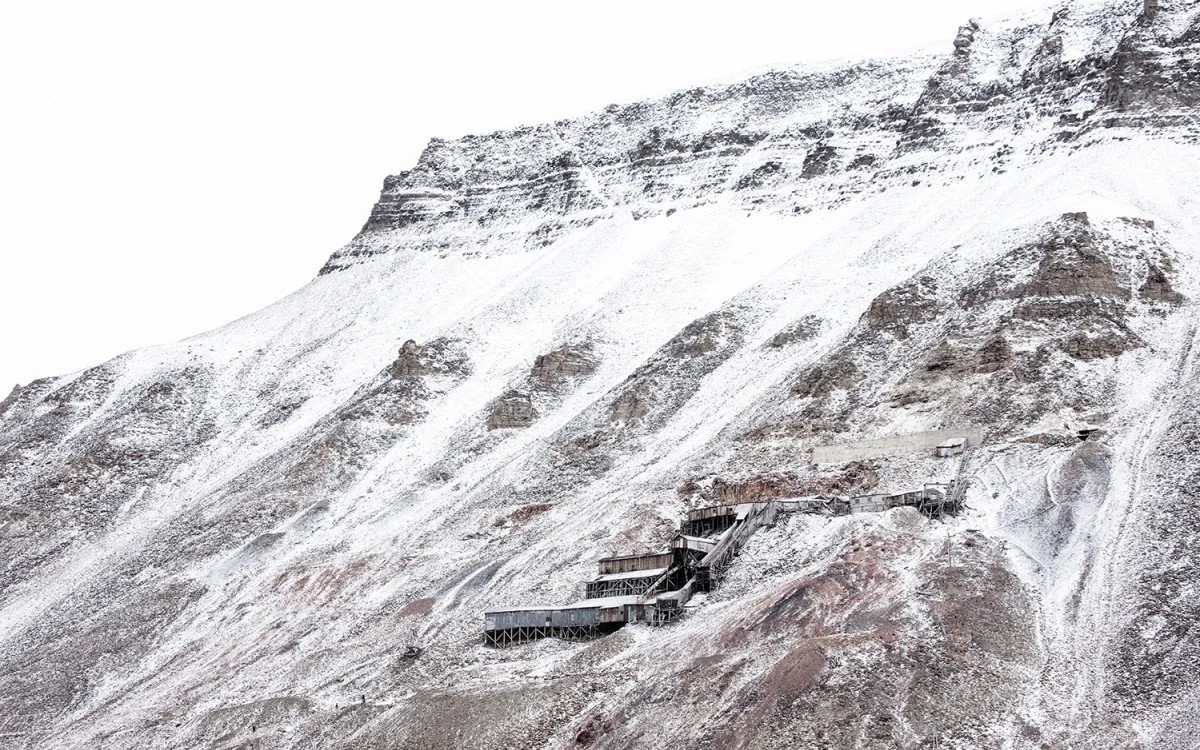
The coal mines in Svalbard are still part of the landscape, but not in operation. Photo: Marta Anna Løvberg
In just a few years, Svalbard went from being a society based on coal production to giving tourism, education and research the leading roles. Can the northern archipelago inspire other societies to move away from carbon-intensive power production?
The EU-funded research project Tipping+ was recently concluded, after three and a half years of searching for so-called "positive tipping points" in 17 countries in Europe, North America and Asia.
So what is a "positive tipping point"?
"Within social research, a tipping point is an event or initiative that leads to a profound change in a society or system," says senior researcher Siri Veland, who worked for the project when it started. Nordland Research Institute , but now has NORCE as an employer.
— A positive tipping point is about events or measures that move coal and carbon-intensive regions to clean energy.
Tipping+ looked at two examples in Norway: Lofoten and Svalbard. Veland was involved in the latter.
Served as a showcase
Svalbard emerged as an exciting and special case. Unlike almost everywhere else in the world, no one is born or lives as a pensioner on the archipelago in the Arctic Ocean. Staying on Svalbard is always temporary, which means that no population group has a long historical and cultural connection to the island.
"This means that the danger of populism in the wake of political changes is much less than, for example, mining communities in Poland or the Czech Republic," says Veland.
— Nevertheless, since the Svalbard Treaty in 1920, coal mining has maintained a Norwegian presence in Svalbard. When the state decided to close down the coal mines, Svalbard served as a showcase for what happens to a society when the coal mines close, she says.
The changes that occurred were more dramatic than the researchers had imagined.
The development affected democracy
In a few years, Svalbard went from being a male-dominated mining community where everyone knew each other, to becoming a society with a high degree of throughput, with a greater balance between women and men and also a more international and seasonal workforce.
"Locals describe the changes as dramatic. They no longer recognized each other. People started locking their houses and cars," says Veland.
The changes also had political effects.
"The government began to see that population growth was affecting democracy. They changed the rules for voting rights so that you must have lived on the mainland for at least three years before you can vote," says Veland.
— This led to a number of people losing their right to vote. There were demonstrations and political reactions. The Green Party no longer had enough members to run for office after the rule changes.
Society was thus significantly changed thanks to a government decision. Can the decision to stop coal mining in Svalbard be called a tipping point?
Building mines, tearing down windmills
Yes, says Siri Veland, but she is more uncertain whether we can talk about a positive tipping point.
"We have stopped using coal in Svalbard, so that box can be checked. At the same time, Svalbard has not switched to clean energy, now it is diesel that produces electricity for Longyearbyen," she points out.
The Tipping+ project has revealed that coal and carbon-intensive regions that produce oil and lignite are not so easy to tip over to green energy. In contrast to the hard coal that dominates in Svalbard, lignite is much cheaper to produce, but pollutes more.
"Hard coal, which is expensive to extract, is being phased out, while lignite mines continue. In Europe, we have seen examples of windmills being torn down to make room for lignite mines," says Veland.
— And Norway hasn't stopped producing oil.
Few alternatives in the Arctic
However, there are also stories that give hope. A region in Spain went from being completely based on coal to converting to green industry.
— The coal-fired power plant - popularly known as "The Two Towers" - has been demolished and they are in the process of building up renewable power. It shows that positive tipping points can be adopted politically, if followed up with economic instruments that work, such as the EU's Green Transition package in this case, says Veland.
— But what happens in Svalbard in the future is difficult to say. What alternatives do you actually have up there in the Arctic? It will be exciting to follow, she says.
Surprising Lofoten
Lofoten was also a special case in the Tipping+ project. The region famously stopped oil extraction before it had even begun and never became a carbon-intensive society.
– The question was whether the successful resistance to oil exploration in Lofoten could be defined as a positive tipping point, from which other societies can learn, says senior researcher Anna G. Sveinsdóttir at Nordland Research Institute .
Together with colleague Brigt Dale, Sveinsdóttir examined the 20-year-long struggle between opponents and supporters of oil exploration in Lofoten, Vesterålen and Senja. The researchers conclude that the outcome was surprising.
– The fact that there does not appear to be a political majority in the foreseeable future to open Lofoten to oil extraction is surprising in a country that is as economically dependent on petroleum production as Norway, says Sveinsdóttir.
– The Lofoten case shows how it is possible to establish an alternative future based on green energy and that strong grassroots engagement can yield results. This is important insight for other communities that want to invest in a green future.
