
Do you work with analyzing qualitative data? Interviews, fieldwork or document analysis? Have you ever sat there with hundreds of pages of transcripts and wondered what to do? How to start analyzing all this? You are not alone.
The article was written by Helga Eggebø and was first published on Forskerforum.no on November 30, 2020.
As a doctoral candidate, I remember feeling overwhelmed and bewildered the day I had collected all the data and sat there with several hundred pages of transcripts and field notes. I also felt so alone. Several of my peers have described uncertainty and confusion in the face of qualitative data material, and the analysis work has been described as a "mystery."
In collaboration with colleagues, I have developed a method for tackling the mystery of analysis in teams. I have called the method “collective qualitative analysis,” and it has four steps:
Summarize and review data in teams
Mapping themes in the data material
Theme grouping
Outline and work plan
We have worked through these steps in 1-2 days of working meetings, right after we have collected all the data.
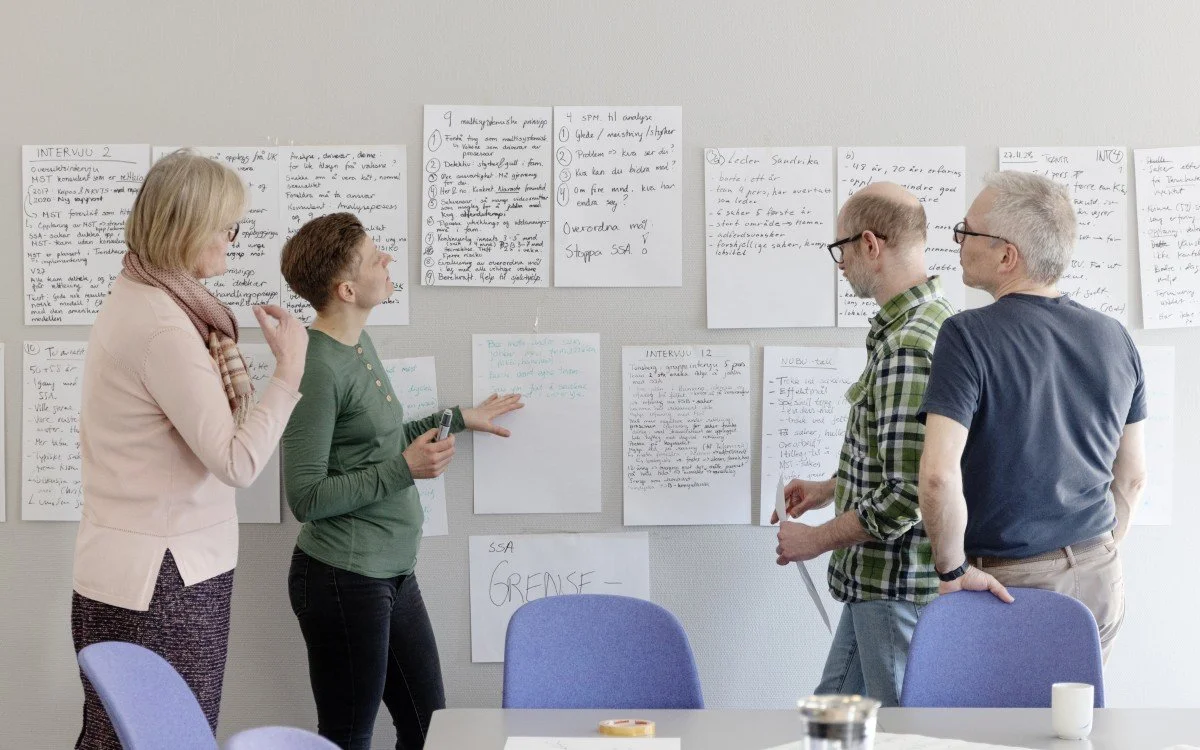
The first step is for the research group to present a summary of the data. The person responsible for the interview, observation note or document in question presents the summary to the others. One of the others writes down key words on an A3 sheet of paper and hangs them up on the wall in sequence. In this way, the scope and diversity of the data becomes a concrete reality in the room.
The second step involves mapping the themes in the data material. After the review, thoughts and ideas come to mind, and these need to be put down on paper and up on the wall. The process leader invites the participants to write a theme as a heading on a large sheet of paper (flip-top). The group then notes key words under the theme and relevant interviews that deal with this theme. This continues until the group feels “emptied” of ideas.
Step three involves grouping topics that belong together by moving the topic sheets on the wall. Moving around the room feels stimulating for the thinking process. Physical work is liberating!
The fourth and final step of the workshop is to create an outline and work plan for the writing work. We have used the grouped themes as a starting point to come up with headings and issues, and are left with a very concrete result: an outline for the writing work and a plan for the work.
Collective qualitative analysis has helped us to gain an overview of the breadth of the data material and see what our contribution to the research can be. By embarking on the analysis process together, we have prevented everyone from sitting alone in uncertainty and browsing confusedly in – or coding themselves completely – page after page of transcriptions. We have not escaped the fact that the writing work afterwards can be both confusing and demanding. But a joint working meeting is a good starting point that opens up a joint, creative analytical process.
Our experience has been that collective qualitative analysis has been an effective, thorough and reliable way to start analytical work, whether you are a student, doctoral candidate or researcher. Therefore, I would like to invite others to use the method and adapt it to their own projects.
