
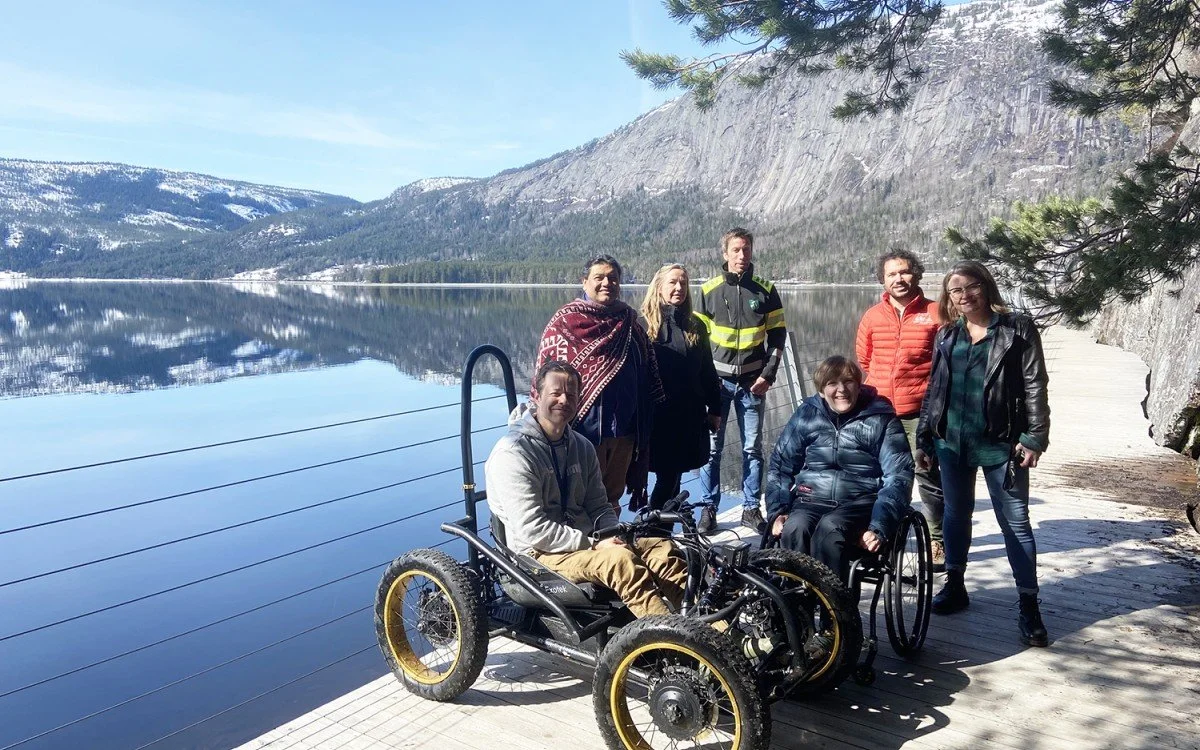
ACCESSTOUR visits Hamaren activity park in Fyresdal municipality, Telemark. From left: Sigurd Groven, Miguel Utreras, Ingeborg Nordbø, Aslak Momrak Haugan, Gunhild Bottolfsen, Martin Lobert and Karin Marie Antonsen. Photo: Nordland Research Institute
A large majority of people with disabilities have never purchased nature-based experiences on their vacations.
Dog walking, whale watching, bird watching, climbing and kiting. Cycling on trails and hiking in the mountains. Surfing, rafting, kayaking and canoeing. Norwegian tourism has a lot on the menu when it comes to experiences in nature. But they still fail to tempt people with disabilities, a fairly large market group. This is shown by a report from Nordland Research Institute , which also reveals why such activities fail to hit the mark.
“Only 15 percent say they have purchased nature-based experiences in the past two years,” says senior researcher Karin Marie Antonsen, referring to a survey on experiences of traveling in Norway, which was conducted in connection with the ACCESSTOUR project. The results are presented in the report “Accessible tourism in Norway – Experiences and preferences,” which was published earlier this fall.
– The target group for the survey was people with disabilities. They say that few available experiences and insufficient information are the main reasons why they do not purchase nature-based experiences, says Antonsen.
Missing aid
Over 40 percent of those surveyed cited a lack of support as the reason they avoid nature-based experiences. The researchers believe the number is actually higher, as many don't even bother to try to participate because they are used to being ignored.
– Many point to challenges related to lack of access due to stairs, lack of elevators or ramps, narrow doorways or unsuitable surfaces for wheelchairs, says Antonsen.
– Several also point out the lack of access to the sea and water for swimming, fishing, paddling or rowing. Distance from parking to activity and incorrect information are also mentioned as reasons.
And if some still take the chance to try a nature-based experience, a lack of aids can put an end to the activity. Activity aids are equipment that is specially developed to enable people with disabilities to participate in play and sports activities and are often a prerequisite. Examples of such equipment are special bicycles and skiing equipment such as studded sleds and sit skis.
– A full 72 percent of those surveyed say that they want and usually rent such aids at the destination, but even if the experience providers have aids available, which is often not the case, there is a good chance that they do not know how to use them, says Antonsen.
Essential need
Information is another challenge when people with disabilities are going on a trip. It is very important to know whether facilities such as parking, access, rooms and bathrooms are usable.
– Over 75 percent of the sample in the survey identified these points as the most important information, says Antonsen.
– Information about nature experiences, cultural experiences, dining venues and common areas is also important to many.
The researchers initially expected to hear that people with disabilities have little trust in information provided about accessibility. However, it turns out that over half have a high level of trust in the information presented on websites and shared in conversations with family and friends.
– Nevertheless, about the same number of people contact the destination to make sure that the information is correct, points out Antonsen.
She believes that it may be related to a lack of access to sufficient information on websites and booking sites.
– In addition, this may be an expression of how essential the need for information is for people with various disabilities, says Antonsen.
– Before traveling, you must know, for example, whether it is possible to use the relevant means of transportation, whether there are necessary aids, whether there are opportunities to receive any assistance during the trip, and whether rooms and any planned experiences are available based on your own needs.
