
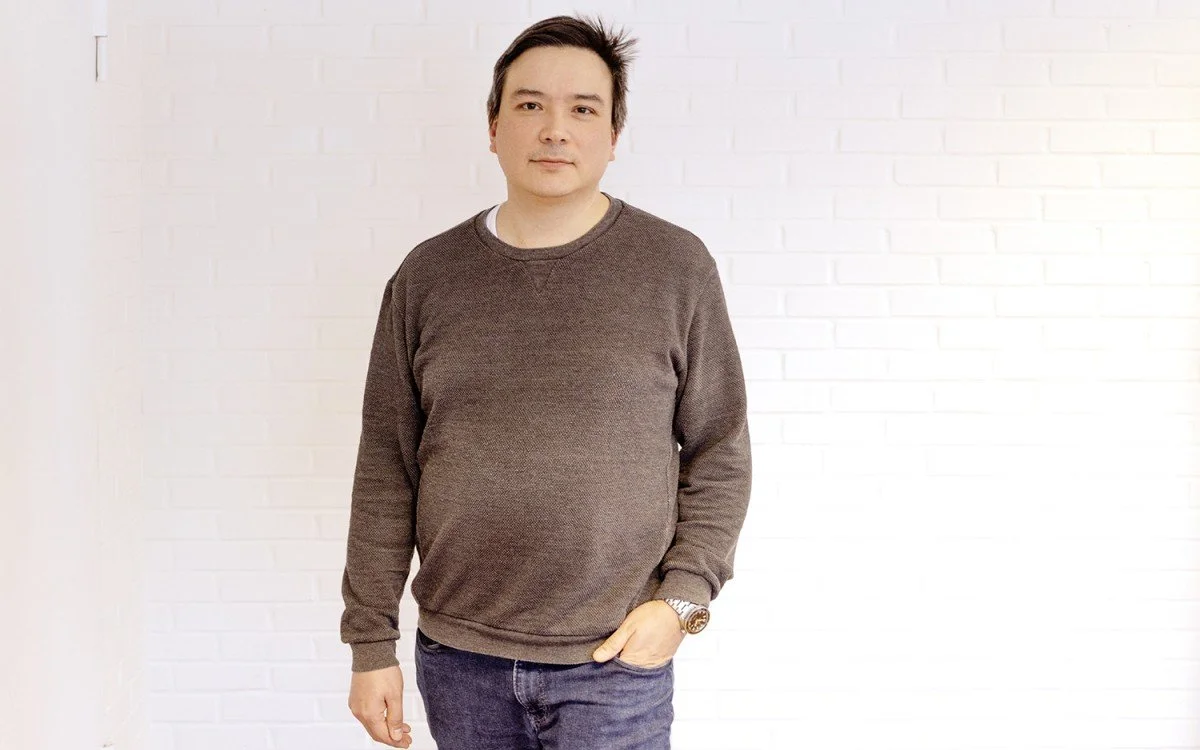
Researcher 1 and Professor Christian Lo. Photo: Marta Anna Løvberg
Among migrant workers, drug dealers and prostitutes in Hong Kong's most notorious quarter, Christian Lo realized that he was destined to be a researcher. 20 years later, the 42-year-old can call himself both a professor and a Researcher 1.
"Located at the southern tip of Kowloon's famous Nathan Road, known to locals and foreigners alike as "the Golden Mile" thanks to its pricey commercial properties, Chung-King Mansions seems wonderfully out of place."
This is the opening of Christan Lo's master's thesis (translated from English, to be sure), which is based on six months of fieldwork in the infamous Chung-King Mansions, the district in Hong Kong known as one of the most diverse in the world. Thousands of people from all over the world, backpackers, migrant workers and locals, gather here, some to live cheaply in dilapidated apartments, others to run or visit shops and restaurants and quite a few to conduct shady business. From early morning until dark of night, both the blocks and the street outside pulsate with bustling life.
"Ten steps after leaving the subway stop, I had been offered fake watches, Indian food, lodging, hashish, sex and a tailored suit," says one of Lo's informants.
Chung-King Mansions is a place unlike any other, but undoubtedly an eldorado for eager and fearless anthropologists. This is where Christian Lo's research career began in many ways. For a long time, there was little to indicate that the boy from Vefsn would become an academic.
The world's toughest backpacker
In the 1980s and 1990s, future professor Christian Lo attended Mosjøen School. He impressed no one there, at least not academically.
"I struggled in school and never achieved anything, neither in elementary school nor high school," he says.
— The first year at university was also tough, but then things started to loosen up.
Lo embarked on what would turn out to be a bit of an educational journey.
— Together with a friend, I spent a semester in India. There we met lots of young, ambitious people, which gave us something to strive for.
Inspired by his new acquaintances and motivated by youthful adventure, Lo continued to travel, both in India and further through Asia. Since his father is from Hong Kong and much of his family lives there, the metropolis became a natural stopover. Here, a fortunate coincidence eventually occurred. The Mosjøværing needed a case for his master's thesis, while the anthropology department at the University of Hong Kong was looking for a student crazy enough to do fieldwork in Chung-King Mansions.
— The quarter was legendary, mysterious and a bit dangerous. Locally in Hong Kong, there was a shortage of students willing to carry out extended fieldwork there. I therefore received very good support from a local professor when I showed interest in the place. I was young and did not think about the consequences at all, says Lo, who thus embarked on six months in Hong Kong's most notorious area.
"My uncle didn't dare tell my grandparents that I was hanging out there," he says.
A journey of formation
Chung-King Mansions is a lot of strange things, but first and foremost a commercial center. When Christian Lo did fieldwork there in the early 2000s, a large part of all GSM phones south of the Sahara passed through the building. And it was precisely the people who ran this type of business that became the focus of the master project.
"I got to know a group of traders from Ghana, who sold mobile phones, among other things. I also got to know several Indians who came to Hong Kong to work in the restaurants in Chung-King Mansions," says Lo.
As the master's student got to know his informants better and better, he gained a greater understanding of what was really going on. These were not people who had moved to Hong Kong to stay there. Their stay was part of a larger journey.
"We were used to thinking of migration as a permanent move from one place to another, like when Norwegians emigrated to America. But these people were here on borrowed time," he says.
They didn't make much money from their businesses either, so the motivation wasn't to get rich.
— I gradually realized that we were quite similar. These people were also on a kind of educational journey, they were going to see and experience the world before they returned home.
The stay in Chung-King mansions was also life-changing for Christian Lo, in the form of an academic awakening.
— I realized that if you are really going to understand what is going on and why people act the way they do, you have to get to know them, only then can you understand the logic of their existence, he says.
— After six months in Hong Kong, I wrote a thesis that I still think is some of the most interesting work I've ever done.
At work in refugee camps
The next step in his academic career was a doctorate, but Lo became distracted. His interest in people and movement patterns led him into an exciting job in the newly established Directorate of Integration and Diversity.
"We worked on integrating refugees. A lot of my job was to persuade municipalities to settle refugees," says Lo.
Working time was not just spent behind a desk.
"I was also part of a team that worked with quota refugees. That meant we traveled to where they were, in refugee camps around the world," says Lo.
— There we conducted interviews with them, before they possibly moved to Norway.
The work was interesting. The years passed and the advisor eventually became a senior advisor.
"I worked a lot with analysis. It was largely about identifying knowledge needs and announcing research," says Lo.
Soon, however, the advisor would switch sides and become the one applying for research funding. After five years as director, Lo once again entered the doors of a university, this time in Bodø.
The North's first doctor
The years-long effort to persuade municipalities to accept refugees had made Christian Lo very interested in the mechanics of Norwegian municipalities. He became a fellow attached to a project on intermunicipal cooperation.
— I was and am fascinated by how municipal policy is created through a mixture of political governance and administrative networks, he says.
— It is fascinating how the world's most advanced bureaucracies are found in tiny Norwegian communities.
In 2015, Lo defended his thesis and became the first doctorate ever produced at Nord University. Like his master's thesis, this academic achievement was no slouch either. Manchester University Press under the legendary Professor RAW Rhodes took an interest and wanted to publish the thesis as a book.
"Rhodes is one of the most famous professors in the world in my field, so it was great. Very labor-intensive, but great," says Lo.
— It shows that even research fellows in Bodø at a medium-sized, new university can produce things that are recognized and noticed beyond our little bubble up here.
Lo didn't have time to celebrate the book too much. He was recruited to Nordland Research Institute and put to work.
Publish or perish
Many fresh Researchers who starts his career in Nordland Research Institute , share the same experience: The pace is fast and the learning curve is steep.
"I was thrown into a lot. Becoming a professor and Researcher 1 was of course an ambition once I became an academic, but not something I had time to think about that much. I had to survive as a researcher," says Lo.
He survived. And his CV grew rapidly thanks to projects and publications.
— The reason why things go fast when you work on Nordland Research Institute , is that you are constantly challenged, says Lo.
— You have to use the knowledge you have in ever new fields and in ever new ways.
The researcher divided his working time between Nordland Research Institute and Nord University. With the principle "publish or perish" as a guideline, the publication list grew longer and longer.
To the top, surprisingly enough
In 2019, Christian Lo became an associate professor at Nord University.
And four years later, the professor title is in the bag.
— One of the most challenging things about becoming a professor is figuring out what to become a professor of. I am an anthropologist with a PhD in sociology who works in a theoretical landscape characterized by political science. What exactly are the core competencies? he asks.
The answer turned out to lie at the intersection of anthropology and political science.
— I am primarily concerned with the actors in the political game and how they act to achieve their political goals, often on behalf of the community.
For Christian Lo, it's still about the interest in people and why they do what they do. The spark that was lit in Chung-King Mansions has taken the school-aged Mosjøer to the top of the academic hierarchy.
"I never would have believed it," he says.
