
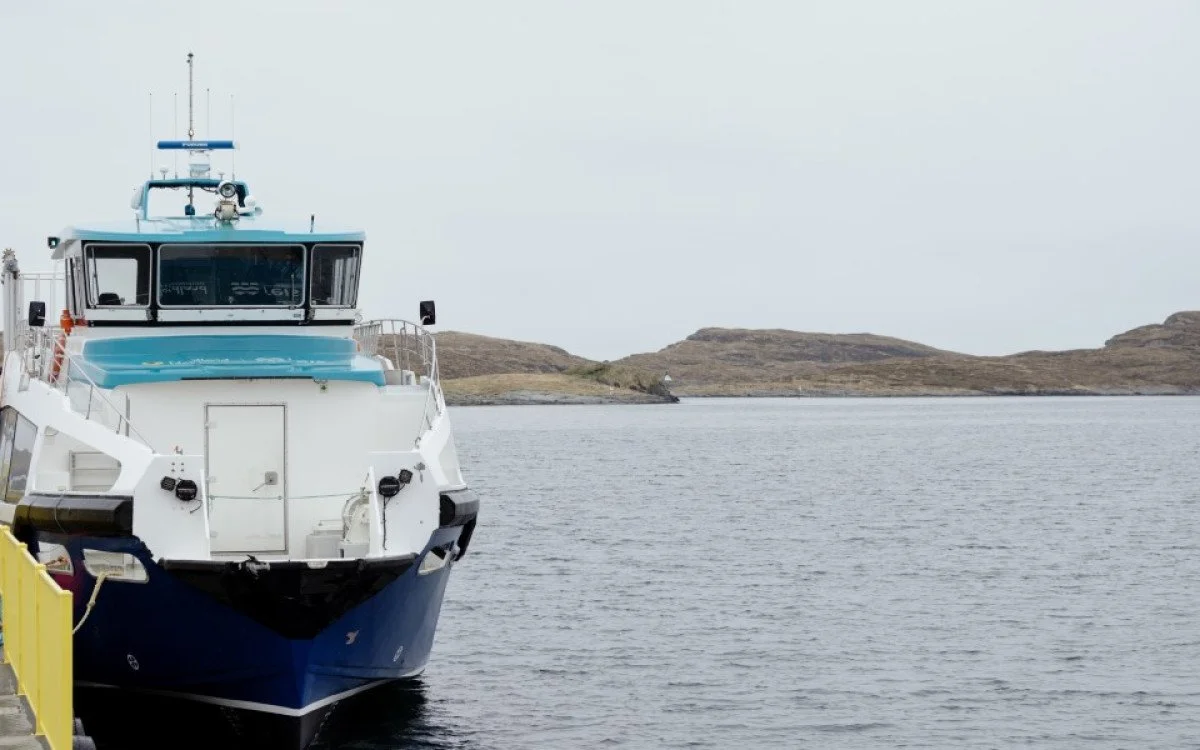
Nordland Research Institute has conducted an analysis of the social benefits of the express boat service in Nordland. Photo: Marta Anna Løvberg
A new report from Nordland Research Institute shows that the socio-economic value of the fast boat service was not sufficiently assessed before the county council adopted the much-discussed cuts in the route service.
Nordland Research Institute has, on behalf of NHO Nordland, Salten Regional Council, Helgeland Council, Polar Circle Council and Lofoten Council, conducted an analysis and assessment of the social benefit of the express boat service in Nordland. The report is based on case documents, reports and analyses, as well as interviews with affected user interests along the route that could be affected.
– The background is the decision to reduce the fast boat service that was made by the Nordland County Council in December 2024, with particular focus on the NEX 1 and NEX 2 routes Sandnessjøen – Bodø – Lofoten, says Jarle Løvland, senior researcher at Nordland Research Institute and lead author behind the report "The social benefit of the express boat service in Nordland - A review of the process and decisions on reductions in the route service for NEX1 and 2 - adopted by Nordland County Council in 2024 and 2025".
– One of the main conclusions is that the county council lacked significant parts of the decision-making basis needed to make thorough societal assessments, says Løvland.
Not detailed enough
Through analyses of the process and interviews with those involved, the researchers have concluded that the data used to assess the high-speed boat offer was not good enough.
– It is difficult to identify the socio-economic values of the offer based on the data that has been available, says Løvland.
– The passenger statistics are not detailed enough to draw conclusions that can support socio-economic analyses. It simply does not provide a basis for saying much about the socio-economic impacts of making changes to the service.
The researchers point out that income figures were included late in the process and were given little importance.
– It is important to point out that when business profitability is lacking, it is all the more important to have good measures of social benefit and socio-economic impact, says Løvland.
– For example, statistics on boardings per day do not say anything about demand and use of route sections, which could be used to calculate the utility value. Here, better follow-up data from route operators is needed to make assessments of socio-economic values.
Looks bad
Changes in the revenue system and financing have also gone in the wrong direction, seen from a Northern Norwegian perspective.
– The cost keys used to equalize operating expenses and finance the operation of the express boat have been changed. This has resulted in equalization funds from the state being reduced by 200 million kroner, says Løvland.
– This funding is not suitable for a county like Nordland, where such a large proportion of passenger transport takes place at sea.
In the latest adjustment of the distribution key for the revenue system from 2024, the sub-cost key for express boats has been merged with rail and bus, even though express boats have completely different cost assumptions.
– Nordland is not compensated to a large extent for the fact that we have five times the travel distance per capita. The coast is long and the population is spread out. This is not compensated sufficiently, says Løvland.
The transport sector is facing major restructuring in the form of investments and the phasing in of zero-emission technology over the next decade.
– Therefore, it is crucial to ensure a long-term and more robust basis for restructuring and trust among users, says Løvland.
