
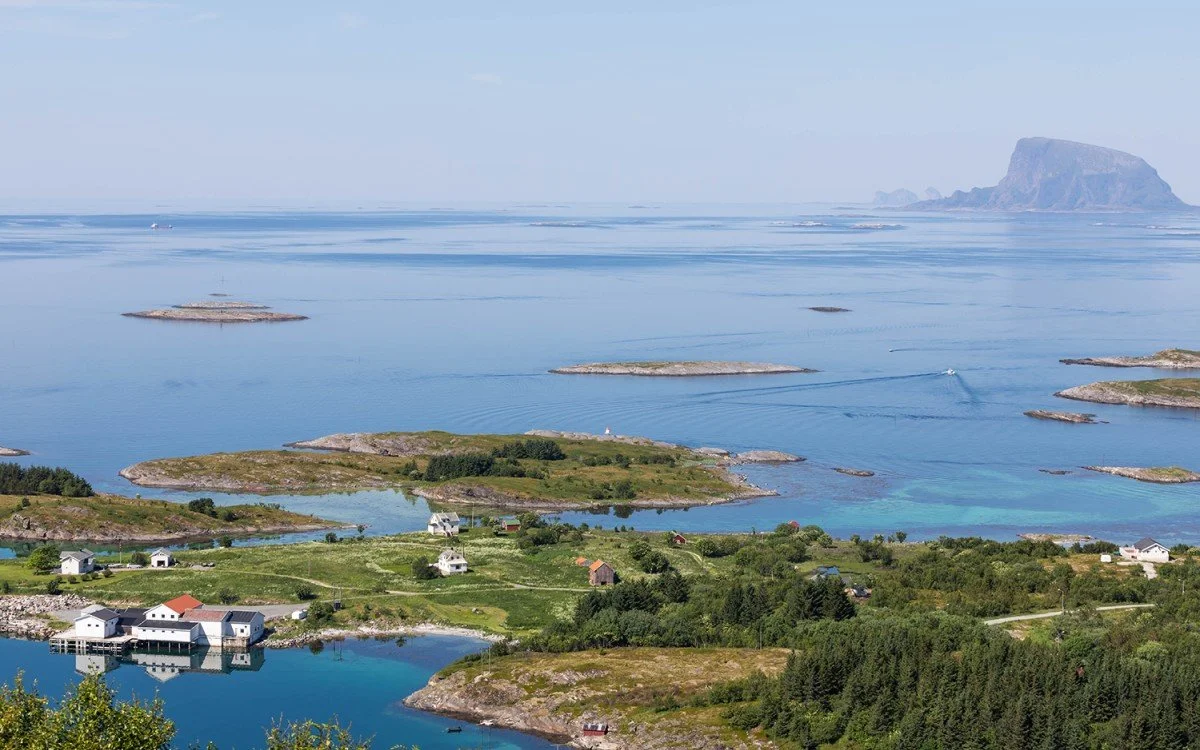
Fewer residents and greater challenges are a combination of societal and climate change that increases the risk associated with climate change in Nordland and Troms in the coming decades. Here from Lovund. Photo: Kathrine Sørgaard / nordnorge.com
Vestland Research and Nordland Research Institute provides knowledge that will help local communities in the North prepare for climate change.
Text: Idun Husabø, Vestland Research
They have mountains and seas that take your breath away, clear local communities and jobs for those who want to live there. But the counties in northern Norway also have many common features that make them extra vulnerable to climate change. Not least that the arrows in social development point in the wrong direction.
All of this is included in the big calculation that the county municipalities in Nordland and Troms have been helped to set up by researchers at two institutes. The answers they get indicate that the municipalities in the north will need a lot of support to prepare for climate change in the years to come. Fortunately, the county municipalities are ready to take on that role.
– It is natural, but still very gratifying, that it was precisely these two counties that first asked for help in analyzing climate risk, says Carlo Aall, center director at Noradapt and leading senior researcher at Vestlandsforsking.
Most vulnerable county
What is interesting about Nordland and Troms in particular is that they have by far the greatest climate risk of all Norwegian counties. This is shown by a national municipal ranking carried out by the Noradapt service Norwegian Climate Monitor in 2024.
Why is that?
The district county has the most unfavorable social development, with a declining population and an aging population. It is also in a county like Nordland, with its 41 municipalities, that one has to deal with a demanding combination of a large area and a low population. This means busy days in the administration and few people for each task, which in turn can mean that climate adaptation comes far down the list. In Nordland and Troms municipalities are doing the least to adapt to a changing climate.
– The sum of all this is that the municipalities in the north are most vulnerable to what awaits them, explains researcher II at Nordland Research Institute , Bjorn Vidar Vangelsten.
Bodø becomes like Copenhagen
In addition, the climate is changing fastest in the far north of the globe. Therefore, the difference between today's snowy winter, which attracts randonée enthusiasts to the peaks of Lofoten and Lyngen, and the slushy and sleet winters of the future will be greatest in the north, with serious consequences for more sectors than just the tourism industry – for example, Lofoten fishing and reindeer herding.
In climate research, we talk about "climate migration speed." This refers to how quickly a given climate migrates or moves north on the map.
“This movement is now happening 1,000 times faster than the average since the last ice age,” says Vangelsten.
– Bodø will therefore have temperatures similar to today's Copenhagen by the end of the century if the world does not succeed in reducing emissions.
The vanishing winter land
Future winters in the north will be characterized by less snow. There will be both fewer days with snowfall and milder winter weather. Popular travel destinations such as Lofoten will notice this.
– Ski tourism in Lofoten will gradually revive, but we currently have little knowledge of how this will affect the ecosystem.
The problem is how fast the changes are happening. Because the changes are happening so fast, we can fear the worst. Nature has always adapted to changes, but they have rarely happened so quickly.
– What seems like a long time to us humans, fifty to a hundred years, is an extremely short time to nature.
This means that industries that depend on the ecosystem will notice it quickly. An example is reindeer herding, which depends on reindeer finding lichen on their winter pastures. The lichen should be covered by snow so that it does not dry out. At the same time, it cannot be encased in ice, because then the animals will have problems.
Another example is the Lofoten fishery, where higher sea temperatures make it likely that the skrei will migrate further north and no longer come to Lofoten.
– On top of this, more rainy winters in the future mean that conditions for drying the fish are no longer as good, explains Bjørn Vidar Vangelsten.
Postpone industries
In both Nordland and Troms, many people live off nature through work in industries such as fishing, farming, agriculture and reindeer herding. What is the problem with that? Yes, the industries are vulnerable to nature changing as a result of a wilder, warmer and wetter climate.
To preserve jobs and local communities so that places like Kvænangen and Røst are still good places to live in 50 years, it is therefore extra important that the county municipalities are on the spot to support the municipalities in thinking ahead and taking preventive measures.
– So it is natural, but still very gratifying, that it was precisely these two counties that first asked us for help in analyzing climate risk, says Aall.
– Interesting that the county councils are signing up
As it stands today, municipalities are responsible for their own climate adaptation. They receive their soil samples from the Norwegian Environment Agency, and before that from the Norwegian Directorate for Civil Protection and Emergency Preparedness. The county municipalities, on the other hand, have never had a formal role in the area.
But the researchers are pleased that county municipalities such as Nordland and Troms are still forward-looking and are joining the work on climate adaptation, more in spite of than because of state initiatives.
– I think it makes sense that guidance on climate adaptation be taken by the county municipality, especially when it comes to small and medium-sized municipalities, says Aall.
At the same time, he emphasizes that the county authorities need professional support from researchers. For example, we can explain to the county authorities how they can break down the broad concept of "climate risk" into understandable parts. This will make it easier to build knowledge that provides a basis for concrete action.
All regional institutes such as Vestlandsforsking and Nordland Research Institute , which has expert expertise in sustainable climate adaptation, is uniquely positioned to support the county municipalities.
– We can do this, not least because we have the connection between nature and social sciences. We also know the municipalities well, emphasizes Aall.
To the whole country
Through the project, Nordland and Troms are pioneers in a way of working that can later be taught to county municipalities throughout the country.
Along the way, the researchers will add region-specific elements related to geography, for example, they have created a special indicator for reindeer herding in Troms, which reveals what kind of combination of temperature and snow depth is particularly problematic. The researchers use four different types of indicators, a total of about 15.
The knowledge provided by researchers in Nordland and Troms will become part of the county's climate plan.
“This way it gets double the benefit,” says Carlo Aall.
In Nordland, the work is structured as a workbook for municipalities. This workbook contains questions and answers about greenhouse gas emissions and adaptation to climate change.
– The municipalities are informed about the picture for the entire county at various points, and what the situation is like for them specifically, if you compare them with the rest of the county, explains Aall.
Bring out what's urgent
Because the researchers want the methodology they have developed for Nordland and Troms to be suitable for other counties, they go one step further with the method each time they conduct a survey.
This means that they are expanding their list of indicators, i.e. pointers to exactly how climate change is affecting society.
Once they have collected enough data, they get a picture of how exposed each municipality is, compared to their efforts to prevent natural damage and other problems.
– This is intended as a starting point for the county municipalities to prioritize efforts. At the same time, the municipality can go in and see how they rank compared to other municipalities, explains Aall.
– If you want to find out exactly how risky it is to live in, for example, Gratangen, you actually have to go out into the field and talk to people and look around. But our analyses help to identify what is important and where it is urgent to do something.
