
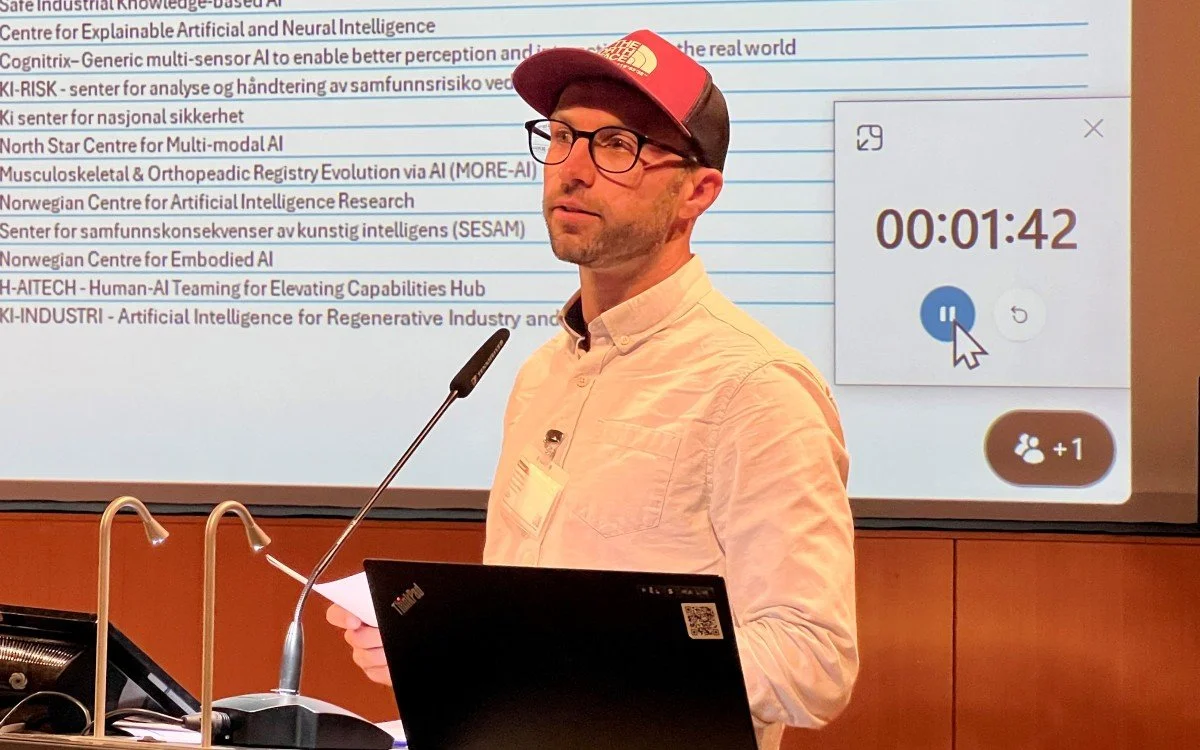
Senior researcher Daniel Weiss pitches NordregAI during the Research Council's meeting place for applicants to AI centers earlier this fall. Photo: Beate Nicoline Andersen / Research Council
The Research Council will allocate NOK 1 billion to research into artificial intelligence (AI). Nordland Research Institute is committed to ensuring that people and communities outside of large cities benefit from AI.
Recently, senior researchers Daniel Weiss and Raj Kumar Thapa traveled to Oslo to take part in a special event in the Norwegian research world. The Research Council arranged a meeting place for applicants for AI centers. One billion kroner will be used to establish four to six research centers for artificial intelligence.
The centers will conduct high-quality AI research, focusing on artificial intelligence, digital security and the societal consequences of digital technology developments.
Before Nordland Research Institute , which is a regional research institute, it is important that the outskirts join in the fun.
– The 15 largest cities in Norway have half of the country's population. What happens to the other half if the largest are allowed to drive AI development alone? asks Weiss.
– We are missing out on all the expertise and opportunities that lie in the peripheral areas, everything from more sustainable fishing to elderly care in the districts. We want AI technology that ensures meaningful, safe lives in every nook and cranny of the country.
Successful pitch
Together with Rana Utvikling, SINTEF and Nord University, Nordland Research Institute formed NordregAI, a collaborative constellation with the goal of becoming a hub for innovation and research in artificial intelligence, where regional challenges and opportunities are in focus.
In Oslo, Weiss was given two minutes to present NordregAI and convince the audience that the initiative deserves a share of the KI billion.
The task was carried out with flying colours. The pitch was featured on the Research Council's social media platforms, an honour that only two out of 52 submissions achieved. After finishing on stage, it was time for matchmaking. Each pitch was given a table and the participants went from table to table, with 15 minutes at their disposal.
“I think it went very well,” says Weiss. “We now have several different options to work on.”
Nordreg AI is not large enough to create its own center, but wants to participate in another.
“Our focus now is to become part of a larger initiative, but to be a significant part of that initiative. We are interested in making a difference for local communities and to highlight the regional perspective,” Weiss emphasizes.
Consequences for social development
Brigt Dale leads the research group Transformation and Green Transition at Nordland Research Institute He is very satisfied with the efforts of Weiss and Kumar Thapa in Oslo and sees more opportunities to continue working with the center's initiative.
– We are concerned with both how AI technology is implemented in society and what consequences it has for social development, says Dale.
– We leave the technological development to others. We are a regional social science research institute, our societal role is to keep the focus on the center-periphery dimension in social development, says Dale.
The research leader believes it is very important that someone speaks for the periphery when artificial intelligence is going to shape the future.
– There are indications that the development and rollout of artificial intelligence may reinforce negative trends and consequences of centralization for small communities. We live in a country that is dependent on good population development in all parts of the country, and an important premise is that no one is left on the platform when the AI train leaves, says Dale.
– Technology must be perceived as important and right for everyone, and as a tool we can all interact with and use. This perspective must be included when AI research is launched in earnest, he says.
