
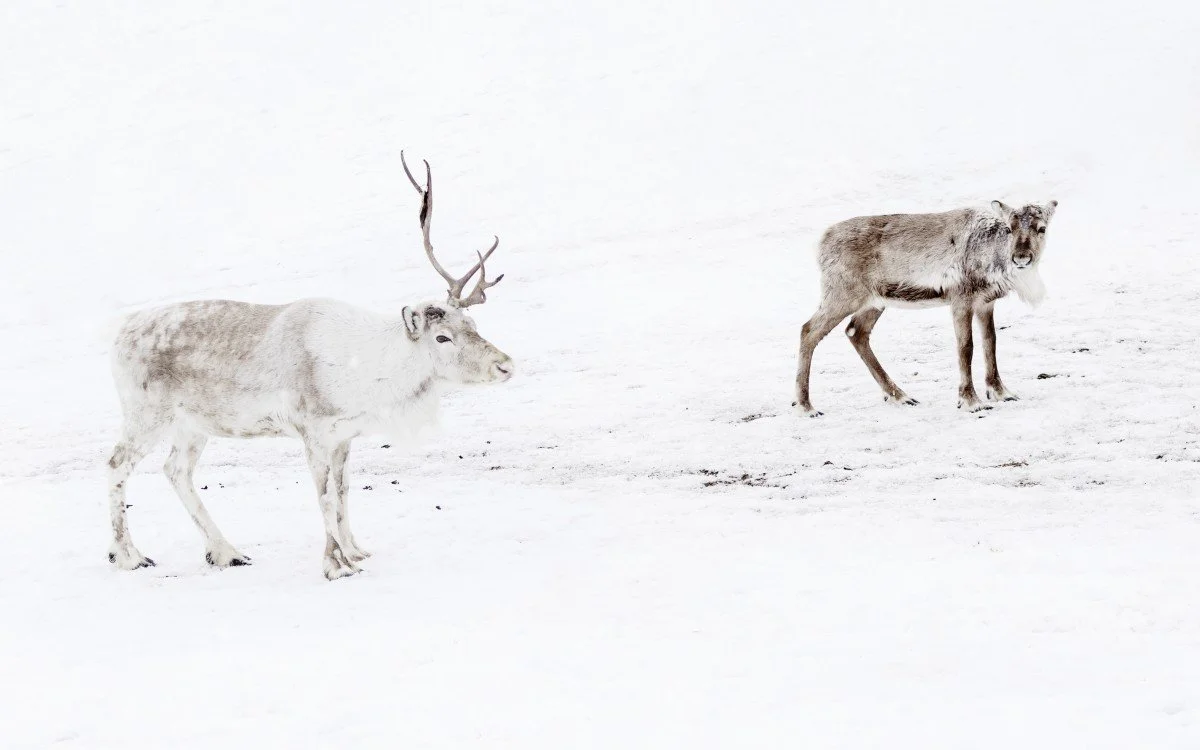
Supplementary feeding threatens the reindeer's natural way of life, which is to fend for themselves. Photo: Marta Anna Løvberg
Constant grazing crises force reindeer owners to supplement their animals with feed. But this practice brings with it a number of new costs that reindeer husbandry is not equipped for.
Climate change is leading to a more frequent need for supplementary feeding. Years of grazing crisis are coming closer and closer, supplemented by other stress factors such as predator pressure and development in grazing areas. Supplementary feeding has become an annual reality for many reindeer herders in Nordland, Troms and Finnmark.
– The expenses involved in feeding the reindeer make the cost level of reindeer husbandry almost unsustainable, says Majken Paulsen, senior researcher at Nordland Research Institute Together with her colleagues Grete Hovelsrud and Camilla Risvoll, she has written the chapter "The Disappearing Free Reindeer - Unexpected Consequences of Climate Change for Fennoscandian Reindeer Herding" in the book Anthropology and Climate Change, which was published this year.
Here they write about what supplementary feeding does to the reindeer husbandry industry. And what makes the practice so expensive.
Expensive shipping
Reindeer have poor digestion and cannot tolerate the regular round bale feed given to cattle.
– Reindeer feed therefore has to be specially produced and costs a lot of money, says Paulsen.
The animals are often far away from people and roads, so the feed must be transported into the mountains.
– Reindeer herders have to acquire more powerful and expensive snowmobiles and use more fuel. They have to produce their own sleds that cut up the feed. In some cases, the food has to be flown out by helicopter, says Paulsen.
Must think about profit
In situations where a grazing crisis forces additional feeding, reindeer herders receive support from the state, but not enough to cover the increased expenses.
– When expenses increase, earnings must also increase. Reindeer owners tell us that they are taking fewer risks, they cannot afford to wait and see if the reindeer will cope, they have to supplement feed already early in the season, says Paulsen.
– The increased cost level means that the industry must think about profit to a greater extent than before, if there is to be anything to live on and pass on to the next generation.
Supplementary feeding not only requires money, it also requires time and effort.
Time-consuming changes
Transporting feed into the mountains takes time, but what really takes time is the feeding itself.
“Many reindeer herders have to live with the herd in the mountains for periods of time. It disrupts family life,” says Paulsen.
The reindeer husbandry industry often consists of sole proprietorships, who during periods of the year receive help from family and friends in connection with slaughter, calving and relocation.
– Feeding ultimately means that reindeer herders need help on a daily basis for months, says Paulsen.
– Such work is difficult to carry out on a voluntary basis.
Uncertain future
It has long been known that supplementary feeding can lead to unwelcome changes in reindeer herding. When reindeer gather in one area to eat, the chance of disease spreading increases. From Sweden and Finland, where feeding has been common for many years, there are reports of reindeer changing their behavior, not pulling properly, and lying down and waiting for food.
– No one in the reindeer husbandry industry wants to supplement feed, it is a last resort, but in four of the last five winters there has been a grazing crisis in large parts of Nordland, Troms and Finnmark, says Paulsen.
After 2017, many more people have started feeding the reindeer. The harsh winters mean that they have to feed for several years in a row. The consequences are that the industry is changing. Both equipment, working methods and workload, and the lifestyles of people and animals are changing.
– No one knows what it will look like in five or ten years, says Paulsen. – But it may look as if the winters have changed. Various types of grazing crises are becoming more common. This means that reindeer herding is forced to supplement feed.
