
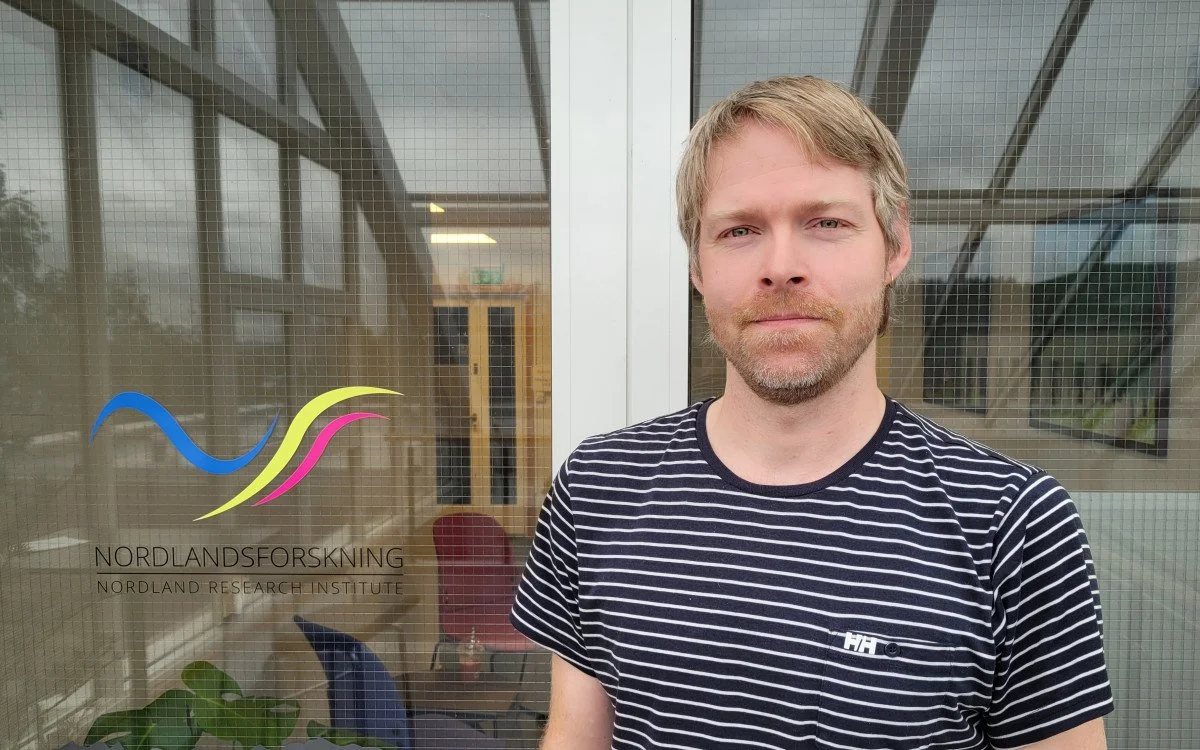
Editor and senior researcher Esben Olesen. Photo: Marta Anna Løvberg
– We must accept that children and adolescents can also experience unregistered coercion as deeply offensive, stressful and traumatizing, says Esben Olesen, one of the editors behind a new book about coercion in child and adolescent psychiatry.
When children and young people are subjected to coercion in mental health care, it is with the aim of protecting and helping. According to Norwegian law, certain types of coercion must be documented and justified, while other types of coercion are not covered by the legal definitions.
Short-term restraint, short-term medication, and forced tube feeding are examples of coercive measures that must be registered. Threats of forced hospitalization and forced feeding, persuasion and pressure, as well as lack of information and understanding, are examples of measures that may be perceived as coercive but do not require registration.
– The problem is that coercive measures that are not covered by the law tend to be downplayed and made harmless. People think that this is not proper coercion, but that is not true, it is just a type of coercion that has fallen outside of what the law requires to be documented, says Olesen.
– We must recognize that this type of restriction is also coercion and can be experienced as deeply offensive, stressful and traumatizing for children and young people who are exposed to it, he says.
Voluntary coercion
The artificial distinction between registered and unregistered coercion is one of the main points in the new book "Coercion and Boundaries in Child and Adolescent Psychiatry", which is produced by Nordland Research Institute and Mental Health Youth, as part of the research project "The complexity of coercion in child and adolescent psychiatry". Olesen is a senior researcher at Nordland Research Institute , leader of the research project and editor of the book, together with Cornelia H. Boman Wiik and Anna Ødegaard from Mental Health Youth.
– The book is written so that young people can read it, but students, professionals and relatives will also be able to benefit from what is written there, says Olesen.
"Coercion and Boundaries in Child and Adolescent Psychiatry" examines what coercion actually is and how coercion is experienced by those who are subjected to it.
– We present young people's own experiences and ask critical questions about how coercion is understood and practiced in child and adolescent psychiatry, says Olesen.
In one of the chapters we meet "Mia", a 16-year-old girl hospitalized with an eating disorder. She is formally a voluntary patient, but says that she does not feel she has any real choice. If she does not cooperate, she knows that forced hospitalization could be the next step.
“It feels a bit like coercion anyway,” says Mia in the book. Olesen points out that such situations create pressure on young people and are an example of coercion that does not require registration.
“They feel they have to be good voluntary patients to avoid more intrusive measures. This can lead to a form of internal compulsion, which is not captured in the statistics,” he says.
Coercion without decision
The book shows that many young people experience coercion in the form of pressure, threats or persuasion, without necessarily having a formal coercive decision.
– Young people do not necessarily distinguish between registered and unregistered coercion. For them, it is about the feeling of not having control, says Olesen.
– It is a democratic problem if young people experience coercion without it being recognized as such, he says.
The book challenges the traditional understanding of coercion as either/or. Instead, Olesen suggests viewing coercion as a spectrum, where the degree of perceived freedom varies.
– I believe that the healthcare system must develop better concepts and tools to capture this nuance. Not least, the voices of young people themselves must be given greater space in the assessment of what constitutes good treatment, he says.
Difficult field of research
Researching coercion in child and adolescent psychiatry is far from easy. Olesen and his colleagues have indeed succeeded in gaining access to eight departments where they have conducted interviews, and three departments where they have conducted observations.
– The reason why this part of the project was carried out is largely that we were met with great goodwill from the local adolescent psychiatric departments, who have been very open and accommodating towards the research project, says Olesen.
– From this we have obtained very valuable data that provides a good basis for analysis. But we have spent a lot of time and resources getting permission to enter the departments. It has been particularly demanding to deal with the data protection officers at some hospitals, he says.
The researchers have also had to fight to conduct a registry study with data from all adolescent psychiatric departments that are approved for forced use.
– Although we have obtained all necessary assessments and exemptions, we have experienced resistance from several hospitals. We also learn that the Regional Committees for Medical and Health Research Ethics, the Ministry of Health and Care Services and the Directorate of Health disagree about current legislation in this field, says Olesen.
– This allows us to conclude that it is currently not possible to conduct a study of the extent and type of coercion used in child and adolescent psychiatry. We believe that this is very unfortunate, and a major limitation, because it is not possible to produce quantitative knowledge about the coercion that young people in psychiatry are exposed to, he says.
