
Investigating how images, maps and art influence our decisions about nature
Maps, photographs and media reports are not just illustrations – they influence how we think about land use conflicts. Now, researchers in the VISUALS project will investigate visual representations and how they shape political priorities about nature in Norway, but also how they can help challenge established mindsets.
– This is the dream project, say Aase Kristine Lundberg and Helena Gonzales Lindberg, senior researchers at Nordland Research Institute and initiators of the project "The power of visual representations in shaping and influencing land use conflicts in Norway (VISUALS)", which recently received over 10 million kroner in funding from the Research Council of Norway. The project is led by Nordland Research Institute .
The goal is to show how land conflicts in Norway are shaped by visual representations such as images, photographs, maps, media reports and works of art.
– As long as municipalities continue to prioritize road construction, cabin fields, wind farms and green industrialization over nature, land use conflicts will increase locally, nationally and in Sápmi, says Lundberg.
“Despite considerable knowledge about how quickly and how much of nature is disappearing and deteriorating, the loss of nature continues bit by bit,” she says.
In VISUALS, researchers will look at the cultural and political barriers that make it difficult to prioritize nature over development.
– We are concerned with how visual expressions can help legitimize nature loss, while also challenging prevailing mindsets and making us think differently about power and political priorities, says Lindberg.
– There is a lot of power in how land use is communicated visually. We see it, among other things, through the media, such as the “Norway in Red, White and Grey” report and the “Ombudsman” program on NRK. But also in decision-making processes in municipalities, where visual representations such as maps and overview images influence both the discussions and the results in land use planning, says Lundberg.
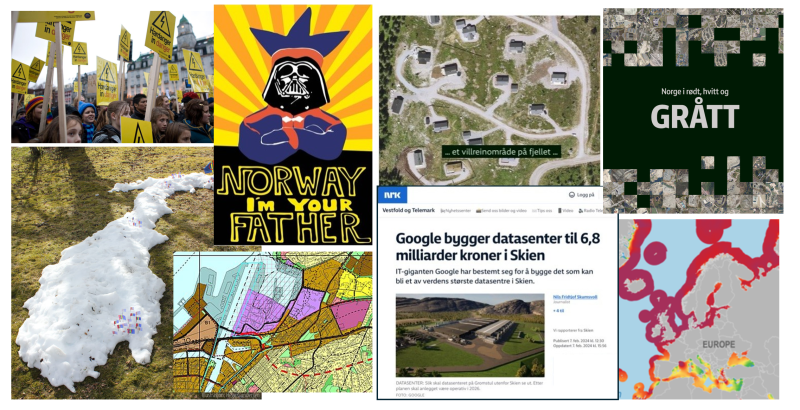
Examples of the use of art in activism and the representation of land use conflict in the media. Sources: Lytring , NRK, Wikimedia Commons and Bergens Tidende.
True interdisciplinarity
VISUALS is interdisciplinary and draws on perspectives from both the humanities and social sciences. Also on the team are Researchers at OsloMet, Nord University and Kode Art Museum in Bergen. This is the first time the Research Council has announced funding for a research project under the theme "Areas under pressure" and focuses on the cultural aspects of land conflicts. The project combines visual culture with media and policy analysis to investigate how people's knowledge and perceptions about land conflicts are visually constructed and challenged.
– In VISUALS, we will actively use art in research to think in new ways about land conflicts and nature loss. It is important to analyze the assumptions behind the visual means used. Take maps, for example. What is shown and what is hidden? And how are we affected by what is not made visible? asks Lindberg.
The project will study four ongoing land use conflicts in Norway to understand how visual elements influence opinion formation in local communities and municipal decision-making processes about nature.
Raising awareness through art
An important part of the VISUALS project is to raise awareness among planners, politicians, journalists and the public about the power of visual expression.
“Visual representations shape people's perceptions of nature and land use. We want to encourage critical thinking and discussion through the visual,” says Lundberg.
To achieve this, art is included as an important and ongoing part of the project. VISUALS explores how artworks, exhibitions and collaborations between Researchers and artists can create new understandings of nature loss and land use change. By focusing on the visual, the role of art in rethinking land use conflicts is examined.
“We will be organizing local art events to encourage people to engage with land conflicts in creative and visual ways. The goal is to promote alternative and sustainable approaches to land management in Norway,” says Lindberg.
VISUALS, in collaboration with Kode Art Museum in Bergen, will organize an art exhibition in 2029 to show different visual expressions that can challenge established mindsets and current practices where more and more of nature is being developed.
