
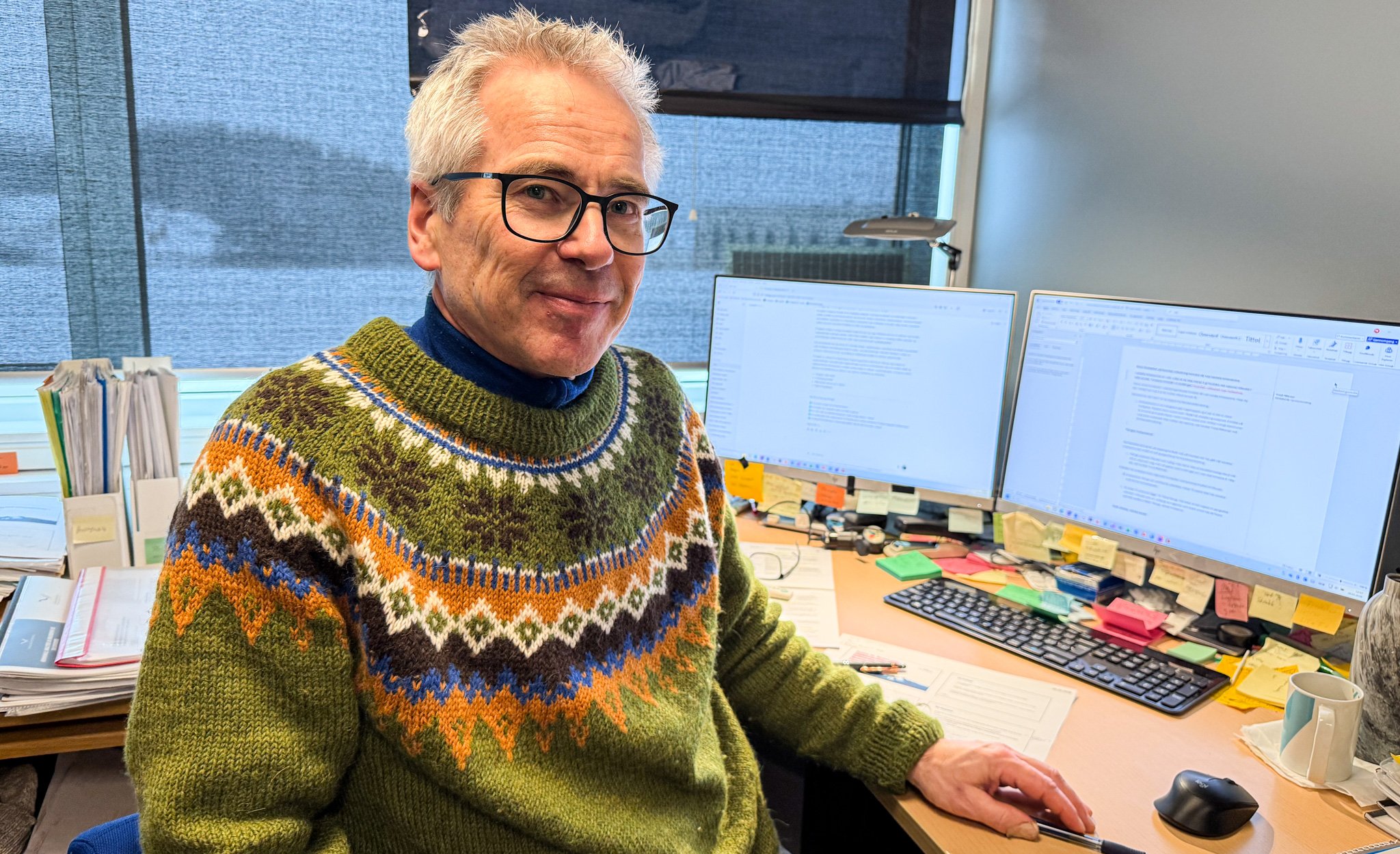
Changes. Trond Bliksvær and more Researchers from Nordland Research Institute has investigated for several years how crisis centers work with parental guidance, and now they are proposing measures.
The country's crisis centers are so diverse that they are unable to provide parents with the same services throughout the country. Researchers suggests how the offer can be improved.
There are big differences in the guidance offered to parents at Norwegian crisis centers. Where you live in the country has a lot to do with what kind of service you can get.
This is revealed in a new report from Nordland Research Institute .
"The crisis centers are a multifaceted organization and we see that there are big differences. Relatively large centers like the one in Bodø have employees and resources to draw on to be able to provide a good service, while smaller centers that cover many municipalities with large distances are not able to do the same," says researcher Trond Bliksvær at Nordland Research Institute .
Lack of competence
Nordland Research Institute On behalf of Bufir, we have looked at how the country's crisis centers have implemented a new group offering for parent guidance.
"Many people find the offer useful, but it is not an appropriate offer as it is designed today. Some changes need to be made if we are to continue offering it," says researcher Trond Bliksvær.
The work has revealed large regional differences in expertise related to the service.
28 crisis centers in Norway have certified counselors, while 15 centers do not have employees with this expertise.
— Of these 15 centers, 10 are located in Northern Norway. This means that there is a geographical bias in the offer that is in favor of the region that, among other things, has the most Sami language areas in Norway, the researchers write.
Good yield, less used
Both employees and managers at the crisis centers, as well as parents who have received offers from the centers, have been interviewed by the researchers.
Both groups describe that the guidance provides parents with good help, yet the use of the guidance as it was intended at the start has decreased.
The most widely used form of parent guidance was launched as a pilot project in 2014, and back in 2016/2017, around 14 percent of those staying at a shelter participated in the offer.
But as of 2019, only about one percent of those staying at the centers have received such guidance.
— There is a clear tendency over time that more people are providing guidance as an individual offer in their daily work, while guidance in the form of parent groups has become less common, the researchers write.
Recommend changes
Trond Bliksvær believes the idea behind the offer is good, but sees that training of supervisors, among other things, was not prioritized in the years after the first trial.
"The means to implement this should have been stronger if we were to be more successful in moving from intention to practice," says Bliksvær.
According to the researchers, several of the challenges were already described in the evaluation after the first trial. Therefore, they believe that the problems with implementation described in the report cannot be said to have been unexpected.
Now the researchers are returning to their client Bufdir with clear recommendations.
"Our results show that it should be possible to choose whether parent guidance should be offered individually or as a group. The offer is developed as a group offer, but many parents are not receptive to participating in groups for various reasons," says Bliksvær.
Both linguistic and cultural differences, trauma, and long distances to the centers are highlighted as challenges in implementing group counseling.
— Limited financial resources and staffing challenges at the shelter make it challenging to offer childcare, which has proven to be an important prerequisite for maintaining the courses, the report states.
Recommendations from Nordland Research Institute , briefly summarized:
• Create good models for maintaining competence
• Create good models for coordinating and utilizing existing expertise
• Increased collaboration with other actors on implementation
• More flexibility in how guidance can be implemented based on the situation
• Consider how the service can be better adapted for more fathers, as participation is currently low.
• Use available experience from the Indre Finnmark Family Welfare Office and the National Sami Competence Center to facilitate activities for Sami parents.
You can read the entire report here.