
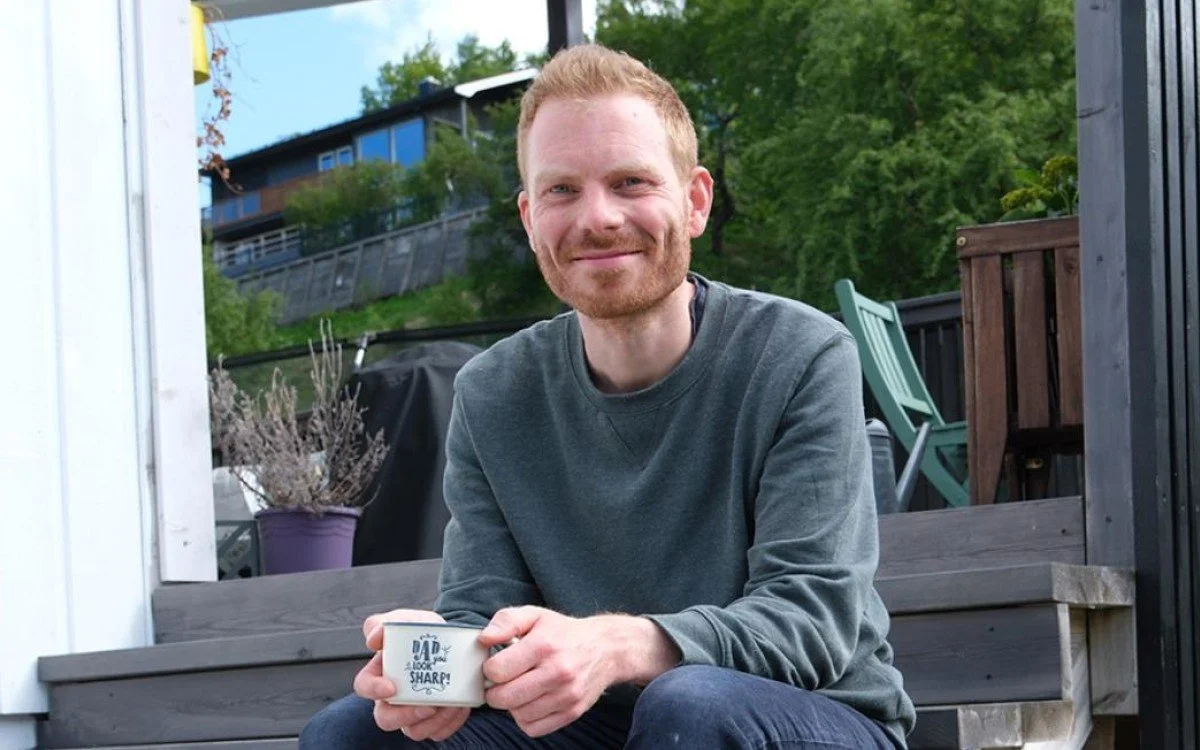
Mathias Brynildsen Reinar takes a coffee break from finishing touches in his home office. On Friday, he will defend his PhD in sociology at the Faculty of Social Sciences. Photo: Vera Isachsen.
In 2015, the UN came up with its 17 Sustainable Development Goals. Researcher Mathias Brynildsen Reinar has looked at how Norwegian municipalities have worked with them since then. He found both inspiration and frustration.
Written by: Vera Isachsen
On Friday, June 7, Brynildsen Reinar will hold his PhD defense in the Elias Blix auditorium in Bodø . With his thesis "Small steps in all directions. Exploring localisation of the Sustainable Development Goals in Norway", he has addressed what happens when a global problem is also to be solved at a local level.
Mathias Brynildsen Reinar has interviewed municipal employees and examined plans in municipalities around the country, of varying sizes, to find out how they have worked with the sustainability goals.
Great expectations
– I have looked specifically at the planners in the municipalities and how the sustainability goals are understood in light of local conditions and political priorities. In some municipalities, there is only one, maybe two people who work with planning, and who have then been told that the sustainability goals should be used and used as the basis for municipal planning. Several express that they find it fun to work with, but there is a big gap between the expectations the state has and what the municipalities actually achieve, concludes Brynildsen Reinar.
The title of the thesis is telling. They achieve a little, but there could have been more concrete results with clearer management from above.
– It has largely been up to the municipalities themselves what this should be, and there has been little else involved other than an expectation from the state to work with the sustainability goals. The kind of expertise, interest and capacity that exists in the individual municipality has a lot to say about the result.
But Brynildsen Reinar emphasizes that this is not just about municipal finances:
– Passive
– It's about making the goals locally relevant in a meaningful way. It's easy to stick goals in a plan and say that you're working towards this goal. For better or worse, the goals are flexible and can therefore cover much of what a municipality is already doing. The 17 goals are also equal, and municipalities can in practice pick the goals they want to work on, he says.
– Is it appropriate in Norway for everything to be weighed equally? he asks, citing the loss of nature as an example.
Norway reports to the UN, and this is one of the goals that the prosperous society of Norway is struggling to achieve.
– One might have thought that nature loss was important, and this is also something that happens locally and where municipalities have great authority. But instead of focusing on nature loss, 17 sustainability goals are being sent down to the municipalities, as if everything was of equal importance. It comes across as quite passive, says Brynildsen Reinar.
A lot to deal with
The 17 SDGs are divided into 169 targets and have 231 unique indicators to measure and report on, which can be overwhelming for a planner in an average Norwegian municipality.
– It becomes completely confusing. Where do you actually start if you have one or two people responsible for planning?
The informants Brynildsen Reinar has used tell of mixed feelings about the task they have been given. Because it is not only negative:
– They say it is inspiring to work with them – it gives perspective on what they do and an importance beyond the municipal borders. But it is also frustrating, because there is only an overall expectation to follow the sustainability goals and little that tells them what they should do specifically. Everyone agrees that sustainable development is important, but it is difficult when you can put whatever you want into it.
Requires tougher policies
The period for working on these sustainability goals ends in 2030. Although a lot has happened, Brynildsen Reinar believes that there is little evidence that they have had such a great practical effect – and he is talking at a global level, not just in municipalities.
In order for municipalities to do better in the years to come, he believes stronger support is needed.
– A sustainable transition requires tougher policies at all levels. This requires political measures where you cannot expect everyone to be satisfied. The sustainability goals can contribute, but it also requires that politicians across the board must make some clear priorities, Brynildsen Reinar asserts.
Friday, June 7th is the day. At 10:15 there will be a trial lecture, before the actual defense at 12:15.
