
The Hybes project is working to develop standard methods that can be used in all regions of the Northern Periphery and the Arctic.
In addition to the Norwegian regions (Trøndelag, Nordland, Troms, Finnmark and Svalbard), the Northern Periphery and Arctic (NPA) cooperation regions cover northern Sweden, northern Finland, Greenland, Iceland, the Faroe Islands and parts of Ireland. In the work to achieve carbon neutrality in these areas, it is a major challenge to address the significant regional differences in energy consumption, climate and renewable resources. Decarbonization strategies must be adapted to the specific needs of each individual area and take these differences into account to ensure that effective and sustainable solutions are implemented.
Nordland Research Institute is leading a project to develop, implement and promote more sustainable energy solutions for Arctic communities.
“In the Hybes project, we focus on different areas, such as improving buildings to meet higher energy standards. We also look at local ways to use more renewable energy, such as solar, wind and geothermal heat. When it comes to energy infrastructure and national requirements, the Hybes partners recognize that different conditions affect what we can achieve,” says Bjarne Lindeløv, researcher and project manager at Nordland Research Institute .
Variation in energy sources
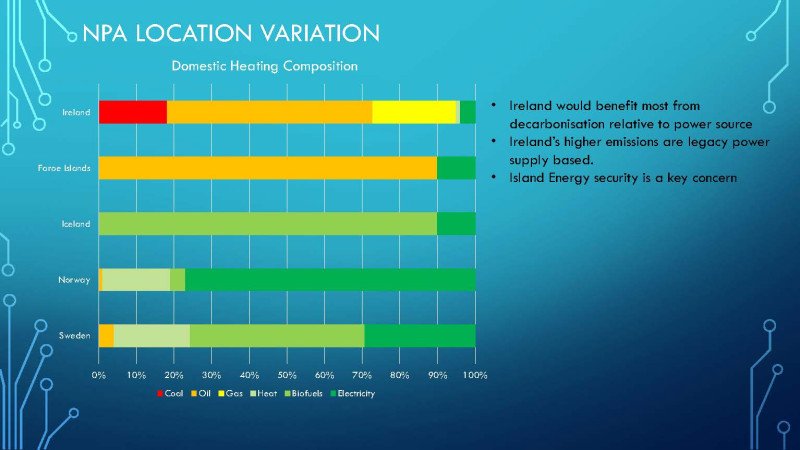
There are large variations in heating and electricity generation between the NPA countries. For example, Ireland and the Faroe Islands have much to gain from decarbonisation, as they are heavily dependent on fossil fuels for heating and electricity. For these countries, a shift to renewable energy is crucial, especially in terms of energy security, as it reduces dependence on imported energy sources. Given the geographical potential, heat pump technology and solar and wind energy are promising solutions for Ireland and the Faroe Islands. Traditional renovation to improve insulation standards in Ireland will also be crucial to achieving the energy targets.
Countries like Norway, Iceland and Sweden, on the other hand, are already more reliant on renewable energy sources such as hydropower and geothermal energy. These countries have a head start in the transition to low-carbon economies, but the focus remains on improving renewable energy infrastructure to meet long-term goals.
– This involves developing local hybrid and flexible renewable energy solutions that can be used to heat buildings, reduce the rising costs of energy infrastructure and contribute to energy security, says Lindeløv.
The climate's impact on decarbonisation
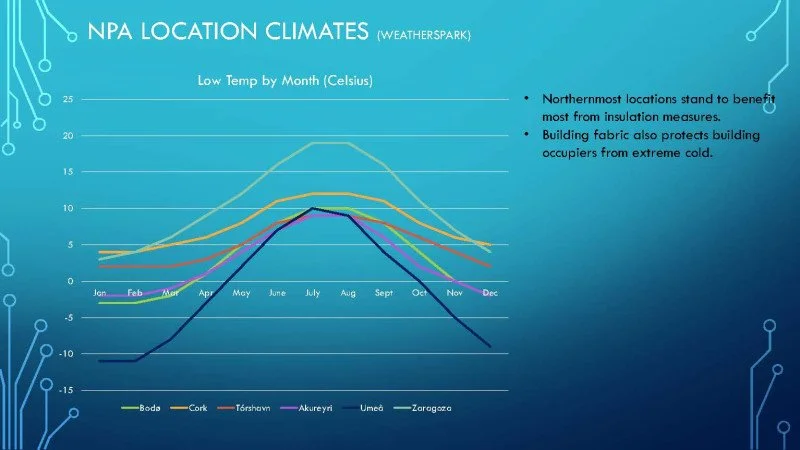
The climate in the NPA regions plays a crucial role in shaping decarbonisation strategies. Northern locations such as Bodø in Norway, Umeå in Sweden and Akureyri in Iceland experience colder temperatures, which is also reflected in higher requirements in their building codes than in countries such as Ireland and the Faroe Islands. However, upgrading the existing building stock through insulation requirements and energy efficiency will remain a key priority in all NPA regions. Improved building stock can protect against extreme cold and reduce energy demand.
Regions with high wind potential, including Ireland and the Faroe Islands, are well placed to expand wind power capacity. However, wind energy infrastructure is capital intensive and inconsistent, requiring careful planning. Solar energy potential varies considerably across the NPA region. Southern areas, such as Cork, receive more sunlight, making solar technology more viable in these regions compared to northern locations such as Bodø or Tórshavn.
Citizen engagement and behavior change
To succeed in reducing carbon emissions in NPA countries, it is important to engage citizens and promote behavioral change. Different groups need different approaches to encourage energy efficiency. People who care about the environment tend to choose lower-cost measures, while those motivated by economic benefits are more likely to invest in higher-cost energy-efficient technologies.
In urban areas, larger households with higher levels of education are more likely to adopt these technologies, while rural populations may need more personal communication and incentives. Easier access to financial support and administrative procedures, for example through “one-stop shops,” could help bridge this gap and increase participation among all citizens.
“To achieve our energy and climate goals, we need citizen engagement and changes in how people behave to reduce carbon emissions. That is one of the main ideas behind the Hybes project,” says Lindeløv.
“Technology alone is not enough. We need to use energy technology wisely and change our habits so that we use less energy and have a more sustainable consumption. To achieve this, we focus on the Living Lab method to connect with young people and key stakeholders who can influence our behavior. We are also looking at how culture and cultural events can help raise awareness about the transition to renewable energy and a low-carbon society,” he says.
Challenges and opportunities
Decarbonization is complex, but the diverse energy production and climate needs of NPAs create unique opportunities. Challenges include finding local solutions that take into account electricity costs, technology applicability, sources of financing and, last but not least, capacity building and awareness-raising. While replicating these solutions across regions may be difficult, tailored approaches can have a significant impact if they are tailored to local conditions. Training programs such as the “carbon school” and others being developed by Hybes partners can play an important role in promoting long-term behavioral changes. Community engagement and practical solutions that take into account regional realities will be crucial to ensure that decarbonization is adopted at scale.
The decarbonization process in NPA regions is different for everyone. The different climates, energy needs and population profiles require tailored approaches that address local challenges while maximizing regional strengths. As our regions and countries strive to reduce carbon emissions, strategies specific to each area will be crucial to achieving a successful and sustainable shift towards carbon neutrality.
– The Hybes partners take stakeholders and strategy as their starting point, and move from hybrid pilot solutions at the building level to the next step with flexible energy at the district level, summarizes Lindeløv.
