
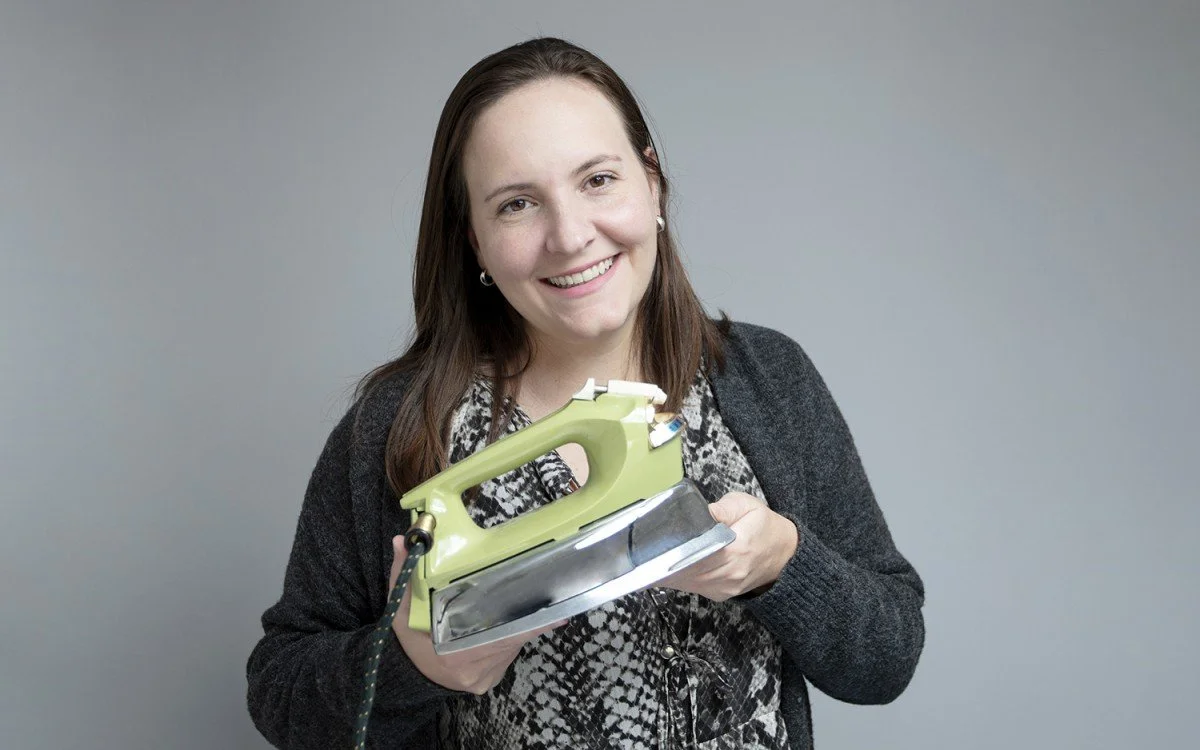
Irons are an example of a completely common product that contains materials that the industry needs, says senior researcher Leticia Antunes Nogueira. Photo: Marta Anna Løvberg
Leticia Antunes Nogueira is a researcher on urban mining. When she heard that a waste company had found irons in residual waste, she had an idea.
Urban mining is about recycling materials that have already been extracted from nature and used in various products, which are now either thrown away or lying unused on shelves and cupboards. Nogueira, a senior researcher at Nordlandsforsker, is central to the UrbanMine project, which researches the conditions for urban mining in Norway. She recently gave a presentation at Avfall Norge's annual conference, where she shared the stage with an iron.
– It turns out that between three and four percent of residual waste in Norway is electronic waste, says Nogueira.
– I tried hard to understand how an iron could find its way into residual waste and came up with a fictional explanation, which shows some of the challenges of today's waste system, she says.
From waste to resource
Nogueira went on stage and told about the family man Tor who is cleaning out the garage. Tor's garage is full of junk and Tor cleans, sorts and throws away for hours after hours. Tor is not a bad guy, he is a completely normal family man who sorts his household waste and drives an electric car, but now Tor gets bored and he gets hungry. When he is almost finished cleaning, the iron appears from some corner and Tor doesn't bother anymore, he throws the iron in the residual waste bin.
– And Tor does that because he thinks of the iron as waste, not as a valuable resource, as it really is, says Nogueira.
– Tor knows that he can hand in his old car and get a scrap deposit for it. But neither he nor most others in Norway think of the iron as valuable.
And the reason for this erroneous attitude lies in the system.
An industrial need
Many Norwegians are interested in urban mining, but as of now the opportunities are very limited.
“The framework conditions are weak. We simply don't have good enough systems in place yet, except for the waste system,” says Nogueira.
– But the waste system has grown with the goal of managing waste, not preserving it for further use in industry.
But now urban mining is becoming imperative. It's time for Tor's irons and all of us to be seen as a resource.
– Irons are an example of a very common product that people have stored and forgotten in their closets, but which contains materials that the industry needs, says Nogueira.
Need new systems
Associate Professor Annelin Seppola at Nord University also works in the UrbanMine project. She has recently received the answers to a survey that Polarfakta has conducted on behalf of the UrbanMine project. The survey looks at households' attitudes towards waste sorting and waste management. 1000 responses were received and showed the following:
12 percent do not sort their waste to a large extent.
Four out of ten are not convinced that waste that can be recycled will be used again.
Seven out of ten keep mobile phones at home in drawers and cabinets.
24 percent of those who stated that they keep unused mobile phones at home have four or more of them lying around.
“We need to find a way to put these valuable materials back into use,” emphasizes Seppola.
– Conventional mining is harmful to nature and often controversial. It is important that society finds a better way to obtain the resources needed for industry.
But setting up good systems for urban mining is not that easy.
“This is not something anyone can fix on their own. We need to create a new institution and it needs to happen in a partnership between decision-makers, the waste industry, producers and consumers,” says Nogueira.
