
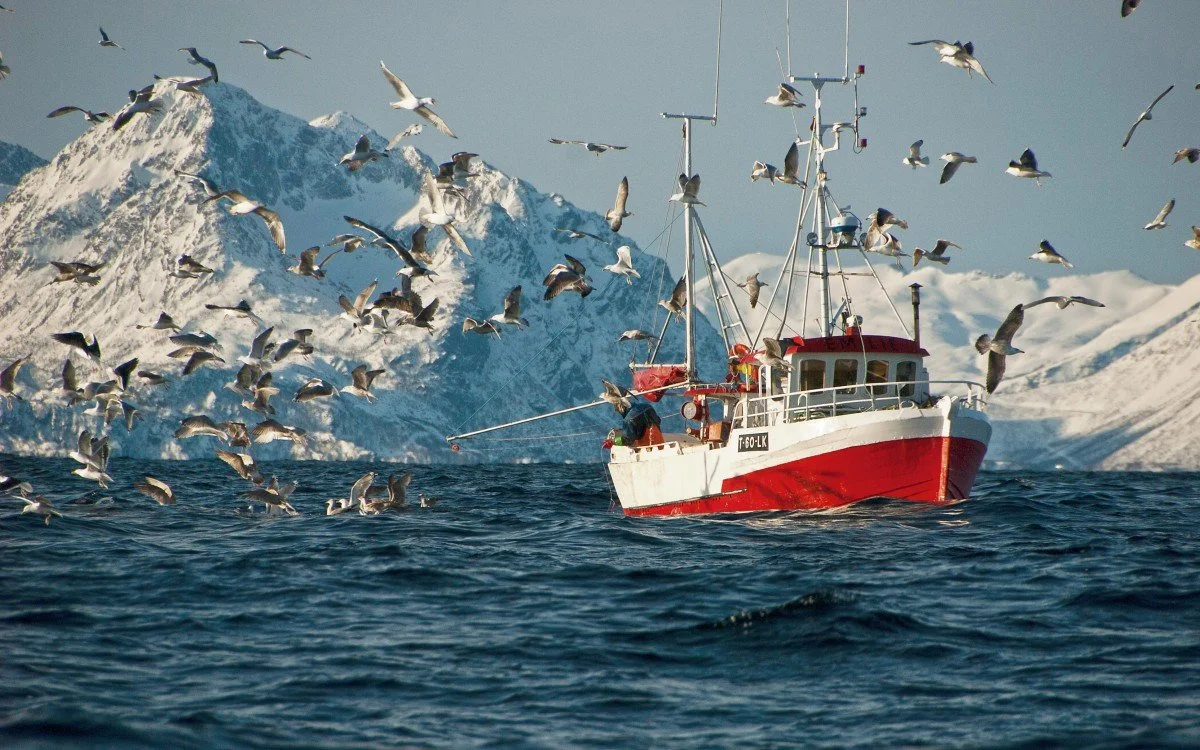
The fact that fishermen's knowledge is not included in management is one of the themes in the book "Introduction to Environmental Planning". Photo: Reiner Schaufler / nordnorge.com
The textbook "Introduction to Environmental Planning" is characterized by knowledge developed by Nordland Research Institute .
Maiken Bjørkan, Aase Kristine Lundberg and Mathias Brynildsen Reinar have all contributed to the book, which was published by Universitetsforlaget earlier this year. It is written for students of environment and planning, but can also be read by anyone else with an interest in planning and environmental issues.
Maiken Bjørkan was invited to contribute because she has published extensively on knowledge-based management.
– I write about knowledge we miss out on because it cannot be translated into numbers, she says.
Trust issue
Bjørkan has repeatedly encountered this issue during his many research assignments in the fisheries sector.
– For example, fishermen can tell a lot about the state of the ecosystem by observing the liver of cod, but such knowledge does not fit into the numerical machinery, she says.
Thus, we end up with quotas and other rules that are based on a partial knowledge base.
– The data collection methods do not represent the whole reality and do not gain trust among those who are supposed to follow the advice, says Bjørkan.
This dilemma is duly addressed in the book. In her pages, Aase Kristine Lundberg is concerned with the use and protection of wild reindeer habitats.
Railways, roads and power development are making the home ranges of wild reindeer increasingly smaller. In addition, cabin construction leads to increased traffic in the mountains. Recently, wind power has been the most obvious threat.
– All of this affects the wild reindeer. But according to the Bern Convention, we have a special responsibility to care for the wild reindeer. So how does the management solve this challenge?
Environmental volunteering in municipalities
The answers vary. Lundberg points to examples where local regulations are overturned by national authorities.
– Because wild reindeer depend on such large mountain areas, it is difficult to see the total consequences of each municipal land issue that involves an intervention in the wild reindeer's habitat, says Lundberg.
– There is a need for a holistic view of the wild reindeer's habitat, and with its intermediate position, the county municipality may be well suited.
Together with Mathias B. Reinar, Lundberg is also involved in a chapter that deals with municipalities' work with the UN's Sustainable Development Goals.
– It's about the sustainability goals as a framework for planning in municipalities and county authorities, says Reinar.
More than packaging
– We present some history and background on how the Sustainable Development Goals came into being as a guide for Norwegian planning and discuss the strengths and weaknesses of the different approaches that have been used at the local and regional level.
The authors are also concerned with what it takes for the sustainability goals to become something more than a new packaging of what is already being done.
The chapter is built on knowledge developed in the ongoing project Field of goals .
