
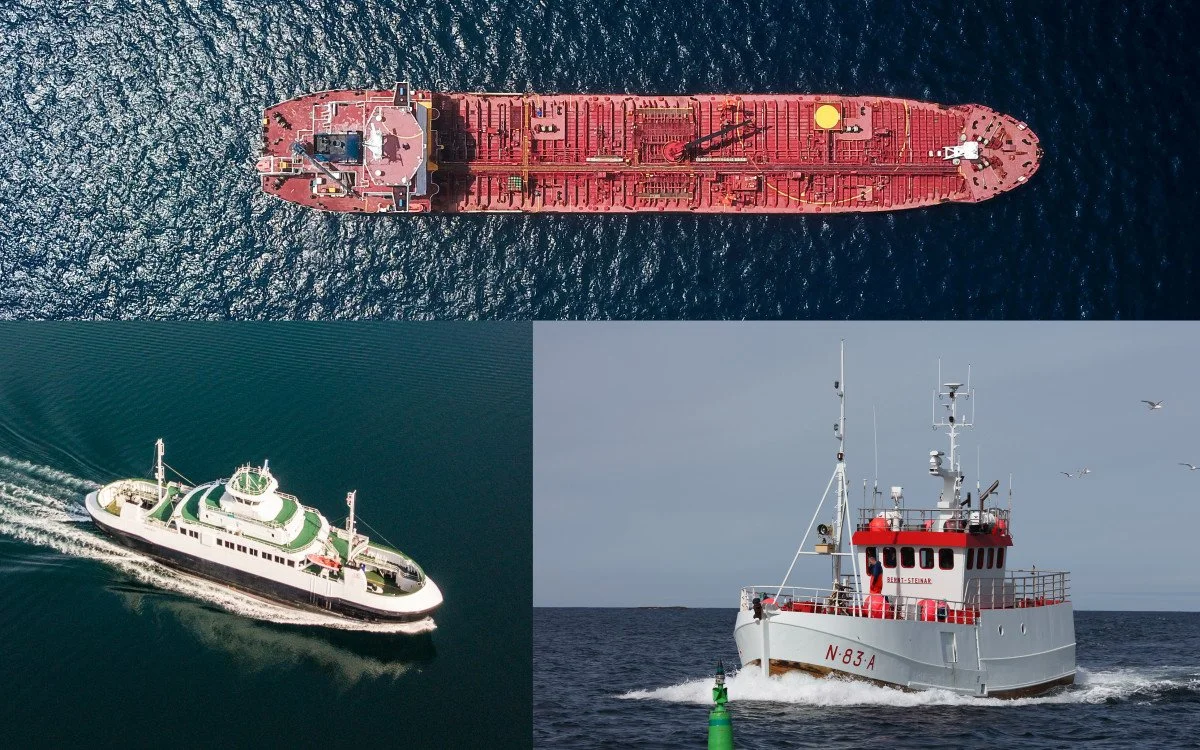
The researchers will spend time on cargo ships, passenger vessels and fishing boats. Photo: Shaah Shahidh/Unsplash, Jonas Berglund/Helgeland Reiseliv and Roger Johansen/ nordnorge.com
About the project
Title: Improving social work environments on board: Antecedents and consequences of psychological safety and social support on Norwegian vessels
Client: Research Council of Norway
Period: 2025-2028
Involved Researchers from Nordland Research Institute : Birgit Pauksztat, Maiken Bjørkan, Lea Louise Videt, Helga Eggebø, Fredrik Langeland, Solveig Øye Bjørdal
Partners: Western Norway University of Applied Sciences, Institute of Marine Research, Università degli Studi di Milano-Bicocca and University of Tromsø – The Arctic University of Norway
In a new project, Researchers spend several weeks aboard Norwegian fishing vessels, cargo vessels and passenger vessels to study the social working environment.
The project is led by Birgit Pauksztat, researcher 1 at Nordland Research Institute , and aims to understand how good working environments are developed among seafarers. The researchers hope to uncover how norms and relationships between crew create a safe and productive working environment.
To succeed, the researchers must set sail. Many of them will live and work alongside the crew for extended periods – up to four to five weeks at a time – to gain a deeper understanding of the daily lives of seafarers. Fieldwork is necessary to understand the complex social dynamics that develop over time aboard a ship.
– The maritime work environment is characterized by special conditions such as isolation, close collaboration and long periods away from family, says Pauksztat.
– Previous research shows that psychological safety and social support reduce stress, exhaustion, bullying and harassment. At the same time, mental health, safety, inclusion and performance are improved. So these factors are particularly important, but we still know little about how they arise. Our goal is to find out what underlies a good working environment and what can be done to create such a work environment on board.
Societal changes also affect seafarers
The maritime sector has traditionally been hierarchical and male-dominated, but Pauksztat and her team are particularly interested in how societal changes, such as the #MeToo movement and increased focus on mental health, have affected the shipboard environment. How do younger generations relate to these changes, and how does it affect collaboration on board?
– 30 years ago there was little talk about mental health among seafarers, but this has changed. Today's generation has different expectations of the work environment and leadership style than previous generations, and it is important to look at how this is reflected on board, says Pauksztat.
The project will therefore not only observe the current situation, but also look at how maritime norms are developing, and which external societal trends can contribute to changes.
From the classroom to the sea
One of the most important questions in the project is how psychological safety and social support are conveyed through norms and values, and how these are developed at different levels. The researchers will investigate whether the education system for seafarers and fishermen plays a role in conveying values that promote a good working environment. Through analyses of educational programs and interviews with teachers and students, the researchers will map which norms are passed on to future generations of seafarers.
“There are no subjects that are explicitly about psychological safety or social support, but these values can be conveyed in subtle ways, for example through the examples used in teaching or the stories told. We will look into this further,” says Pauksztat.
Another part of the project will focus on how organizational measures affect social relations on board. Through questionnaire surveys, the researchers will look at how structural frameworks such as employment contracts, rotation schemes and shipping companies' staffing policies shape the social environment on board.
– For example, we will look at whether there is a difference in the working environment of crews with permanent contracts versus those with temporary employment, and how the crew's experiences are affected by whether they work on permanent vessels or switch between different vessels, says Pauksztat.
– Shipping companies cannot dictate how relationships develop, but they can create conditions that either promote or hinder good social relationships. Our research will help shipping companies create environments that promote collaboration, social support and security for employees.
Unique access to the everyday life of seafarers
Living closely with the crew for several weeks will give researchers unique insight into the working environment on board. Pauksztat has previously conducted field studies at sea, and her experiences show that being part of everyday life on board opens up informal conversations and observations that provide deeper insights than traditional interviews can provide.
– When we are on board for longer periods, we get the opportunity to observe the dynamics of the crew and see how they handle challenges such as fatigue and stress, says Pauksztat.
– We learn how people talk and collaborate in practice. This type of close study gives us the opportunity to become aware of unconscious norms that influence the social environment, which we can later address in interviews to gain further clarity on the matter.
The project, which runs from 2025 to 2028, is expected to provide valuable insights into how to promote a better working environment at sea, with the potential to influence both maritime education programs and shipping companies' working practices.
– By understanding how psychological safety and social support arise, we can help create safer and more inclusive workplaces, says Pauksztat.
