
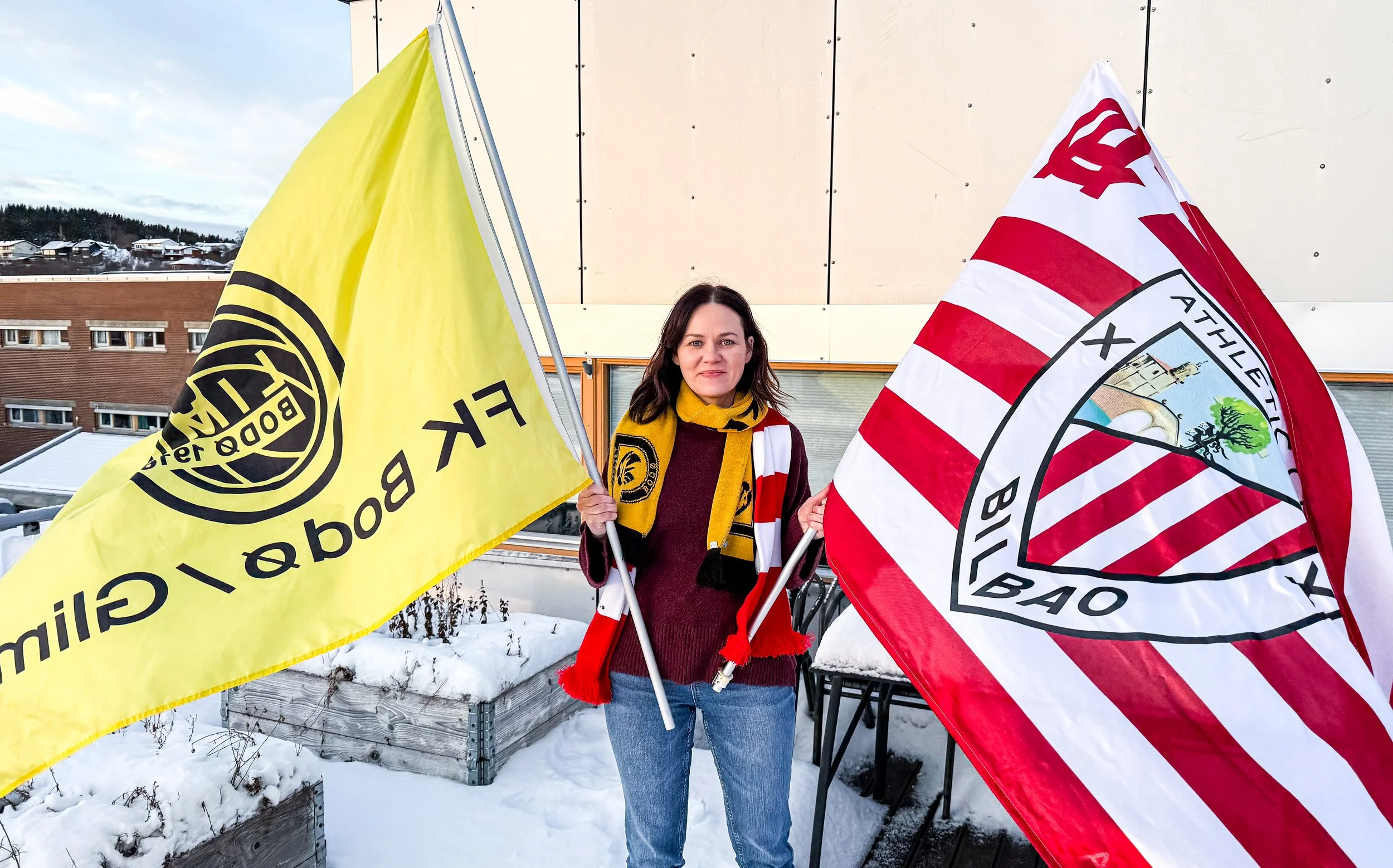
New Nordland researcher. Linn-Marie Lillehaug Pedersen follows both Bodø/Glimt and Athletic Club Bilbao. Interest in football runs strong in the family. Photo: Tarjei Abelsen
Linn-Marie Lillehaug Pedersen already spoke Arabic and Spanish when she decided to learn Sami. She is now pursuing a bachelor's degree in Lule Sami, with a desire to use the language in research and contribute to strengthening Sami social work competence.
Text: Tarjei Abelsen
– I thought that if I could manage to learn Arabic, I should also be able to learn Sami.
This is according to Linn-Marie Lillehaug Pedersen, who recently started as a researcher at Nordland Research Institute .
Pedersen has a varied academic background. She studied Middle Eastern studies, with a specialization in Arabic, and holds a master's degree in peace studies from the University of Tromsø. She has also learned Spanish.
Sami was not a language Pedersen grew up with, even though she has Sami roots on her mother's side. Her grandfather spoke Sami, and her sister was the first in the family to start learning the language. Linn-Marie herself wanted to get closer to this part of her family history.
- I didn't grow up with the language, but I want to be able to use it more actively at work and contribute to Lule Sami being used in the Lule Sami area.
Will strengthen Sami competence in child welfare services
Pedersen is concerned with how public services meet people in vulnerable situations, and the importance of language and cultural understanding.
Already in its first week at Nordland Research Institute She was involved in the work on a project application on Sami competence in child welfare services in Luleå and Southern Sami areas.
– We want to investigate what Sami competence exists in the services, how it is used, and whether it is expressed differently in different phases of child welfare investigations.
She believes that relatively little research has been done in the field of child welfare in these areas, and hopes that the project can help build knowledge that will also benefit the field of practice.
– Sami competence is not just about knowing the language. It is also about understanding the culture, what concepts you use, and how you approach people and local communities.
In the longer term, she wants Sami social science knowledge to become a more natural part of both research and practice.
– I have a long-term vision that the Sami social work field will become more integrated into the work that is being done, both in research and in practice.
She points out that being in contact with child welfare services can be a vulnerable situation, and that meeting with the services is not always easy for those who need help.
– Better cultural understanding and language competence can make the encounter with services easier and be beneficial to those who need help.
Concerned about those who fall outside
Her interest in social work issues has followed her throughout her professional life. Pedersen holds a doctorate from Nord University, where she conducted research on the follow-up of young users in NAV and cooperation between different services.
She has previously worked in a labour market company in Tromsø, where she followed up with young people who were outside of work and education. She also has experience from the refugee service in NAV.
– I think it's an important topic. You want to do something that helps make things better for those who find life difficult.
Through her work experience, she has become particularly interested in people and groups who find themselves in difficult life situations. In her doctoral work, she was less concerned with why the young people had ended up outside, and more with how the aid system met them.
– I was concerned with how the young people were met, what measures were implemented, and what could make cooperation between different agencies difficult.
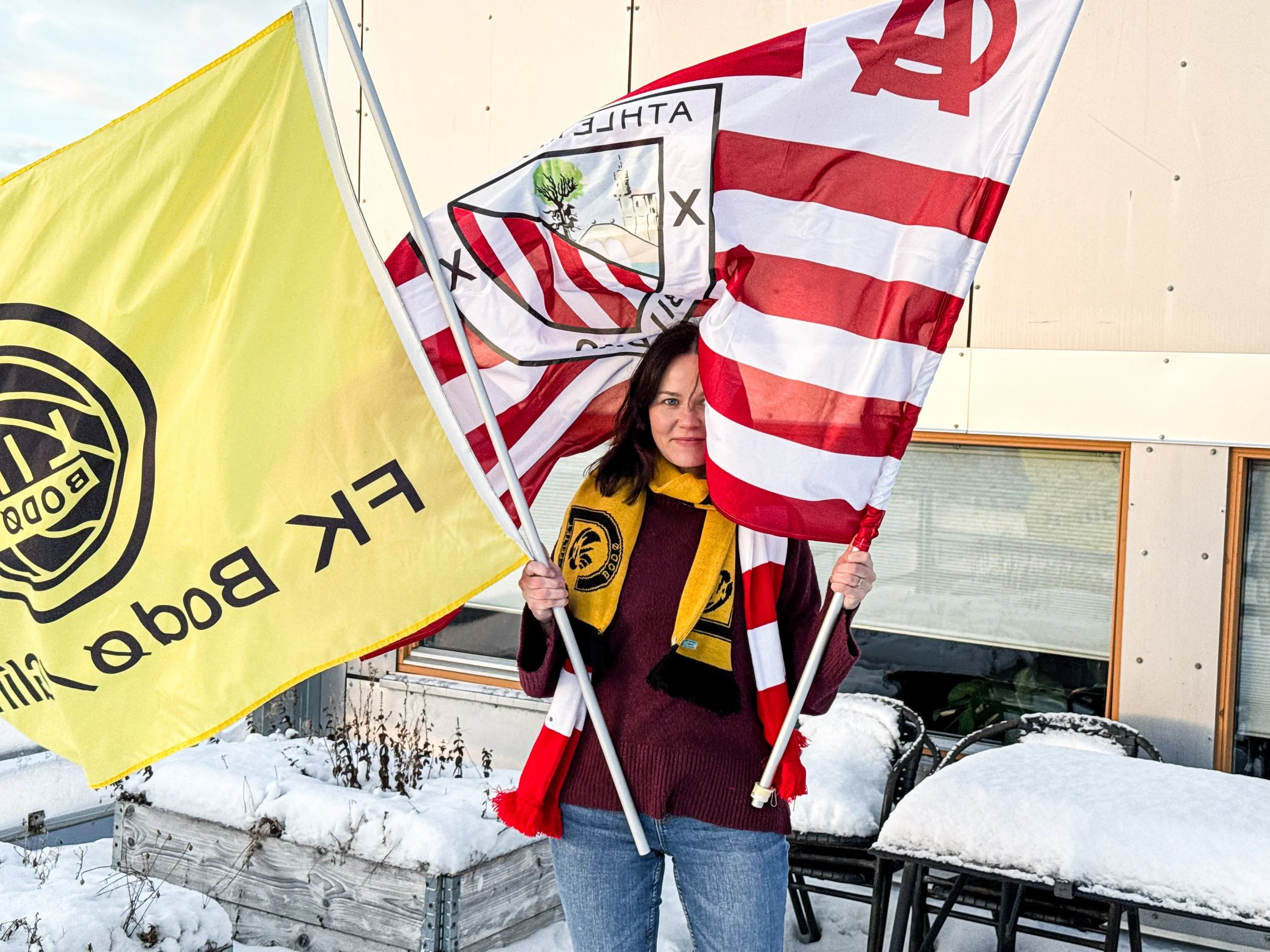
Strong in languages. Linn-Marie speaks Arabic, Spanish and Sami. In her free time, she enjoys reading, sewing cardigans and playing duodji. She also has an interest in carpentry, home improvement and growing food.
Will shift responsibility away from the individual
An important point in her research is that the challenges do not necessarily lie with the individual user or the staff who are supposed to help. They can often be linked to how the services are organized.
– This can be about opening hours, contact areas, the time aspect of follow-up and how long different benefit schemes last. When several services are to collaborate, different institutional frameworks also come into play.
She believes that responsibility is often individualized and placed on the users or the staff who meet them on the front line, while organizational obstacles receive less attention.
– Often there are conditions in organizations that make it impossible to help in the way one would like. Then the responsibility is shifted onto the individual instead of looking at the system.
Thrives with the breadth of research
Before Pedersen came to Nordland Research Institute , she held a postdoctoral position at Nord University. Before that, she worked for two years as an international advisor in the county municipality. There, she worked with Interreg and as a national contact point, among other things.
She wants to take her varied background with her and use it in her research. One of the reasons why Nordland Research Institute What seemed attractive was the opportunity to work on different themes and participate in different types of projects.
– I like that you can work on quite different things, be involved in different projects and learn a lot of new things, both in terms of themes and methods. I find that very developing.
She hopes to contribute to several fields, including social work, welfare research, Sami health and child welfare. She also appreciates the opportunity to develop and apply for funding for projects she believes are important.
– It's nice to be involved in projects across research groups and to work broadly.
One of the most exciting things about social research, Pedersen finds, is precisely that the disciplines are constantly changing. Society is evolving, and so are institutions, legislation and practice.
– You can research a field for ten years and still have something new to discover. There will always be a need for new knowledge.
Football, duodji and renovation
Pedersen comes from Steigen and has connections to both Steigen and Hamarøy. She has lived in Bodø for ten years and is married to a man from Bilbao in the Basque Country in Spain. Together they have two boys, eight and ten years old.
Football is an important part of family life, and the family follows both Bodø/Glimt and Athletic Club Bilbao.
– We need to get both Glimt matches and Athletic Club Bilbao matches. It's very important!
In her free time, she enjoys sewing cardigans and playing duodji. She also does some carpentry, home improvement, and growing food, and enjoys spending time at the cabin.
– I also like to play squash, but I've lost all my squash partners, so it's not that easy to do it alone.
Otherwise, she appreciates reading books, even though there isn't always much free time to spare.
After his first two weeks at Nordland Research Institute She has a good impression of her new workplace.
– It has been very good, with many nice people, nice and interesting conversations and lots of delicious cakes on Fridays.