
The goal is for this ant to continue living in its new home in the mountains. Photo: Avinor
Peatlands store almost twice as much carbon as all the forests in the world. The Myr i Rana project has raised awareness of the importance of peatlands, in addition to studying a real peatland migration.
The importance of preserving our peatlands is starting to sink in among Norwegian decision-makers. The government will ban new extraction of peat from Norwegian peatlands and limit new interventions in peatlands. In connection with the development of the Hålogalandsvegen road, Skanska Norge has moved 11,000 cubic meters of peat and built it up elsewhere. The Norwegian Public Roads Administration has also built a road and moved peatlands in Hadeland.
Helgeland is part of the trend. In connection with the development of a new airport at Mo i Rana, Nordland Research Institute , NIBIO, Avinor and Sweco collaborated on the Myr i Rana project.
– The goal has been to increase awareness of what a bog is and why it is so important, says Salina Spiering, project manager and senior researcher at Nordland Research Institute .
– With the construction of the new airport, a unique opportunity has also arisen to study the relocation of marshlands. As part of the construction project, Avinor has initiated a pilot project to transfer marshlands by creating new marsh habitats in an artificial basin blasted into the mountain, she says.
Wetlands under pressure
What exactly makes bogs so important? A lot, Spiering can tell you.
– Peatlands act as important carbon sinks and store almost twice as much carbon as all the world's forests combined, she says.
– Ants contribute to climate regulation by keeping carbon safely stored in the soil, thereby preventing large emissions of carbon dioxide.
Bogs are also essential habitats for a variety of plants, insects, amphibians, birds and mammals.
“In Norway, bogs cover about nine percent of the land area. They support unique species that thrive in wetlands and help preserve remnants of old-growth forests and historic landscapes,” says Spiering.
– In addition, the marshes function as natural flood protection. They conserve water and thus reduce the risk of flooding.
But the mire areas are and have long been under pressure. Peat extraction, cottage building, wind power, agriculture and the construction of roads and other infrastructure are examples of activities that destroy mires.
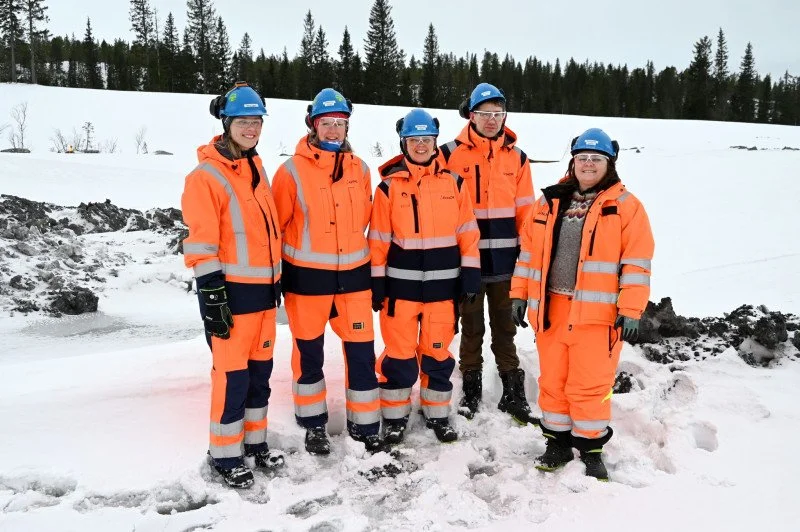
Here is the group that worked together on the Myr i Rana project. From left: Marie Sagvik and Rannveig Nordhagen in Avinor/Sweco, Salina Spiering, Svein Eilertsen and Maiken Bjørkan in Nordland Research Institute /NIBIO. Photo: Hedda Hiller
“It is important to raise awareness in society about the importance of preserving our marshlands. That is a main goal of our project,” says Spiering.
Traveling exhibition and survey
To promote the excellence of the mire areas, the project has been implemented widely. A website has been created in both Norwegian and English, where the researchers, among other things, communicate the importance of the mire for carbon storage, flood mitigation, biodiversity and culture – especially with children and young people as a target group.
– In addition, we have been able to expand the already existing traveling exhibition MoseVis to focus on bogs to a greater extent, says Spiering.
– MoseVis consists of informative posters and visual elements that convey natural diversity and the importance of ecosystems in an engaging way for schoolchildren, children and young people. The exhibition was shown at Museum Helgeland in Mo i Rana and we are in dialogue about showing it elsewhere in Helgeland, she says.,
The project has also created a still active survey about the values of the bog . Everyone is welcome to contribute.
But Myr i Rana was not just about information and dissemination. Avinor and Sweco, in collaboration with the executing contractor AF-gruppen and the designing company Rambøll, were behind a very special pilot project where a bog was moved and re-established elsewhere within the development area.
Blasted out swamp pool
An important goal for Avinor during the construction of the new airport has been to limit interventions in the marshes, and avoid draining affected marshes where possible. In addition, a pilot project was initiated to relocate marshes within the development area.
– The purpose of the relocation is to investigate the extent to which a reduction in greenhouse gas emissions can be achieved, in addition to preserving the bog as a habitat type, says Spiering.
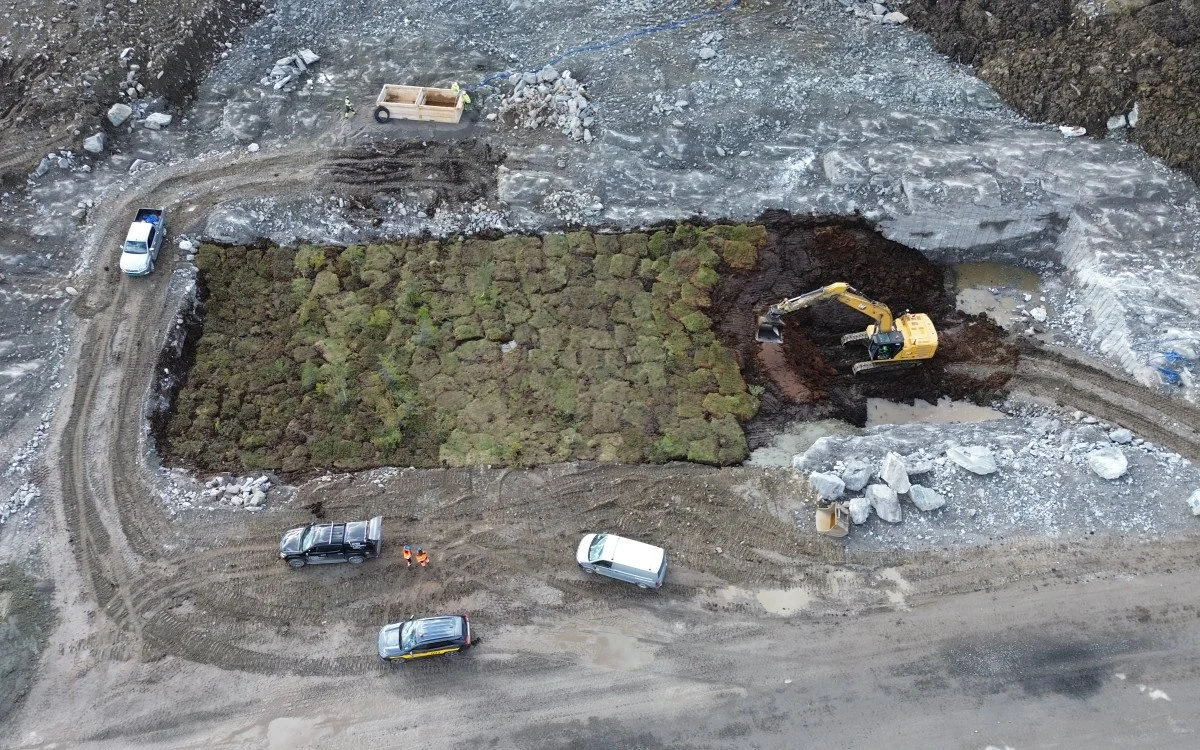
The experts decided to place the new bog in a blasted rock at a location where blasting would have to be done anyway. The bog basin was then blasted out and filled with peat masses and vegetation cover from three different bogs in the development area.
“The vegetation cover was gently divided and handled in isolation from the peat masses. The peat masses were extracted like pieces of cake and laid out in layers,” says Spiering.
The relocated bog was built over a couple of weeks and completed in July 2024. It is estimated that the bog basin holds approximately 3,500 cubic meters of peat, is approximately three meters deep, and has a vegetation cover of approximately 1,100 square meters. This is small in the grand scheme of things, but still an interesting experiment.
But how is Nymyra doing just a year and a half after moving?
Good chance of success
– Overall, the observations indicate that the bog has fared relatively well, says Rannveig Nordhagen, environmental coordinator in Avinor's development project.
– But it is only when we have sufficient monitoring data that we can say anything more certain about the climate effect and how much greenhouse gas emissions have been saved compared to traditional peatland reduction, she says.
NIBIO will continue monitoring groundwater and hydrology at least until 2027, so that developments can be followed over time and supplemented with more robust data.
Nordhagen believes that the thorough professional preparation, and the special framework conditions, have given the mire relocation a good chance of success.
– We found a degraded area to move the bog to and it was established in a landscape that has the right characteristics to maintain and develop the bog over time, she says.
– The bog also received sufficient natural water inflow, in addition to the peat structure in the peat masses and the structure of the vegetation cover being maintained and kept intact, each separately.
Learning and innovation
Both Spiering and Nordhagen emphasize that the very best way to deal with bogs in a development is to avoid encroachment completely. However, in the work on the new airport, it became clear early on that the possibilities for avoiding or limiting encroachment on bogs were small.
– Therefore, alternative solutions were considered, such as building a new bog from masses that would have to be excavated anyway, and moving some of the bog masses to an already blasted area within the construction area, says Nordhagen, who is happy about the opportunity to investigate the effects of bog relocation.
– Avinor and Sweco are pleased that we were able to establish such a good and educational collaboration with both Nordland Research Institute and NIBIO in this exciting pilot project, she says.
– It has provided an opportunity for sharing experiences, transferring knowledge and increasing expertise about bogs in general, and not least increasing awareness of the importance of bogs locally, nationally and globally.
The purpose of the pilot project has primarily been learning and pioneering work for future infrastructure development projects in Norway.
– The Norwegian Environment Agency is working on a regulation banning the destruction of bogs, but it is assumed that there will be projects where it is still not possible to avoid coming into contact with bogs, for example in connection with the construction of critical infrastructure or other special cases, says Nordhagen.
– And then we hope that the experience from our pilot project can help create a basis for guidelines for mitigating or compensatory measures in the event of any exceptions to the regulations.
