
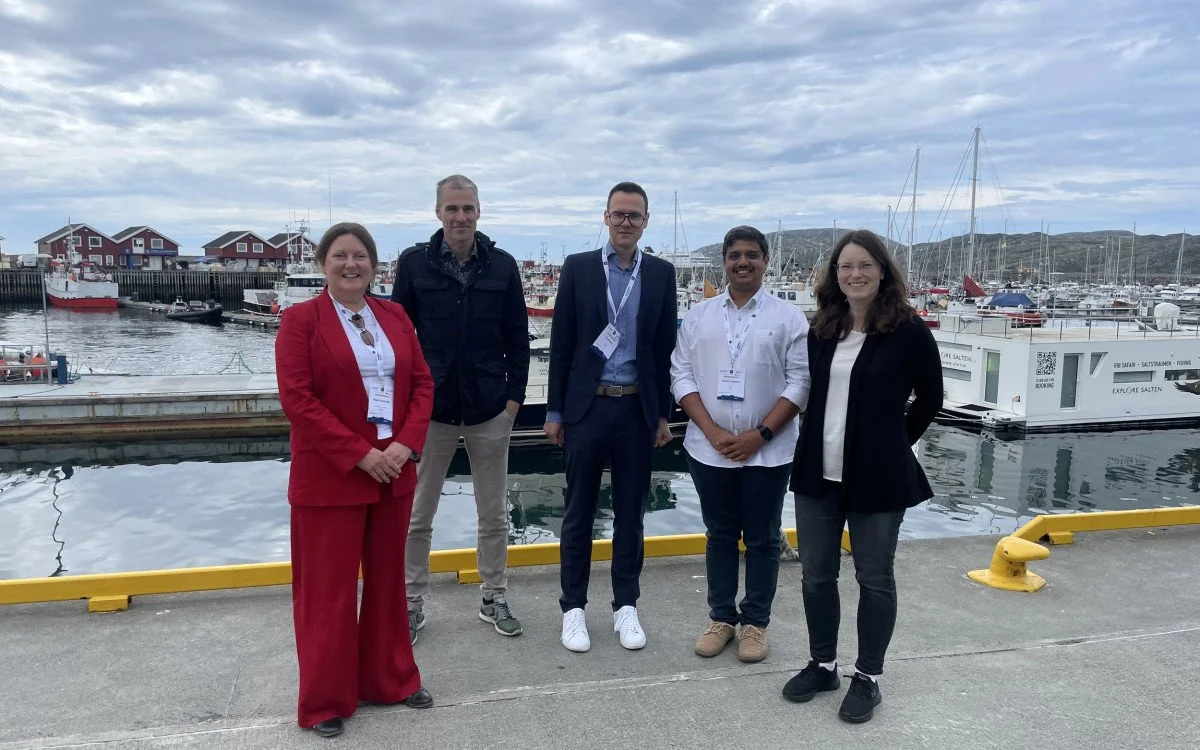
Key people in the ShiftPlastics project gathered in Bodø harbor. From left: Megan Palmer-Abbs (editor/ Nordland Research Institute ), Hans Jakob Walnum (editor and project leader/Vestlandsforsking), Christian Karl (work package leader/Sintef), Paritosh Deshpande (editor/NTNU) and Hilde Rødås Johnsen (SALT subcontractor). Photo: Thoralf Fagertun
About the textbook
Published on Routledge February 2, 2026
Editors: Hans Jakob Walnum (Vestlandsforsking), Megan Palmer-Abbs (Nordlandsforsking) and Paritosh C. Deshpande (NTNU)
Three parts: mapping of practices and challenges, principles for sustainable circular economy, and innovation and solutions.
11 chapters with contributions from 18 researchers from SINTEF, NIVA, NTNU, Nordland Research Institute and Vestland Research
Background: The Shift Plastics project, funded by the Research Council of Norway and led by Vestlandsforsking
Broad participation from the entire value chain in fisheries and aquaculture:
equipment manufacturers (Selstad, Løvold and Hallingplast)
public authorities (the Norwegian Environment Agency, the Norwegian Directorate of Fisheries, Vestland County Council, the State Administrator of Nordland, Bodø Municipality and Bodø Port)
interest organizations (Salmon Group and Fiskarlaget Nord)
players in recovery and resource utilization (Nofir, Oceanize, Iris Produksjon, Scandi Energy and BioRegion Institute).
After four years of research into how we can prevent plastic from fisheries and aquaculture from ending up in the ocean, researchers at Vestlandsforsking, in collaboration with a number of other research intuitions, are publishing an international textbook on the topic.
– That a publisher like Routledge would publish our book shows how pressing the issues in Shift-Plastics are, says project leader Hans Jakob Walnum .
In just a few years, plastic in the ocean has become an environmental problem that most countries are taking seriously. At the same time, all attempts to establish an international plastics agreement have failed.
– This makes it all the more important that other actors work to develop solutions, and that researchers, industry and governments work closely together, says Hans Jakob Walnum.
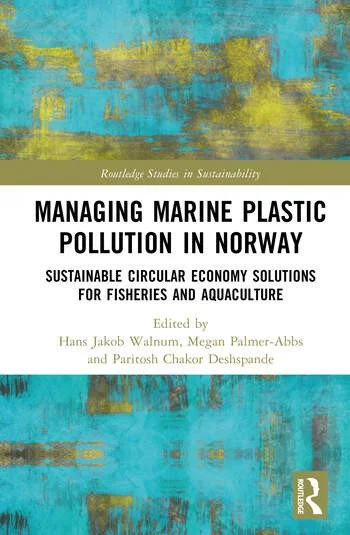
He has led the research project Shift-Plastics, which is the backdrop for the book Managing Marine Plastic Pollution in Norway . It deals with the fisheries and aquaculture industries and all the equipment there that contains plastic – not least plastic that is combined with other materials, making repair and recycling demanding.
The project is based on a systemic understanding of plastic pollution in the fisheries and aquaculture industries. This understanding is based on insights from various professional perspectives, such as materials technology, analysis of material flows, life cycle analyses, law and policy, in close collaboration with industry, interest organizations, administration and recycling actors.
Has quantified the material flows
The book maps material flows and current practices. It shows that the largest amounts of plastic are associated with the aquaculture industry and that there is significant room for improvement in plastic management in both fisheries and aquaculture.
The fishing industry in Norway is responsible for 4,200 tons of plastic waste per year. Of that, only 45 percent is recycled. The rest goes to incineration and landfill (48 and 7 percent).
Aquaculture accounts for ten times as much plastic waste, 42,046 tons. Of this, 33 percent is recycled. 42 percent goes to incineration, 21 percent to landfill and about 3 percent is lost to nature.
Industries account for 6 percent of the total amount of plastic waste in Norway.
“Aquaculture is a very plastic-intensive industry. It takes far more plastic to produce 1 kilogram of fish in aquaculture than in fisheries,” says the project manager.
The large cages where farmed fish are kept are part of the explanation.
The book provides concrete recommendations
Sustainable circularity is an important keyword for the textbook. The idea is to avoid the world having to constantly produce new plastic and to extend the life of plastic from used equipment.
– There is great potential to preserve, repair and recycle more equipment such as ropes, nets and cages, but obstacles such as poor design and lack of collection stand in the way, says Walnum.
The goal, formulated in technical terms, is to establish "sustainable circular value chains" for marine plastics. This means that the development of marine industries must be socially just and stay within the limits of nature.
To prevent plastic use, we must specifically put in place better sorting systems, clearer labeling of product content, introduce a producer responsibility system and change regulations so that environmentally friendly choices become profitable and we can reduce overall plastic use, says Walnum.
If we are to succeed with these changes, the researchers recommend establishing an expert committee of researchers, industry and authorities that actively works to reduce plastic use in industries and monitors developments over time. This is in line with Norwegian tradition, including efforts to reduce emissions in the process industry, says Walnum.
Relevant for other countries and sectors
Hans Jakob is very pleased with the great commitment in the Shift Plastics project, on which the book is based, and with the close interaction between user partners and researchers. Together, they have mapped the challenges and come up with ways to work to reduce plastic use in industries.
– We provide a comprehensive analysis of challenges and solutions when it comes to preventing plastic pollution from fisheries and aquaculture.
The project manager is pleased to have collected these insights in a book published by Routledge.
– It is a recognition of the work in the project and a contribution to making the knowledge available to others, says the project manager, who is also one of three editors.
Since the language is English, the book will also have an international audience.
– Although the book deals with Norway and the prevention of plastic pollution in fisheries and aquaculture, the experiences are transferable to other countries and to other sectors where one wishes to reduce and prevent plastic pollution, emphasizes Walnum.
