
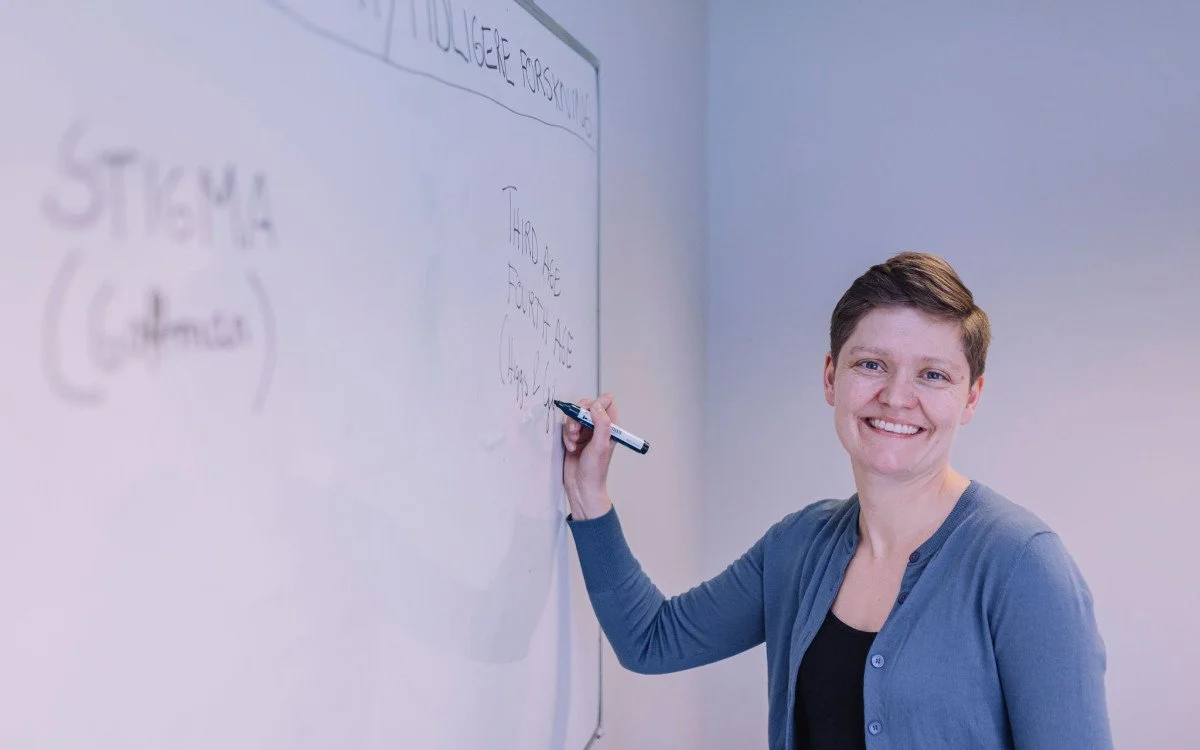
Senior researcher and soon-to-be textbook author Helga Eggebø. Photo: Karoline OA Pettersen
Important article in an international journal or a less prestigious method article in Norwegian? Helga Eggebø chose what she wanted most and now it will soon be a book about "Collective Qualitative Analysis".
Eggebø works at Nordland Research Institute , where she researches migration, gender equality, aging and living conditions among queer people. She is enthusiastic about her work and became a Researcher 1 - the research institute's answer to a professor - before she turned 40.
A researcher with ambitions naturally wants to spend their time on assignments and articles that bring the most prestige possible. If you want to reach the top, it is publication points and international reputation that count.
But what if you want something else?
– I wondered whether I should write an important article for an international journal or a Nynorsk article that would not give nearly as much prestige, says Eggebø.
– Considering my career, I thought that the international article would definitely be the most targeted. But I was more interested in writing a method article in Nynorsk!
After much contemplation and conversations with a good colleague, Eggebø decided to follow his gut feeling.
– He said that I should write the article I wanted to write and not follow the competitive logic in the research field.
Developed through project
"Collective qualitative analysis" is the name of the method that Eggebø has developed. In short, it is about finding a sensible way to analyze research data, a task that many may find difficult to undertake.
– As a research fellow, I felt very alone with my data sets and had no idea what to do with them. The need for a method became apparent even then, says Eggebø.
In 2014 she worked at the KUN Equality Centre in Steigen. While working on a project she developed an early variant of the method and has since used it in all her projects.
– But it wasn't until after a project on Nordland Research Institute "That's when I first thought that there was actually a real method here, a method that should be documented and published," says Eggebø.
In extension of this thought, Helga Eggebø made the choice that resulted in the article "Collective qualitative analysis" , published in the Norwegian Journal of Sociology in March 2020.
The book she herself missed
Eggebø experienced a much better response to the article than she had expected.
– Gradually, he started to be quoted and people contacted him and said that they had missed a scientific reference for this type of method, she says.
The method also caught on outside the research world. Both the museum sector and the National Audit Office adopted it. Collective qualitative analysis grew larger. Eggebø gave lectures and courses, both physically and digitally. And one Saturday she had a revelation.
“Of course you’re going to write a textbook on collective analysis,” she said to herself.
The Norwegian Non-Fiction Writers and Translators Association (NFFO) fully agreed. In 2024, Eggebø was awarded a writing grant.
– Now I'm writing the book I missed when I was a research fellow, she says.
– The target group is students at all levels and even professors who need inspiration or a refresher.
Write where it burns
There are a couple of important reasons why Helga Eggebø's gut feeling did not allow itself to be seduced by prestige. One of them is that she has a permanent job in a research institute and does not go bankrupt from putting the Norwegian-language method at the top.
– The fact that I had the opportunity to choose to write the article I most wanted to write is thanks to Nordland Research Institute "Here, researchers can get hours to write articles, without any guidelines for what we should write about," says Eggebø.
Another reason is the author Ida Jackson, who has developed a digital writing course that Eggebø is following.
– Jackson teaches writing where it matters. And for me, it was collective qualitative analysis that mattered the most, she says.
The textbook on collective qualitative analysis is planned to be published in 2027.
