
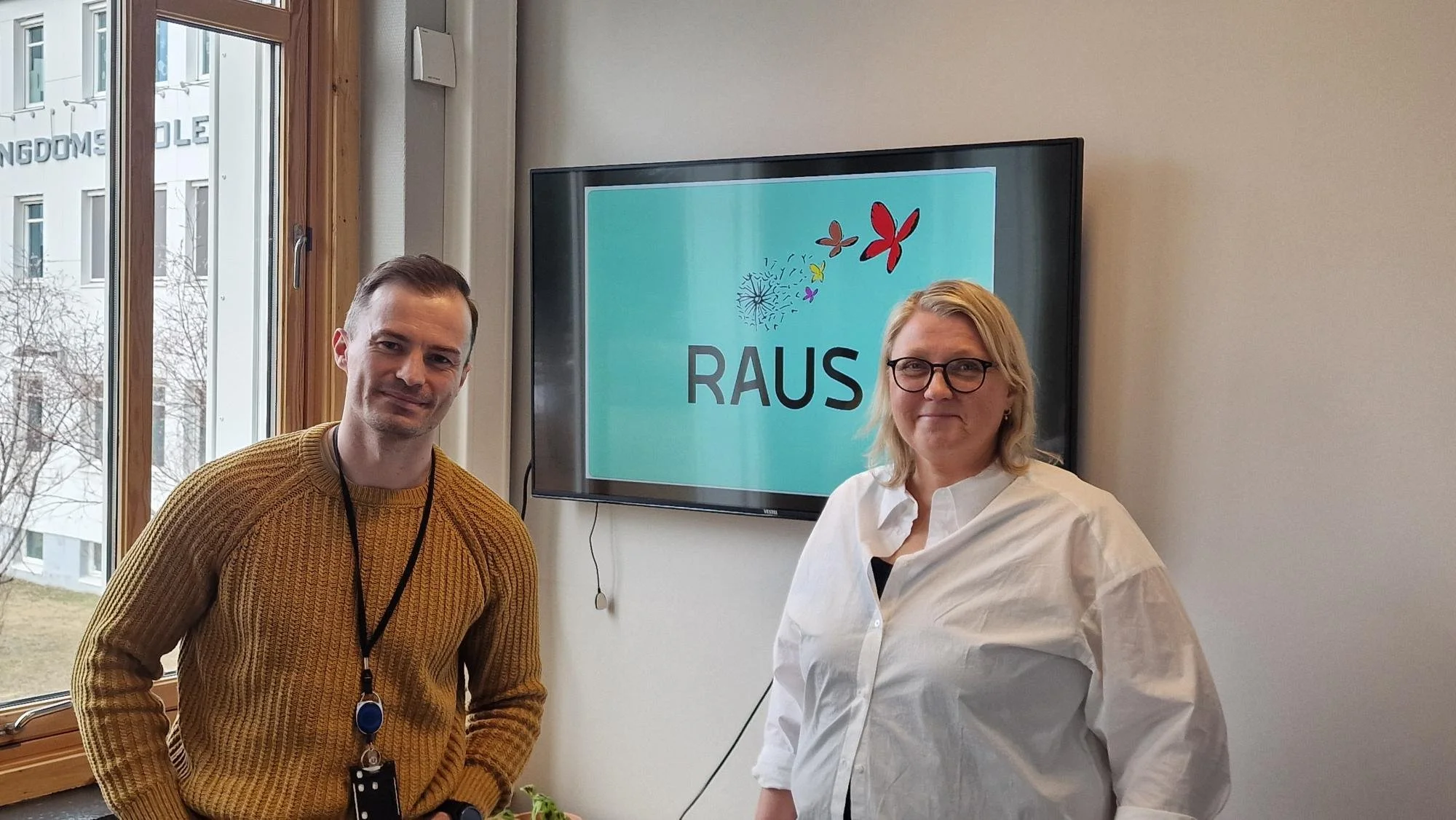
Teaching. Project manager and teacher Jørgen Lynghei and principal Hilde Thoresen at Rana Junior High School have learned a lot from leading a research project on absenteeism at their own school. Photo: Rana Junior High School
Rana Junior High School struggled with high and worrying levels of absenteeism. After a research project in which the school looked at its own practices, the proportion of students with extensive absences has been significantly reduced.
In 2018, Rana Junior High School opened and, with its approximately 900 students, became Norway's largest junior high school. Four schools near the city were merged into one large school. Already in the first year, the school had a major concern: more and more students were not showing up for school. Whether this was due to the merger, or whether increasing absenteeism was already a trend, the school management still does not know.
"It felt like we were standing in a river and bringing up one case after another," explains Hilde Thoresen, one of three principals at the school.
Then came Covid.
Facts:
Raus is a project where Rana Junior High School has worked to crack the code on challenging school absences.
RAUS stands for “Reduction of Challenging School Absences”.
The project has aimed to develop knowledge and concrete measures that can reduce challenging school absences among primary school students.
Dramatic increase after the pandemic
When the school opened for normal teaching after the pandemic, the challenges became even clearer.
— After Covid, we had a dramatic increase in school absences, where it was even more difficult to get students back to school, says Thoresen.
At the time, the junior high school had up to ten students who were completely out of the school system, and progress was slow. Cooperation with the homes was difficult.
"At most, seven percent of our students had such extensive absences that we had to take measures. Those were very demanding cases," says Thoresen.
Something had to be done.
"We thought that it couldn't be just us who were in this river of cases. This must be a societal problem that we need to address," says Thoresen.
Then the school decided to do something different.
Seeked outside help
The school contacted Kunnskapsparken Helgeland, which connected them to the Regional Research Fund (now defunct) and Nordland Research Institute .
"We didn't really believe that this was a relevant issue for a research project, but the researchers took a liking to the idea," says Thoresen.
Nordland County Municipality also came up with the idea, and in collaboration with Nordland Research Institute an application was made.
The role of research in the project
Researcher Lea Louise Videt at Nordland Research Institute explains that the project has been based on existing research on school absenteeism, which has been translated into practice through lectures and workshops with school staff.
" We have worked closely with teachers to discuss their own attitudes and understandings of what lies behind worrying school absences ."
In parallel, the researchers have followed the school's development work through interviews and focus groups, to investigate how the work affects practice and problem understanding.
"A consistent finding in the research is that the school often explains absences with conditions at the student and at home, while parents point to the school. Rana Junior High School has to a greater extent come to terms with this division of blame," says Videt.
She emphasizes that research also shows that the reasons for school absence are usually complex.
"There is rarely one explanation. Therefore, each case must be understood individually, and the measures must be adapted to the individual student," says Videt.
Rewarding project. School researcher Lea Louise Videt often finds it difficult to recruit schools for research projects. That's why it was extra rewarding to work at Rana Junior High School, which itself led a research project about its own practice.
Led the project myself
"We could never have done it without the collaboration with Nordland Research Institute "We work at school and can write, but it was crucial to get help with the application," says principal Hilde Thoresen.
Teacher Jørgen Lynghei joined early and became project manager. Although Researchers sharpened the issue, it was Rana Junior High School that led the project.
"What we have done in this project is to look inward at ourselves, and see what we can accomplish within the framework we have. In short, we have gone from thinking that the fault lies with others, to focusing instead on what we can do," says Lynghei.
The cases have become easier to handle for the school, although each case has its own unique challenges.
"We have been challenged in terms of collaboration with the homes and how we can make the transition from primary school to secondary school in the best possible way," says Lynghei.
"There are probably some parents who would prefer to see us do more for their youth, but the issues we have now are not characterized by conflict, but by mutual respect and cooperation," says Principal Thoresen.
Safer handling
Lynghei experiences that Rana Junior High School as an organization is curious about its own practices and willing to change, and that the research project has contributed well to this.
Among other things, the school has established meeting times for discussions about absences and worked on planning as part of the development work.
"Of course we have disagreements, but good discussions also have value," says Lynghei.
He believes it has become safer to talk openly about absences in the college, and to accept that you don't always know what is best to do.
" I feel that instead of groping blindly, we are now more secure in our routines, and teachers are more secure in dealing with absence cases. "
More peace of mind
Both the principal and the teacher believe the school is not up to the mark; they still have students who are hardly ever in school.
"At the same time, I think we have a different calm when we work on the cases. We dare to give students and parents the space they need, instead of imposing solutions on them," says Thoresen.
Previously, the secondary school reported absence cases to child welfare services, but they have now stopped doing this altogether, in line with clear instructions from the Ministry of Children and Family Affairs.
"It is an abuse of public resources," Thoresen now believes.
Many municipalities routinely notify, and this negatively affects the cooperation between school and home.
"If the student doesn't want to come to school, it's pretty obvious that they don't feel safe and secure. Then we need to investigate why and take action if the learning environment is unsafe," she says.
Results after three years
From having absence cases with measures of 7 percent of students in 2022, this number had dropped to 2.3 percent for the 2024/25 school year.
Lynghei believes that the school was previously rigid in matters. Now the focus has shifted from external factors to what the school can do.
"We have become concerned with how we can create movement in the issues. Before, we had students who were not at school at all, and nothing happened. Now we have meeting points and something to build on," explains Lynghei.
All absence cases are still unique and complex, and some cases are demanding.
"It is still challenging to be a teacher and take a stand on these issues," says Lynghei.
The research project has helped the school's staff become more confident in what they do and why.
— It has been very safe and good to have Nordland Research Institute in the back, says Lynghei.
— We are working on the solution
Thoresen believes the research project has been positive for the school's reputation.
"It has been exciting and has brought us together as an organization," says Thoresen.
— Generosity has, in a way, become Rana Junior High School. When we ask a hundred teachers if we have become more generous in the face of school absences, we get a unanimous yes.
Thoresen recommends other schools seek collaboration with Researchers when it comes to issues they have difficulty solving.
Lynghei emphasizes that the solution lies primarily in turning the mirror on oneself.
"We have the solution. We can work more actively with the school environment and teaching practices to create a more inclusive classroom. It is an ongoing effort for all of school Norway," says Lynghei.
Movement in all matters
For the principal, some of the lessons learned from the project were unexpected.
"I am surprised by how much effect a change in attitude has on these individual cases," says Thoresen.
2-3 percent of students at the school still have high levels of absenteeism and measures, compared to 7 percent when they started. But the school has no students who are completely absent.
"We have movement in all cases, and the number of students with measures has been greatly reduced, although it has now increased slightly again. Absenteeism varies, but is significantly lower than before," says Thoresen.
For project manager Lynghei, there is excitement about how the absence will develop in the coming years.
"This is a long-term effort that must be followed over time, and this must not become a "happening," says Lynghei.
Good starting point for change
The generosity mentality has contributed to better cooperation with homes and other agencies.
"We are dependent on each other. Generosity challenges us to search outside our own practice," says Lynghei.
— My advice to other principals with worrying absences? Dare to look at your own practice. That's where you get the most done, says principal Hilde Thoresen.
School researcher Lea Videt finds it rewarding to work with Rana Junior High School, especially because the school itself has been motivated to change.
Normally, researchers struggle to get schools to step up and provide access.
— Here it was the other way around. Rana Ungdomsskole got in touch and wanted to be researched, and wanted knowledge-based development itself. It is a good starting point for a research project and for a successful school development project, the researcher states.