
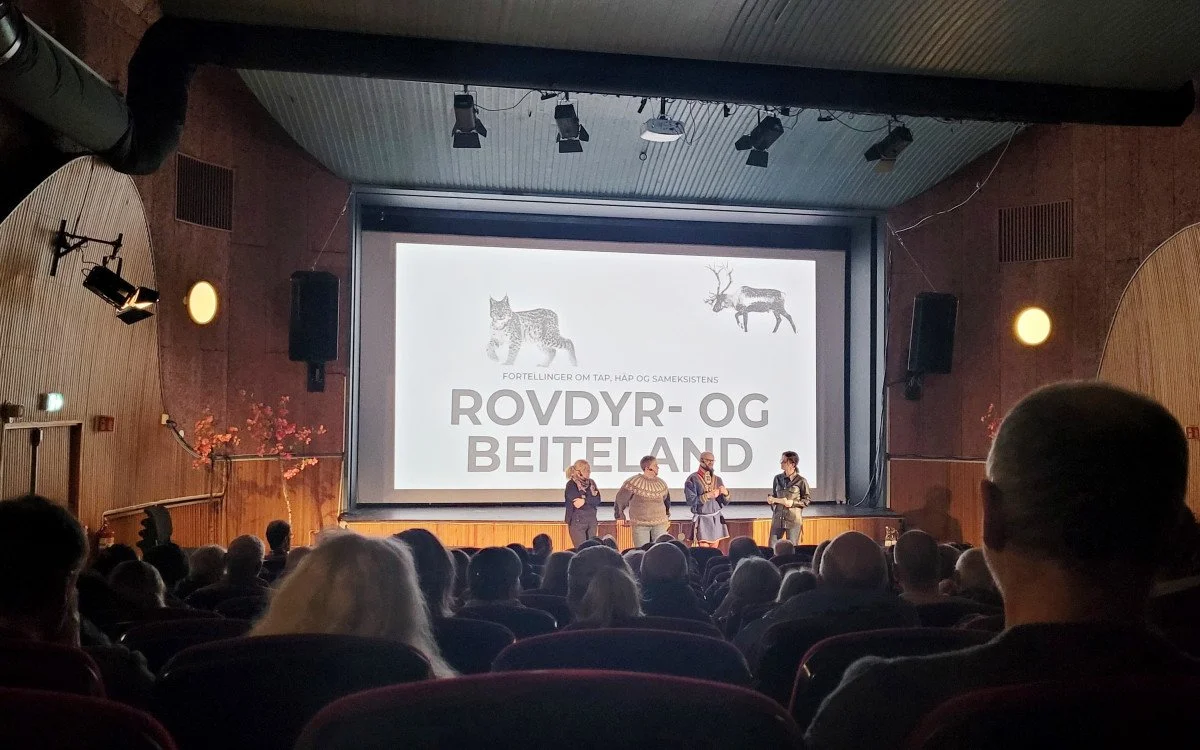
After the film, a panel discussion was held with sheep farmer Rakel Nystabakk, reindeer owner Mats Pavall and researcher Camilla Risvoll. The discussion was led by the cultural manager of Fauske municipality, Martine Eidissen Nymo. The participants shared their reflections and answered questions from the audience. Photo: Marta Anna Løvberg
With 134 people in attendance, the documentary film Predator and Pastureland was shown for the first time on March 13 at Fauske Cinema. The film, which provides insight into the everyday lives of sheep farmers and reindeer owners in Salten, has contributed to reflection and engagement among the audience.
The audience experienced that the film shows aspects of the debate about predators and grazing animals that are not usually brought up. The grazing farmers who are featured in the film point out that natural diversity and cultural landscapes are interconnected, and that a more holistic way of managing nature is needed.
Sheep farmer Johan Rødås says in the film:
– It's not that if we give up, we've lost and the predators have won – then everyone loses. If the grazing animals disappear, the predators also lose an important food source. In the green shift we are in, we must produce more food in Norway with the resources we have. And the open countryside is a crucial part of that. We have to use it – otherwise we won't be able to manage in the long term.
– The larger society has forgotten that everything is interconnected, and that is precisely what we want to convey. We are part of the same ecosystem – both grazing farmers, grazing animals and predators are mutually dependent on each other. That must be a basic premise for how we choose to manage nature, said reindeer owner Mats Pavall after the premiere.
For several of those who participated in the film, the screening was experienced as significant.
– I hope the film can help raise awareness of the situation the grazing industries in Salten are in. The predator population and losses have increased in recent years, and we have had to scale back operations to keep the sheep close to the farm and inland. I hope the film can open the eyes of the administration and politicians, so that we can once again release the sheep onto the lush mountain pastures, says sheep farmer Morten Skoglund.
Camilla Risvoll, who directed the film with Marta Anna Løvberg, has worked closely with the grazing industry for several years. She says the goal of the film was to reach more people and highlight the experience-based knowledge that grazing farmers have. She hopes the film can contribute to a more balanced and knowledge-based discussion.
Risvoll also emphasizes that open-field grazing has great potential for food production, especially at a time when preparedness is becoming increasingly important. Graziers have valuable knowledge through their daily work, but this knowledge can be lost if they are not provided with the means to operate sustainably. As the film shows, many food producers in Nordland have already closed down their operations in recent years.
– Documentaries function as a learning arena where complex topics can be conveyed in an engaging and recognizable way. The film helps document the experiences of the grazing industry, and helps preserve important social issues for the future, says Marta Anna Løvberg, co-director of the film.
