
Research report inspired museum exhibition
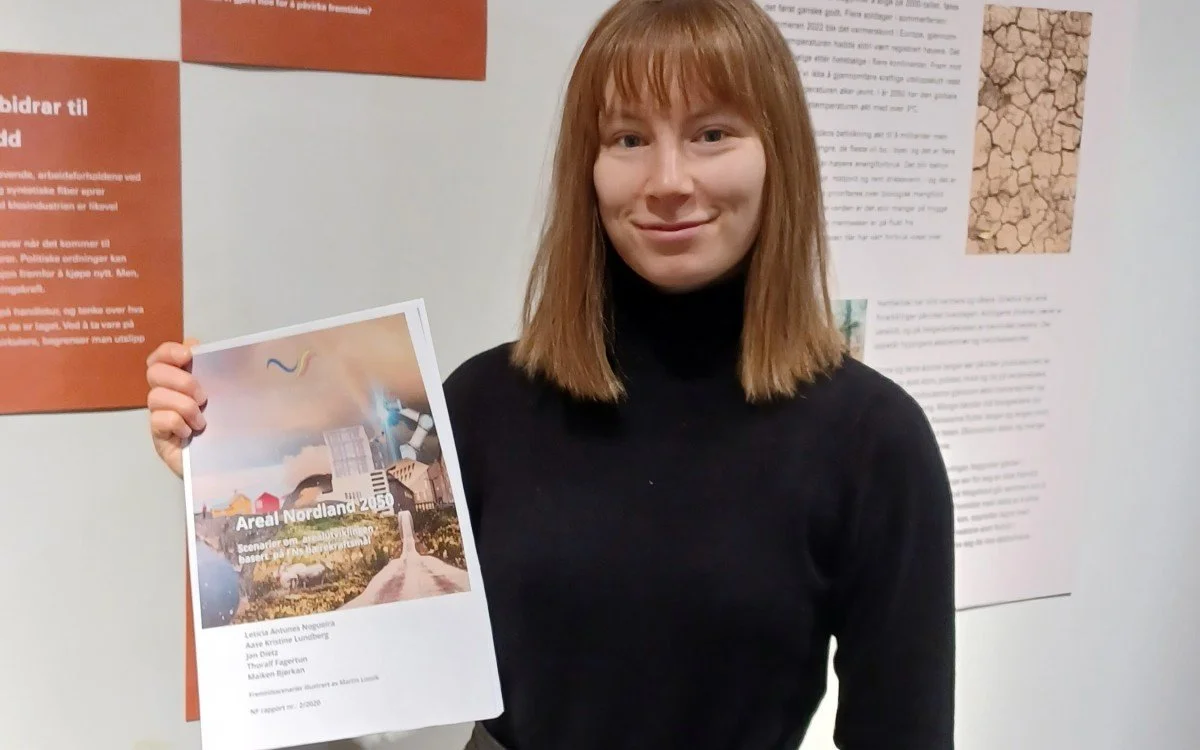
Othelie Eriksen. Head of Helgeland Museum's branch in Hattfjelldal. Photo: Helgeland Museum
Last year, Othelie Eriksen read Nordland Research's report on Nordland in the year 2050 and got an idea. Recently, a very special exhibition opened at the Fjellfolkets hus in Hattfjelldal.
"Area Nordland 2050: Scenarios for Area Development in Nordland based on the UN Sustainable Development Goals" is not like all other reports. Developed in collaboration with Dietz Foresight Nordland Research Institute five different future scenarios, based on how Nordland manages land in light of the UN's sustainability goals.
The scenarios describe what Nordland will look like in 2050, if the authorities only take into account some sustainability goals and ignore others. Not all scenarios are equally rosy, one possible fate is described as follows: "In 2050, the air in northern Norway is gray and toxic, the few remaining residents have gathered in two or three towns, and hungry wolf packs roam the forests."
Nevertheless, in Hattfjelldal, a newly hired department manager was inspired.
Forced slaughter and famine
On Thursday, November 10, the exhibition "Hattfjelldal in the Year 2050" opened at Fjellfolkets hus, where Helgeland Museum's Hattfjelldal branch is located. The exhibition is the work of Othelie Eriksen, inspired by Nordland Research's report from 2019.
– Just like in the report, we present future scenarios, says Eriksen.
To come up with plausible future visions, the department head has asked people in the local community, read up on local news from the past and studied municipal plans. The work has resulted in three different scenarios for what Hattfjelldal will look like in 2050.
One of them imagines a development with a warmer climate.
– Passivity in the face of the climate crisis has consequences, and by 2050 the global average temperature will have increased by a full three degrees, says Eriksen.
– Hattfjelldal is warmer and wetter, crops are drowning and extreme weather is more frequent. Farmers are forcibly slaughtering animals, and granaries are being reintroduced to better prepare for the drought years.
Eviction and recession
The second scenario presents a Hattfjelldal in the wake of a cabin boom.
– The municipality wants to address a declining population, and they are investing heavily in cabin tourism, describes Eriksen.
– Towards 2050, the number of cabins in the municipality will grow by 400 percent, and it will be bustling with life on weekends and holidays. The municipality's infrastructure, social meeting places and hiking trails must be adapted to the increased use of the village.
Power shortage is the premise of the third scenario.
– Construction of renewable energy sources is taking longer than expected, there will be national power shortages, and electricity is periodically rationed, says Eriksen.
– The villages in Hattfjelldal are being vacated, and the village is experiencing an economic downturn.
No prediction
Eriksen hopes that the exhibition can make visitors think about the factors that influence the future.
“The point is not to be preachy. We want people to reflect on what the future might look like,” she says.
The exhibition will be open to the public at least until the summer of 2023. And before you get depressed about drowned crops or excited about the brilliant municipal economy as a result of wealthy cottage owners, it might be wise to recall an essential premise from the research report:
"It is important to emphasize that possible scenarios map and explore the uncertainty in developments. They must not be confused with predictions, forecasts and projections."
