
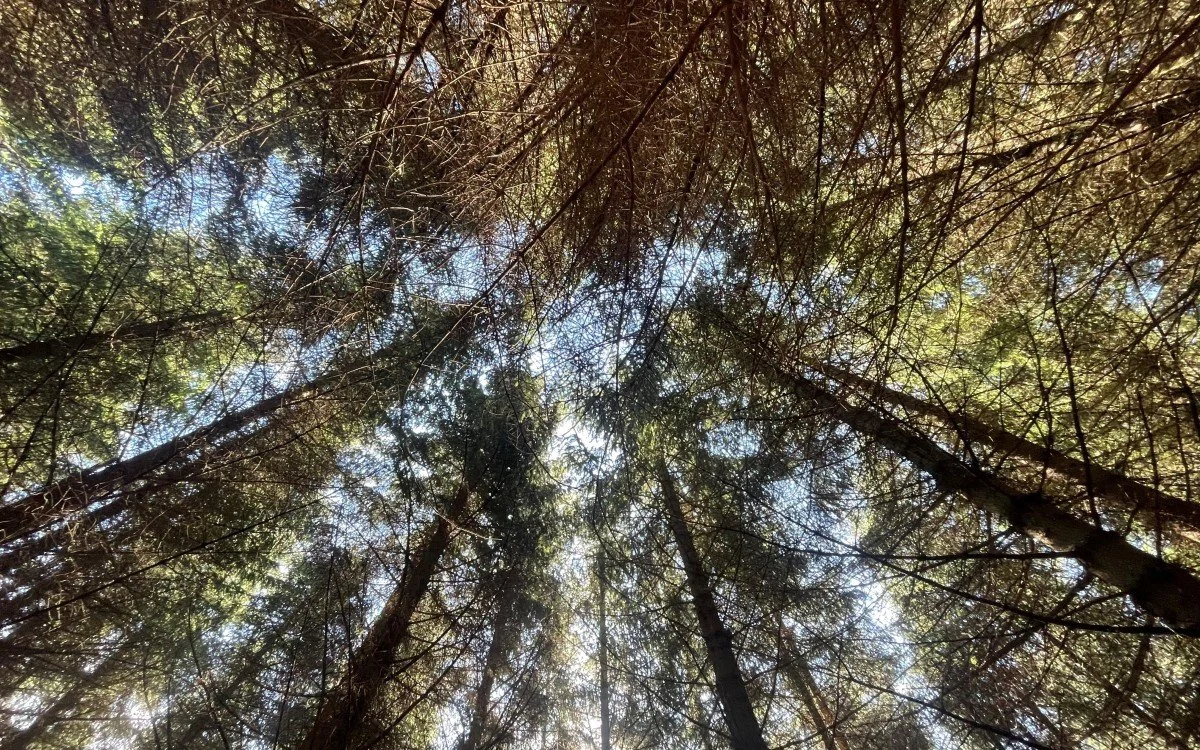
Spruce forest in the Nordland region of Northern Norway. Photo: Thoralf Fagertun
Can the Nordland spruce forest be used in new, sustainable products? The DelWaWood project will find out.
In the 1950s and 1960s, spruce was planted on a large scale throughout Nordland. Now these trees are ripe for harvesting and the State Administrator of Nordland wants to find out whether spruce has the potential for a profitable timber industry and increased local value creation. To find out, Nordland Research Institute hired to look at the possibilities, and is collaborating with a network of North Scandinavian forestry expertise from Sweden and Finland.
– The situation here in Nordland is that much less forest is being extracted than is justified, says senior researcher Jarle Løvland at Nordland Research Institute , who is the project manager for the DelWaWood project, a so-called Interreg project that will strengthen cross-border cooperation, under the auspices of the EU.
– In Northern Norway, only about a quarter of the annual growth of forests is logged, while the proportion for the country as a whole is two-thirds. The question is how to utilize these resources in new products, in a profitable and sustainable way.
Reduces carbon footprint
The main goal of DelWaWood is to develop solutions that reduce the carbon footprint of the forest and construction industries. In Sweden and Finland, it is about recycling waste from the construction industry into new products.
– The northern Norwegian part of the project goes in a different direction and focuses on the opportunities to better utilize the increasing and available forest resources, says Løvland.
– The carbon footprint of forestry and the construction sector is reduced by utilizing local wood resources and thereby reducing the otherwise significant transport distance that leads to emissions. By being able to use forest resources and wood waste for buildings and building elements, one will achieve increased long-term storage of carbon rather than burning the materials for energy recovery and increased emissions.
The project will start at the end of August and will continue until 2027.
The plan is niche products
DelWaWood is a collaboration between knowledge communities and industry in Norway, Sweden and Finland. In the two neighboring countries, the forest and wood products industry is large and well-developed. There is much to learn here for Nordland, which in many ways is completely at the starting point.
– Most of the Norwegian forest and wood products industry takes place in the south, although there are exceptions such as Arbor in Hattfjelldal and Norgesvinduet Svenningdal in Grane. Here in the north, the infrastructure for wood processing is lacking. For example, the nearest larger sawmill is located in Namdal in Trøndelag, says Løvland.
The researcher says that the ambitions of the project are not to create forestry in Nordland that can compete with large-scale industry elsewhere.
– This is about being able to develop niche production based on small, regional networks in particularly favorable locations with available forest resources, he says.
– This could provide a basis for the establishment of sawmills and volumes that can supply cooperation with local companies. These possibilities will be further investigated in the project in some geographical pilots.
Profitability and survival
And where are the particularly favorable locations? One region is located in Lofoten and Vesterålen, another in Rana and a third in Salten. The three locations have different qualities, but some things are common: access to forests and access to a good network of industry and knowledge actors. The idea is that the expertise and resources of the different actors in the location can reinforce and complement each other.
– The forest resources from these pilot areas will be tested as raw materials in, for example, the production of building elements, says Løvland.
– The scale will be small, but it is about creating profitability and an industry that can survive and develop.
It will help to have the Swedes and Finns on the team.
– Our Finnish partners have experience with forest utilization and creating prototype products, while Luleå University of Technology is a specialist in structural testing, says Løvland.
– We can validate and assess the properties of the products to determine whether there is a basis for mobilizing an initiative in Nordland, says Løvland, who also looks forward to collaborating with the Norwegian partners to concretize pilot solutions that can increase local value creation from the growing forest and wood resources in the region.
