
Together for youth inclusion
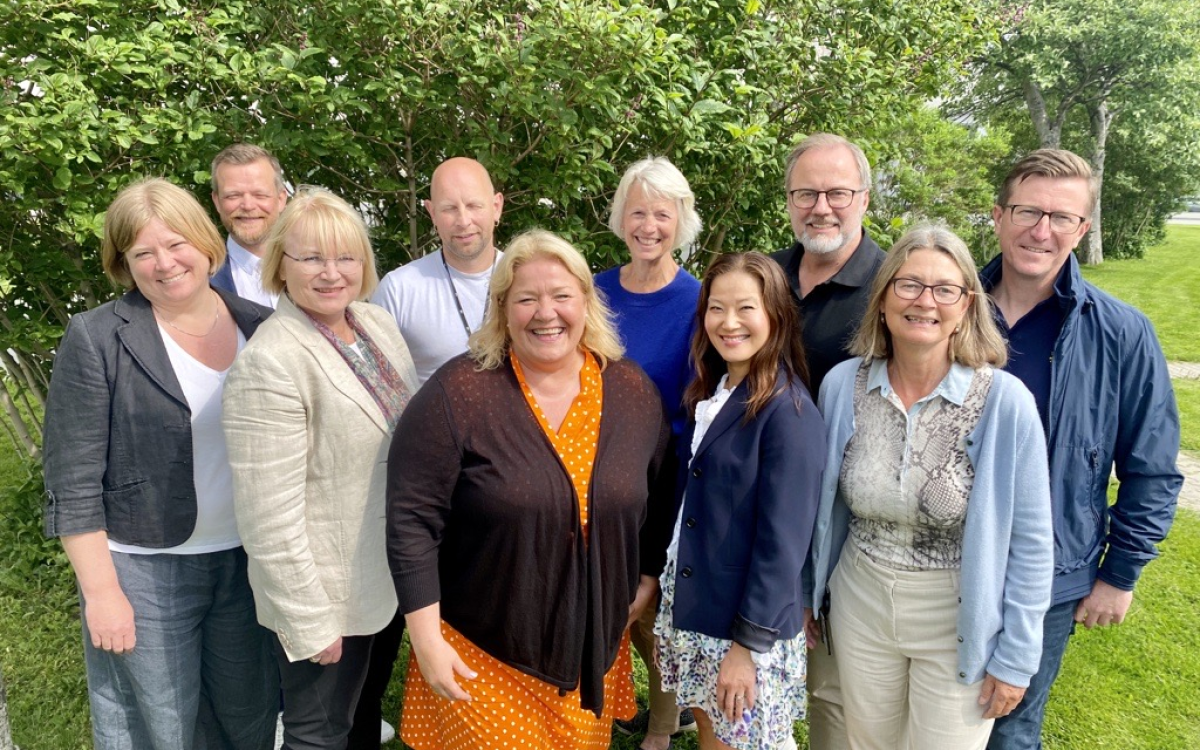
Partnership for youth inclusion in Nordland. From left: Ragnhild Holmen Waldahl ( Nordland Research Institute ), Robert Isaksen (KS), Cathrine Stavnes (NAV), Ronny Olsen (NFK), Elin Dahlseng Eide (who was the county council leader for education and competence in Nordland, when the photo was taken in June 2023), Iselin Marstrander ( Nordland Research Institute ), Linn Gros (Health Nord), Gisle Berg (State Administrator), Hanne Østerdal (NFK) and Petter Bugge Richardsen (NAV). Photo: Nordland County Municipality
Nordland Research Institute is part of a new partnership that will strengthen the work with young inclusion in Nordland. One of the initiatives is the Oppvekstkonferansen, which will take place in Bodø on January 30th and 31st.
The State Administrator of Nordland, Nordland County Municipality, NAV Nordland, KS (Municipal Sector Organization), Helse Nord and Nordland Research Institute constitutes the partnership, which was formed last year at the initiative of the county municipality.
– We are working together to ensure that fewer young people in Nordland end up outside society, says Ragnhild Holmen Waldahl, who heads Nordland Research's research group for welfare, health and upbringing.
It is far from a coincidence that the research institute is on the team. Waldahl and her colleagues have long been researching the topic and are also behind the knowledge base for the county council's strategy against youth exclusion, which was launched in 2022.
– We have entered into a cooperation agreement with the county municipality, which states that we will contribute knowledge to this work going forward, says Holmen Waldahl.
– An important lesson from working on the strategy is that the various players in the field have not collaborated well enough. The partnership is a measure to remedy this problem.
A complex concept
The growing-up conference is a good example of the new collaboration. Previously, each actor had its own conferences, which gave the municipalities too much to choose from and too fragmented information.
– This time we are joining forces to arrange a conference. It will provide a more comprehensive offer to the municipalities, says Holmen Waldahl.
The conference is fully booked, so the initiative seems to be working. As part of the extensive program, Holmen Waldahl will attempt to define the concept of young outsiders. It is more complex than one might think.
– Firstly, the term is quite new, no one used it ten years ago. It is little used in a professional context and is not an international term. When we worked on the strategy for the county municipality, it became important to ask what kind of exclusion we are actually trying to prevent, says the research leader.
Needs common understanding
In public documents, public reports (NOUs) and parliamentary reports, the term is understood as young people without education, young people who are outside the working world and young people who experience a subjective feeling of exclusion.
– When working with young people's exclusion, it is important to know which exclusion you are concerned with. The challenge with the reports to the Storting is that they start with a broad understanding, but when it comes to measures, only work or education matter. Preventing a subjective feeling of exclusion requires other types of measures than getting everyone into working life, points out Holmen Waldahl.
– The different understandings of the concept are often mixed together and make the measures less effective. Therefore, it is important to review the concept of exclusion, not to define a right or wrong version, but to have a unified understanding of the concept when working together to prevent youth exclusion.
On the national agenda
It is not only in Nordland that the actors working with young inclusion are beginning to see the value of working together. Alliances are also being formed nationally. The government has initiated work on a so-called targeted social mission for young exclusion. Social missions as a form of work is a European invention, known on the continent as "missions", which according to the Research Council can be compared to a volunteer effort, where all good forces contribute from their point of view.
In February this year, a proposal for how the social mission should be implemented will be launched. A broad group consisting of the Research Council, the Directorate of Labour and Welfare, the Directorate of Children and Family Affairs, the Directorate of Health, the Directorate of Education, Kulturtanken, DOGA (Design and Architecture Norway) and KS are behind it.
– It will be exciting to see what is in this proposal and how these actors understand young exclusion, says Holmen Waldahl.
