
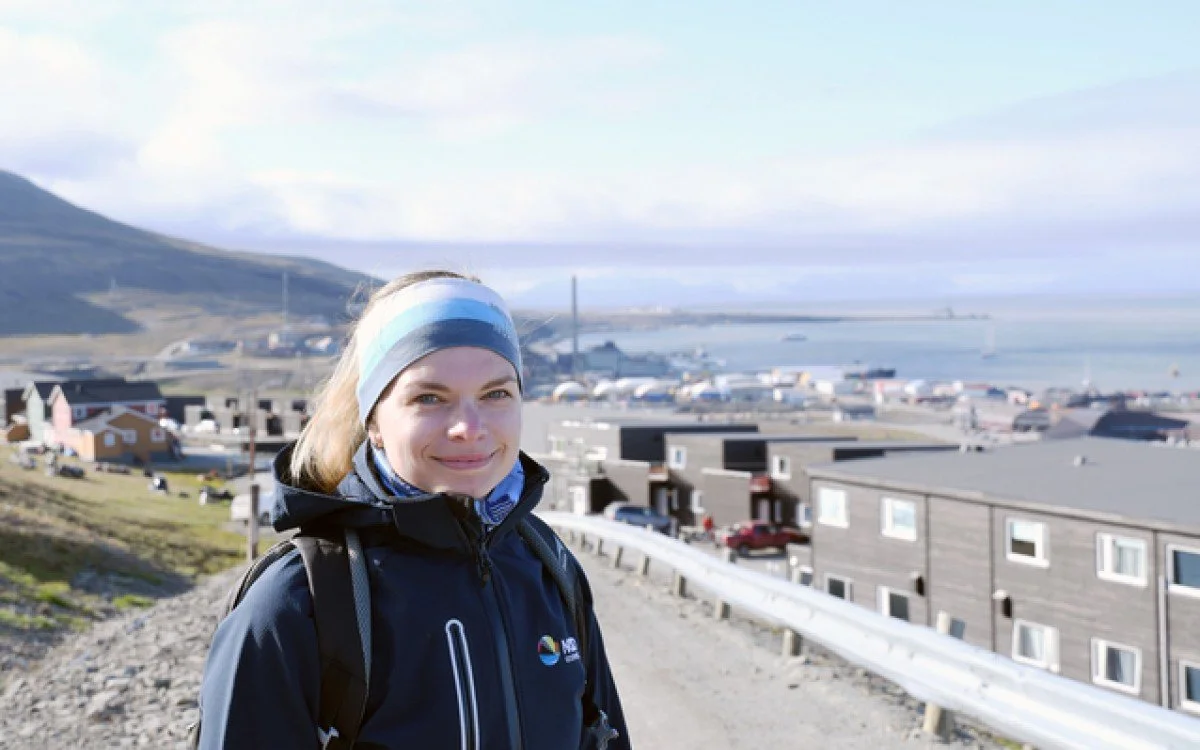
Julia Olsen on a research trip in Longyearbyen. Photo: Thoralf Fagertun
Senior researcher Julia Olsen has been inducted as one of ten new members of the Academy for Young Researchers.
The pool for admission to the Academy for Young Researchers (AFY) is tight. This year, the academy received 65 applicants for its ten new positions . And one of those who made it is Julia Olsen, who works in a temporary position as a senior researcher at Nordland Research Institute .
"I still can't believe it happened. I was so happy when I got the news," she says, laughing.
Julia Olsen (35) has been employed at the Nordland Research Institute , as an environmental researcher. She is now primarily an associate professor at the Faculty of Social Sciences at Nord University and has an adjunct position at her old workplace. Olsen has environmental sociology as her subject area and leads the research group Arctic Research: Context, Theories and Methods.
She says that she submitted her application to AYF in June, and that it has been a long process from application to interview and now - finally - admission.
High international level
When Julia Olsen is accepted as a member of the Academy for Young People Researchers , has Nordland Research Institute two representatives among the 40 members of the academy. Aase Kristine Lundberg was admitted in 2021.
– In tough competition with 65 other applicants, Julia has distinguished herself. She contributes valuable experience from the institute sector and becomes one of the few members from Northern Norway. It is important that AYF reflects the breadth of Norwegian academia and that smaller institutions from the north are represented. I look forward to collaborating with Julia in AYF, says Lundberg
Of the academy's 40 members, seven belong to the institute sector.
– That two of the members of AYF have a background from Nordland Research Institute , shows that we are working purposefully with career development for young researchers and that our researchers maintain a high national level, says Iselin Marstrander, Managing Director of Nordland Research Institute .
Great prestige
The members are selected after an open application process in which the Academy seeks to recruit younger researchers from different fields, job categories, regions, institutions and backgrounds.
– There is great prestige attached to being a member of this academy. The fact that I am among the ten strong candidates who are now being accepted makes me proud, she says.
Olsen researches relationships between humans and nature with a particular focus on climate adaptation and sustainable development in the High North. The High North is an important area for business development, knowledge development, environmental protection and emergency preparedness. The region is also characterized by several challenges, including climate change, pollution, limited infrastructure and population displacement.
– It was recently determined that the region is warming three to four times faster than the rest of the world. If this trend continues, it will be possible to sail across the North Pole in a few years. Therefore, it is important for us who live in the region to gain more knowledge about what the changes mean for us and for sustainable development, she says in a recent interview with AFY. And further:
– As a part-time employee at Nordland Research Institute I address these challenges through participation in several international research projects. These projects focus on tourism, maritime traffic, marine litter and environmental management. We shine a spotlight on how climate and environmental changes in the High North affect local communities, how society adapts and how environmental problems are recognized in everyday life and environmental policy.
Marine litter and knowledge about climate and the environment
She further explains that there are two issues in particular within her field that she finds particularly exciting.
– The first is the production of knowledge about climate and the environment, which is characterized by several dilemmas. Why do some environmental problems receive a lot of attention, while others are ignored? Who has knowledge about environmental problems: Scientists or local populations who experience these problems firsthand?
– The other topic I am particularly interested in is measures against marine litter and the path towards a circular economy. Here we work closely with the business community and the administration. We are researching measures that can contribute to the reduction of marine litter in the seafood industry, and to the recycling of equipment. One of the coolest examples is swimwear, blankets and furniture made from recycled materials from yarn and rope.
Passion for research communication
As a member of the Academy for Young Researchers, Olsen says she wants to work with research communication.
– I want to continue the existing ones, but also create new activities aimed at school students. I am particularly interested in communicating about climate adaptation, environmental pollution and sustainable development to the younger generation.
– I also want to work for a more diverse academy where younger researchers have predictable frameworks for good career development. I want to contribute to strengthening the attractiveness of research in Northern Norway, she says.
The membership, which lasts four years, will be officially celebrated during the academy's autumn meeting in Trondheim on October 19.
