
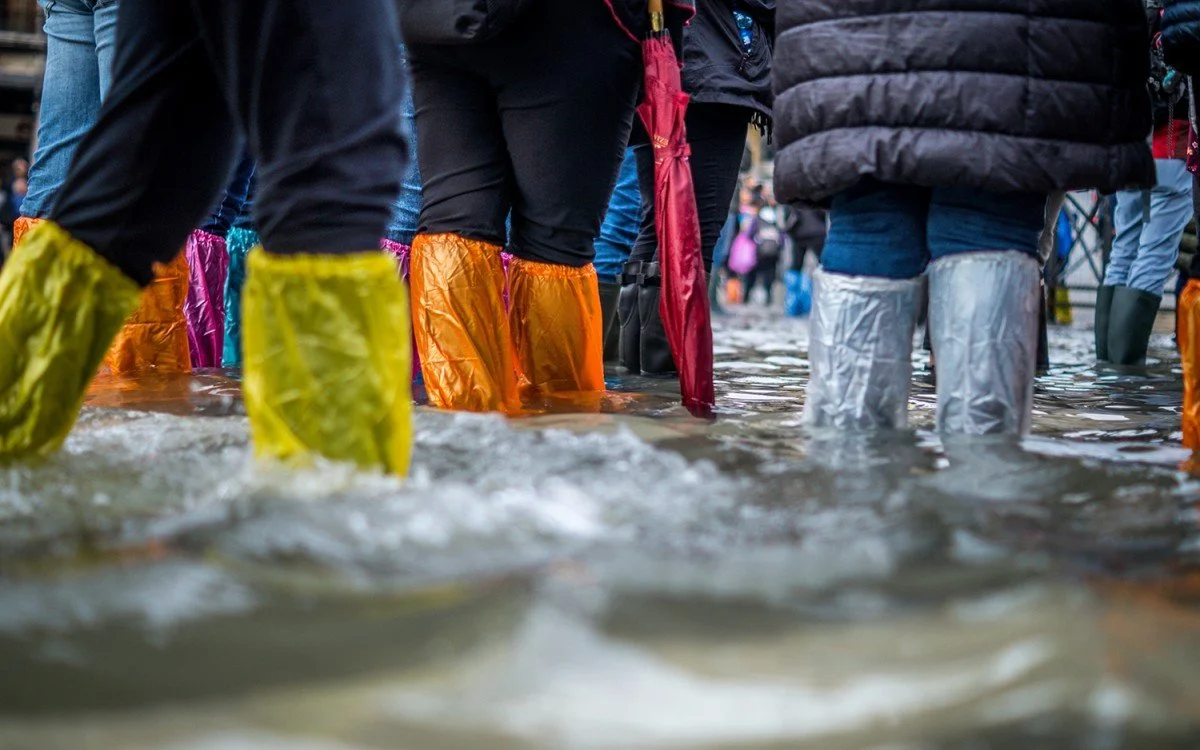
It may also get wet on the streets of northern Norway in the years ahead. Illustration photo: Jonathan Ford / Unsplash.
Climate change is upon us, both locally and globally, new research shows. “The future we should be talking about and improving upon is already here,” says climate scientist Grete Hovelsrud.
Recently, NRK wrote that the highlands must prepare for a future with bark beetles, ticks, forest fires, more frequent extreme weather and a sharp increase in precipitation, if we exceed the UN's 1.5-degree target. The bleak outlook is based on a report from the PROVIDE project, where Nordland Research Institute is one of the partners.
“According to the report, the Arctic is warming three times faster than the global average. While the rate of warming varies across the region, the northern areas of Norway, Sweden and Finland are facing very rapid warming with shorter and more unpredictable winters, as well as increasing precipitation,” says Helena Gonzales Lindberg, senior researcher at the Nordland Research Institute .
Then came the report of the UN's climate panel, which is described as a "final warning" to humanity. With current policies, we are heading towards more than 3 degrees of warming by 2100, according to the panel.
Grete Hovelsrud, who is a senior researcher at Nordland Research Institute , has long been researching climate change and climate adaptation. In 2014, she herself sat on the UN climate panel. Hovelsrud is disappointed, but not surprised by the dramatic development.
– This was already in the cards 20 years ago. We had the knowledge of what was going to happen. But it didn't lead to political action. Unfortunately, it seems that climate change has to be felt physically before society does anything, she says.
Landslides and cyclones
Now climate change is upon us. In the vicinity of Nordland Research Institute Increased rainfall has led to mudslides that have closed Highway 80 several times. Globally, more and more cyclones and hurricanes are ravaging vulnerable areas. Other places are struggling with droughts and heat waves.
– Climate change is causing precipitation to increase in some places, like here where we already have more than enough, and to decrease in other places, where there is drought, says Hovelsrud.
The PROVIDE project looks at how the highlands can adapt to increased precipitation. Hovelsrud is and has been involved in a number of projects dealing with climate adaptation.
– We have looked at how climate change affects different industries. We have worked on climate adaptation in relation to reindeer herding, fisheries, aquaculture, agriculture, we have looked at the role of municipalities and what is happening in Svalbard and in Arctic fjord systems, says Hovelsrud.
Not surprisingly, climate adaptation turns out to be complex and does not always produce the desired results.
– Take reindeer herding, for example. One climate adaptation measure is supplementary feeding, but in the long term this is not a good solution. It changes the behavior of the reindeer and leads to, among other things, more diseases, says Hovelsrud.
Consumption reduction necessary
Although the situation looks rather bleak, Hovelsrud has not thrown in the towel. There is still hope, but the solutions will require major changes both in society at large and for the individual.
"It is no longer enough to reduce greenhouse gas emissions; we must somehow remove CO2 from the atmosphere and store it elsewhere. This is the biggest adaptation challenge," says Hovelsrud.
– And then we as individuals must reduce our consumption. We must consume less, because most of what we buy is produced in a way that negatively affects the climate.
Hovelsrud is optimistic about young people and their awareness of their own role in the climate fight, but she is less impressed by today's decision-makers.
– I think it's a shame that all the knowledge we have generated has not led to even greater policy changes, she says.
